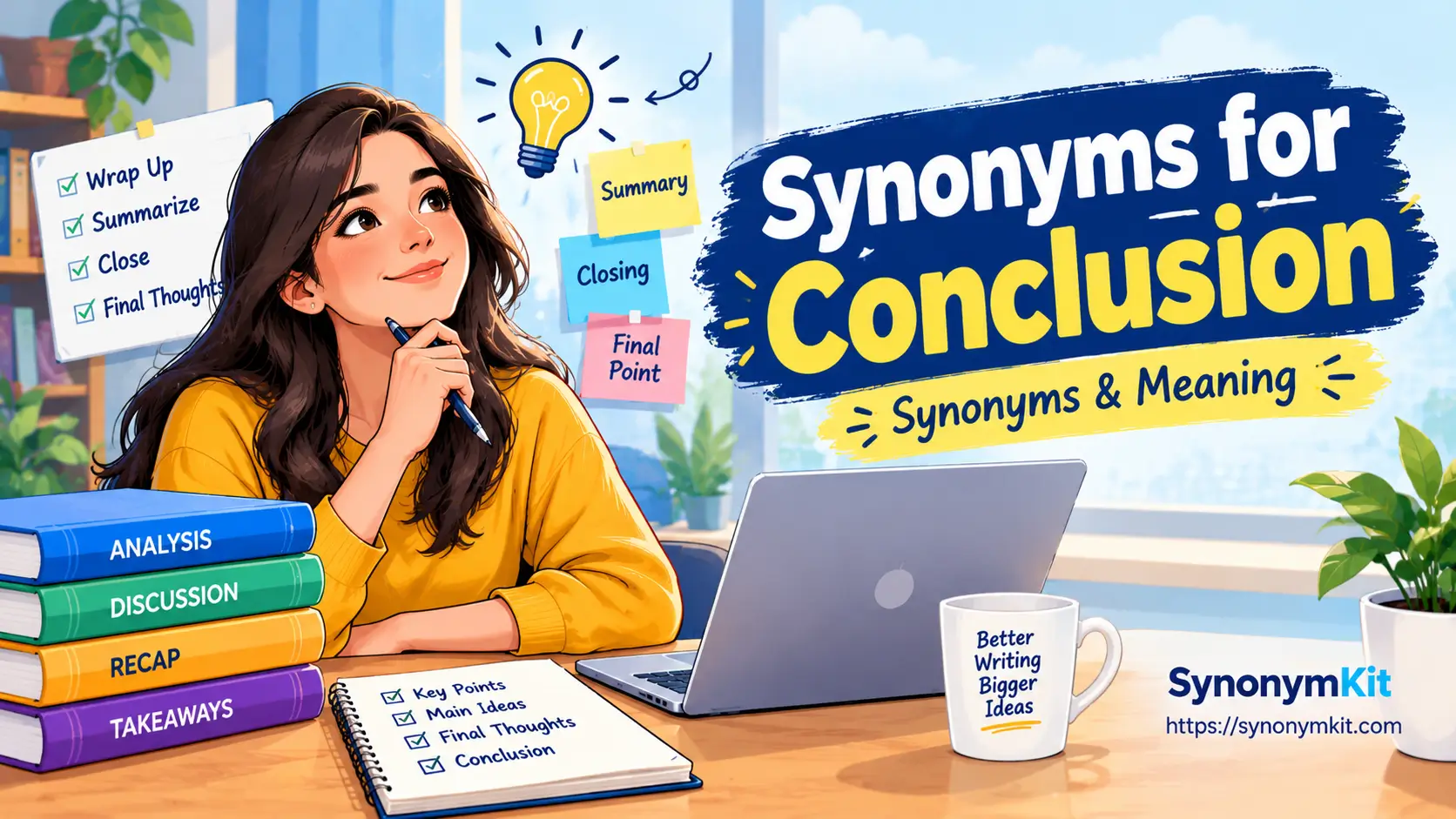
Synonyms for Conclusion: 50 Better Words for Clear Writing
Synonyms for conclusion include ending, summary, closing, outcome, result, and final thoughts. The best word depends on your purpose and sentence. Some words fit essays and reports, while others work well in speeches, emails, and daily conversations. Choosing the right word makes your writing clear and easy to understand.
You have just finished writing an essay. Your main points are clear, and your examples support your ideas. Now, you need a strong final paragraph. You type “In conclusion,” but then you stop. You have used these words many times before, and you want something fresh.
Imagine writing a school report about healthy food. You can end it with “To sum up” or “Overall” instead of using the same phrase again. These small changes can make your writing sound more natural.
Learning new words helps you express your ideas in different ways. Students can use them to finish essays with confidence.
Bloggers can make their final paragraphs more interesting. Content writers can create clear endings for articles. Daily English users can choose better words in emails and conversations.
The goal is not to use difficult words. It is to choose words that fit your message and your reader. A simple word can often make your point stronger.
“A clear ending helps readers remember your main idea.”
Think about your reader before choosing your final words. A school essay may need a formal ending, while a friendly message may need only a short closing line.
“Good writing leaves readers with something worth remembering.”
50 Synonyms for Conclusion
1. Ending
Meaning: An ending is the final part of something, such as a story or speech.
Examples:
- The ending made the whole story better.
- We enjoyed the happy ending of the film.
2. Summary
Meaning: A summary gives the main points without including every small detail.
Examples:
- Please write a short summary of the lesson.
- Her summary helped me understand the report.
3. Closing
Meaning: A closing is the last part of a speech, letter, or event.
Examples:
- His closing was warm and very clear.
- The meeting ended with a short closing speech.
4. Outcome
Meaning: An outcome is the final result of an action, event, or plan.
Examples:
- The outcome of our hard work was excellent.
- We waited patiently for the final outcome.
5. Result
Meaning: A result shows what happened because of an action or event.
Examples:
- The result proved that our plan worked.
- Everyone was pleased with the final result.
6. Final Thoughts
Meaning: Final thoughts share the main ideas you want readers to remember.
Examples:
- My final thoughts explain why teamwork matters.
- She shared her final thoughts with the class.
7. Wrap Up
Meaning: A wrap up brings the main points together at the end.
Examples:
- Our teacher gave a quick wrap up today.
- The wrap up covered every important point.
8. Finish
Meaning: A finish marks the point where an activity or piece of work ends.
Examples:
- We reached the finish after hours of work.
- The speech had a strong finish.
9. Finale
Meaning: A finale is the final part of a show, event, or performance.
Examples:
- The concert ended with a brilliant finale.
- Everyone cheered during the grand finale.
10. Resolution
Meaning: A resolution shows how a problem or difficult situation is settled.
Examples:
- The story reached a peaceful resolution.
- Their resolution brought the family back together.
11. Completion
Meaning: Completion means that something has reached its finished or final state.
Examples:
- The project reached completion before Friday.
- We celebrated the completion of our schoolwork.
12. Closure
Meaning: Closure brings an experience or situation to a clear and settled end.
Examples:
- The final talk gave everyone closure.
- She found closure after their last meeting.
13. Last Word
Meaning: The last word is the final statement on a topic or issue.
Examples:
- He had the last word in the debate.
- Her last word made everyone think.
14. Final Statement
Meaning: A final statement gives the last clear message about a subject.
Examples:
- His final statement explained the main problem.
- The report ended with a final statement.
15. Summation
Meaning: A summation brings important facts or ideas together in a short form.
Examples:
- Her summation covered the main points well.
- The lawyer gave a clear summation in court.
16. Recap
Meaning: A recap briefly reviews the most important parts of a discussion or event.
Examples:
- The host gave a recap before leaving.
- Our recap helped everyone recall the lesson.
17. Takeaway
Meaning: A takeaway is the main lesson or idea readers should remember.
Examples:
- My biggest takeaway was the value of patience.
- The article offers one useful takeaway for parents.
18. Culmination
Meaning: A culmination is the final point of a process after much effort.
Examples:
- The award was the culmination of years of practice.
- Their success marked the culmination of hard work.
19. Termination
Meaning: Termination means the formal ending of an activity, process, or agreement.
Examples:
- The contract reached termination at month’s end.
- The notice explained the termination of services.
20. Conclusion Paragraph
Meaning: A conclusion paragraph brings the main ideas of a written piece together.
Examples:
- My conclusion paragraph restates the central argument.
- She wrote a strong conclusion paragraph for class.
21. Final Section
Meaning: A final section presents the last important information in a document or report.
Examples:
- The final section explains what happens next.
- Please check the final section of the report.
22. Closing Remarks
Meaning: Closing remarks are the final words spoken to end a meeting or event.
Examples:
- The principal shared closing remarks at assembly.
- Her closing remarks thanked the whole team.
23. Final Remarks
Meaning: Final remarks share the last important points before a talk or discussion ends.
Examples:
- He offered final remarks before the guests left.
- Her final remarks were short and thoughtful.
24. End Result
Meaning: An end result is the final effect of an action or process.
Examples:
- The end result was better than expected.
- We discussed the end result of our changes.
25. Bottom Line
Meaning: The bottom line is the most important point or final message.
Examples:
- The bottom line is that practice really helps.
- Our bottom line stayed clear throughout the report.
26. Final Analysis
Meaning: A final analysis gives the last judgment after examining the facts.
Examples:
- The final analysis showed a clear improvement.
- Our final analysis supports the new plan.
27. Inference
Meaning: An inference is an idea reached by using facts and careful thinking.
Examples:
- Her inference came from the evidence provided.
- We made an inference after reading the results.
28. Deduction
Meaning: A deduction is an answer reached by reasoning from known facts.
Examples:
- His deduction helped solve the mystery quickly.
- The detective shared her deduction with the team.
29. Judgment
Meaning: A judgment is a decision made after thinking about facts or choices.
Examples:
- The judge gave her final judgment today.
- Our judgment was based on clear evidence.
30. Decision
Meaning: A decision is a choice made after considering facts or options.
Examples:
- The team reached a decision after discussion.
- Her decision brought the debate to an end.
31. Finding
Meaning: A finding is a fact or answer discovered through study or research.
Examples:
- The study reported an important finding.
- Each finding helped explain the problem.
32. Verdict
Meaning: A verdict is a final decision, especially in a court or formal debate.
Examples:
- The jury announced its verdict this morning.
- Our verdict followed a careful review.
33. Final Outcome
Meaning: A final outcome shows how a process, event, or situation ended.
Examples:
- The final outcome pleased both teams.
- We recorded the final outcome in our notes.
34. End Point
Meaning: An end point is the place where a process or journey finishes.
Examples:
- The final chapter marked the end point.
- We reached the end point of our study.
35. Last Stage
Meaning: The last stage is the final part of a process or activity.
Examples:
- Editing was the last stage of our project.
- The last stage took only two days.
36. Final Phase
Meaning: A final phase is the last period of a longer process or plan.
Examples:
- The final phase begins next Monday.
- We checked every detail during the final phase.
37. Wrap Up Statement
Meaning: A wrap up statement briefly brings together the main points of a discussion.
Examples:
- Her wrap up statement was easy to follow.
- I added a wrap up statement to my presentation.
38. Concluding Remarks
Meaning: Concluding remarks are final comments that help bring a speech or report to an end.
Examples:
- His concluding remarks thanked the audience.
- The speaker shared concluding remarks about teamwork.
39. Concluding Statement
Meaning: A concluding statement gives the final message in a piece of writing or speech.
Examples:
- My concluding statement supports the main argument.
- The essay needs a clearer concluding statement.
40. Final Summary
Meaning: A final summary collects the most important points at the end of a text.
Examples:
- The final summary reviews the main results.
- Please add a final summary to the report.
41. Overview
Meaning: An overview gives a general picture of the main points in a subject.
Examples:
- The overview explains our project in simple terms.
- I read the overview before starting the report.
42. Review
Meaning: A review looks back at important facts, ideas, or events.
Examples:
- The review covered the main lessons from class.
- Our final review found two small errors.
43. Recapitulation
Meaning: A recapitulation repeats the main points to help people understand them clearly.
Examples:
- The teacher gave a short recapitulation after class.
- Her recapitulation made the speech easier to follow.
44. Final Assessment
Meaning: A final assessment gives an overall judgment after reviewing information or performance.
Examples:
- The final assessment showed steady progress.
- We completed our final assessment before lunch.
45. Final Observation
Meaning: A final observation shares one last point noticed after careful thought.
Examples:
- My final observation concerns the study results.
- She added a final observation to her notes.
46. Closing Statement
Meaning: A closing statement gives the last message in a speech, debate, or report.
Examples:
- The speaker prepared a strong closing statement.
- His closing statement answered the main question.
47. Final Word
Meaning: A final word gives the last comment or message about a subject.
Examples:
- She offered a final word of thanks.
- His final word reminded us to stay hopeful.
48. Conclusion Section
Meaning: A conclusion section presents the final ideas in a report, essay, or article.
Examples:
- The conclusion section explains the key results.
- I revised the conclusion section this morning.
49. Final Chapter
Meaning: A final chapter is the last main part of a book or longer work.
Examples:
- The final chapter answered several open questions.
- I enjoyed the final chapter of the novel.
50. Final Takeaway
Meaning: A final takeaway is the most useful lesson to remember at the end.
Examples:
- The final takeaway is to keep learning.
- Her final takeaway encouraged us to work together.
Synonyms for Conclusion in an Essay
When writing an essay, choose words that connect naturally with your main argument. In summary, to sum up, and overall are useful when you want to review key points. Ultimately works when you want to show your final judgment.
For a formal essay, a clear final paragraph is often stronger than a fancy phrase. Always connect your ending to the ideas you have already explained.
Synonyms for Conclusion in Writing
Different types of writing need different endings. A blog post may use the key takeaway, while a report may use final findings or overall results. In a personal piece, final thoughts can sound warm and natural.
Choose a phrase that matches your topic and readers. Avoid adding a new argument at the end unless you also explain it clearly.
Synonyms for Conclusion Paragraph
A conclusion paragraph brings your writing together and reminds readers of your main point. You can introduce it with to sum up, in summary, or overall. In academic work, you may not need a transition phrase at all. Start with your final insight instead.
A good paragraph feels complete, avoids repeating every detail, and leaves readers with a clear message.
Synonyms for Conclusion in Research
Research papers often use precise terms to explain what the evidence shows. Findings, overall results, and final analysis may fit when discussing study outcomes. However, these words do not always mean the same thing as a conclusion.
Findings report what the study discovered, while a conclusion explains what those findings mean. Use the term that matches your section and the evidence presented.
Formal Synonyms for Conclusion
Formal writing benefits from clear and accurate language. Useful options include concluding remarks, final assessment, overall analysis, and in summary. In business reports, use words that show whether you are reviewing facts, judging results, or giving a final recommendation.
Avoid choosing an uncommon word just to sound professional. A precise phrase helps readers understand your message without extra effort.
Frequently Asked Questions
1. How to replace “in conclusion”?
You can replace “in conclusion” with to sum up, in summary, overall, ultimately, or to conclude. You can also begin with your final point instead of using a transition phrase. For example, write, “These results show why daily reading matters.”
The best choice depends on your sentence, audience, and purpose. Avoid repeating the same phrase in every essay or article.
2. What is a professional synonym for “in conclusion”?
In summary is a professional and widely understood alternative to “in conclusion.” Other useful choices include overall, to summarize, and based on these findings. In a business report, you might write, “Based on these findings, we recommend a new plan.”
Choose a phrase that matches your message. Professional writing should be clear and direct, not filled with difficult words that make the meaning harder to follow.
3. How to professionally say “in conclusion”?
To say “in conclusion” professionally, use a phrase that fits your purpose. Try “In summary” when reviewing key points, “Overall” when giving a broad judgment, or “Based on the results” when presenting an evidence based recommendation. You can also state your final message directly.
For example, “The data supports further testing.” This approach sounds confident and helps readers understand the main point without unnecessary wording.
4. What are 50 different ways to say “in conclusion”?
Some alternatives are in summary, to sum up, overall, ultimately, to conclude, in closing, all in all, in brief, briefly, in short, on the whole, to summarize, in review, in the end, finally, as a result, therefore, thus, consequently, for these reasons, based on this, taken together, looking at the evidence, in light of this, to wrap up, as discussed, to bring this together, the main point is, the key takeaway is, the bottom line is, in essence, in a nutshell, to put it simply, after reviewing the facts, considering these points, given these findings, the evidence suggests, this shows that, these points reveal, the results indicate, the study suggests, the report shows, in the final analysis, as a final point, before closing, to finish, as we have seen, in the final section, my final thought is, and lastly. Use each phrase only when its meaning fits your sentence.
Conclusion
Learning synonyms for conclusion helps you finish your writing with greater confidence. The right words make essays clearer, blog posts more engaging, and reports easier to follow. They also help you speak naturally and share your ideas in emails, meetings, and daily conversations.
You do not need to learn all 50 words at once. Start with simple choices such as overall, in summary, ending, and final thoughts. Then practise more formal words, such as final assessment and concluding remarks, when you need them.
Try using one new phrase in your next essay or blog post. Read your final paragraph aloud and check whether it sounds natural. If a phrase feels too formal or does not fit, choose a simpler one. Clear meaning matters more than fancy language.
Remember that some words describe a final section, while others describe a result, decision, or lesson. Check the meaning before replacing one word with another. With regular practice, you will learn which phrases work best in different situations.
“The right words make your message easier to understand.”
Keep reading, writing, and testing new expressions. Every small step helps you build stronger English skills.
“A thoughtful ending can make a lasting impression.”

Amelia is a linguistics graduate and lifelong word nerd who believes the right word can change how a sentence feels. She writes and edits vocabulary guides for SynonymKit, helping readers sound sharper and more confident in their writing.