50 Powerful Synonyms for Very to Make Your English Stronger
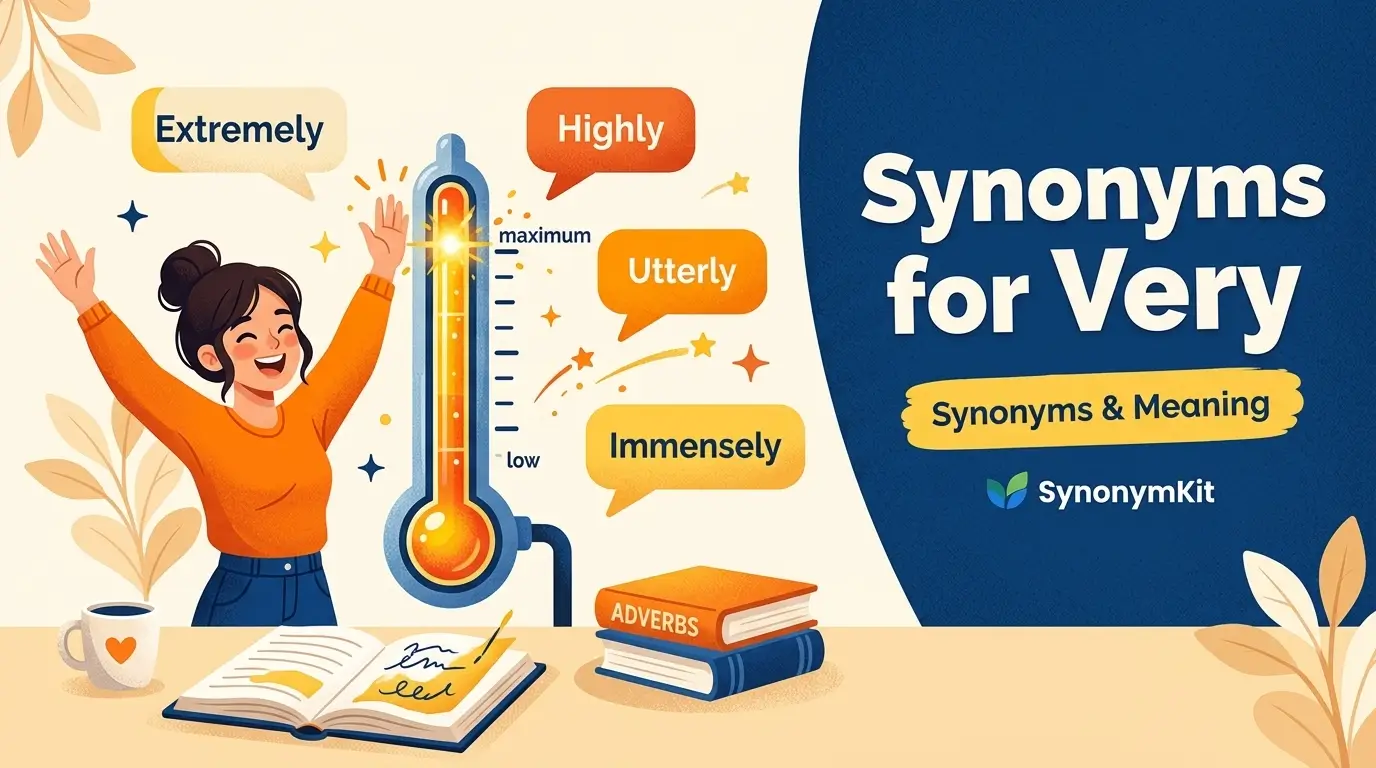
Common synonyms for very include extremely, highly, really, truly, especially, incredibly, and exceptionally. These words can make your writing clearer and more expressive. The best choice depends on the sentence, tone, and strength you want to show in everyday English, school writing, professional work, or creative writing.
Maya looked at her test paper and smiled. She had worked hard for weeks, and now she had a very good result. Instead of using the same word again and again, she could choose stronger words that make her writing more interesting.
For example, instead of saying, “The movie was very funny,” you could say, “The movie was hilarious.” The second sentence gives the reader a clearer feeling.
Learning different words for very helps students make essays more interesting. Bloggers can use stronger words to keep readers engaged.
Content writers can create clearer and more natural sentences. Daily English users can sound more confident and expressive.
“The limits of my language mean the limits of my world.” Ludwig Wittgenstein
These words are useful because small changes can make a sentence sound much stronger.
“Words are, of course, the most powerful drug used by persons.” Rudyard Kipling
Below, you will find 50 useful choices, simple examples, and practical ways to use them.
1. Extremely
- Meaning: Extremely shows that something has a very high level or strong quality.
- Examples: The weather was extremely hot today.
She was extremely happy with her results.
2. Highly
- Meaning: Highly shows that something has a strong or excellent quality.
- Examples: This book is highly useful for students.
She is highly respected at work.
3. Really
- Meaning: Really adds strong emphasis to a quality, feeling, or action.
- Examples: That story was really funny.
I really enjoyed the concert.
4. Truly
- Meaning: Truly emphasizes that something is genuinely strong, real, or important.
- Examples: She is truly kind to everyone.
This was a truly special moment.
5. Especially
- Meaning: Especially highlights one person, thing, or quality above others.
- Examples: I love winter, especially snowy days.
This lesson is especially useful today.
6. Incredibly
- Meaning: Incredibly shows that something is surprisingly strong, good, or impressive.
- Examples: The view was incredibly beautiful.
He was incredibly helpful yesterday.
7. Exceptionally
- Meaning: Exceptionally describes something that is unusually high, good, or impressive.
- Examples: She is exceptionally talented at painting.
The hotel was exceptionally clean.
8. Remarkably
- Meaning: Remarkably shows that something is surprisingly strong, unusual, or impressive.
- Examples: He recovered remarkably quickly.
The little garden looked remarkably beautiful.
9. Tremendously
- Meaning: Tremendously means to a very great or powerful degree.
- Examples: Your advice helped me tremendously.
The team improved tremendously this year.
10. Immensely
- Meaning: Immensely means to a very great degree or amount.
- Examples: I enjoyed the trip immensely.
Her support helped me immensely.
11. Highly
- Meaning: Highly can strongly emphasize praise, value, importance, or ability.
- Examples: This course is highly recommended.
He is highly skilled at writing.
12. Exceedingly
- Meaning: Exceedingly means to an unusually great or high degree.
- Examples: The room was exceedingly quiet.
She was exceedingly polite to everyone.
13. Extraordinarily
- Meaning: Extraordinarily describes something far beyond what is normal or expected.
- Examples: The child was extraordinarily bright.
Her performance was extraordinarily strong.
14. Especially
- Meaning: Especially can add extra force when highlighting a particular quality.
- Examples: The soup was especially tasty.
I felt especially proud that day.
15. Particularly
- Meaning: Particularly gives extra importance or strength to one specific thing.
- Examples: This book is particularly helpful.
She looked particularly happy today.
16. Terribly
- Meaning: Terribly can strongly emphasize feelings, problems, or negative qualities.
- Examples: I am terribly sorry about that.
The road was terribly busy.
17. Awfully
- Meaning: Awfully can strongly emphasize a quality in informal everyday English.
- Examples: The baby looks awfully cute.
It is awfully cold outside.
18. Deeply
- Meaning: Deeply strongly emphasizes serious feelings, thoughts, or emotional experiences.
- Examples: She was deeply worried about him.
We were deeply grateful for help.
19. Greatly
- Meaning: Greatly shows that something happens or exists to a strong degree.
- Examples: Your help is greatly appreciated.
The change greatly improved our results.
20. Absolutely
- Meaning: Absolutely gives strong emphasis when something is complete, certain, or intense.
- Examples: The food was absolutely delicious.
I was absolutely amazed by it.
21. Completely
- Meaning: Completely shows that something reaches a full or total level.
- Examples: The room was completely silent.
I was completely surprised by her answer.
22. Totally
- Meaning: Totally means completely and adds strong emphasis in casual English.
- Examples: I totally agree with you.
That idea is totally amazing.
23. Entirely
- Meaning: Entirely means completely and stresses that nothing is left out.
- Examples: The plan was entirely successful.
She was entirely focused on work.
24. Thoroughly
- Meaning: Thoroughly strongly emphasizes complete care, effort, or attention.
- Examples: We thoroughly enjoyed the evening.
Please check the report thoroughly first.
25. Strongly
- Meaning: Strongly adds force to opinions, feelings, beliefs, or recommendations.
- Examples: I strongly support your idea.
Doctors strongly recommend regular exercise.
26. Seriously
- Meaning: Seriously adds strong emphasis to feelings, problems, or statements.
- Examples: The mistake was seriously costly.
I seriously enjoyed the event.
27. Vastly
- Meaning: Vastly shows that something is much greater or stronger than another.
- Examples: Her skills have vastly improved.
The new system is vastly better.
28. Profoundly
- Meaning: Profoundly emphasizes a very deep feeling, effect, or change.
- Examples: The story profoundly moved me.
His words profoundly affected everyone.
29. Intensely
- Meaning: Intensely describes something experienced with very strong feeling or force.
- Examples: She felt intensely proud of him.
The players competed intensely today.
30. Acutely
- Meaning: Acutely emphasizes a strong awareness, feeling, need, or problem.
- Examples: He was acutely aware of danger.
She felt acutely embarrassed afterward.
31. Notably
- Meaning: Notably highlights something that is especially noticeable, important, or different.
- Examples: The weather was notably warmer today.
Her writing was notably clear.
32. Distinctly
- Meaning: Distinctly emphasizes that something is clearly noticeable or strongly felt.
- Examples: I felt distinctly nervous before speaking.
The room was distinctly colder.
33. Decidedly
- Meaning: Decidedly emphasizes that something has a clear and strong quality.
- Examples: The new plan is decidedly better.
He looked decidedly happier today.
34. Unusually
- Meaning: Unusually shows that something is stronger, greater, or different than normal.
- Examples: The city was unusually quiet.
She seemed unusually cheerful today.
35. Considerably
- Meaning: Considerably means by a large amount or to a strong degree.
- Examples: The price is considerably higher now.
Her confidence has grown considerably.
36. Significantly
- Meaning: Significantly shows that something changes or differs by an important amount.
- Examples: Sales increased significantly this month.
The new version works significantly better.
37. Phenomenally
- Meaning: Phenomenally describes something that is exceptionally great, successful, or impressive.
- Examples: The business grew phenomenally fast.
She performed phenomenally well yesterday.
38. Supremely
- Meaning: Supremely shows an extremely high level of a positive quality.
- Examples: He is supremely confident today.
The hotel was supremely comfortable.
39. So
- Meaning: So strongly emphasizes an adjective or adverb in casual everyday English.
- Examples: That puppy is so cute.
I am so tired today.
40. Super
- Meaning: Super is an informal word that adds strong emphasis to positive qualities.
- Examples: Your idea is super helpful.
The new café is super popular.
41. Ultra
- Meaning: Ultra adds strong emphasis and often describes something beyond a normal level.
- Examples: This phone has an ultra clear screen.
She chose an ultra modern design.
42. Very Much
- Meaning: Very much strongly emphasizes feelings, actions, agreement, or appreciation.
- Examples: I very much enjoyed your speech.
We very much appreciate your help.
43. A Lot
- Meaning: A lot can strongly show a large amount, degree, or frequency.
- Examples: She likes this song a lot.
Your advice helped me a lot.
44. By Far
- Meaning: By far emphasizes that something is clearly greater than other choices.
- Examples: This is by far my favorite.
She is by far the fastest runner.
45. To a Great Degree
- Meaning: This phrase emphasizes that something happens at a strong or high level.
- Examples: The plan helped to a great degree.
His advice mattered to a great degree.
46. To a Large Extent
- Meaning: This phrase shows that something is true or present to a strong degree.
- Examples: The project succeeded to a large extent.
Her work improved to a large extent.
47. Incredibly Much
- Meaning: This phrase can emphasize a large amount, though natural alternatives often sound better.
- Examples: She helped me incredibly much.
I miss my family incredibly much.
48. More Than Usually
- Meaning: This phrase shows that something happens at a higher level than normal.
- Examples: He seemed happier than usual today.
The shop was busier than usually.
49. Beyond Measure
- Meaning: Beyond measure describes something so great that it cannot easily be counted.
- Examples: Her kindness is beyond measure.
Their joy was beyond measure.
50. To an Extreme Degree
- Meaning: This phrase clearly shows that something reaches an unusually high level.
- Examples: The heat rose to an extreme degree.
His fear grew to an extreme degree.
“The difference between the right word and the almost right word is the difference between lightning and a lightning bug.” Mark Twain
Synonyms for Very Good
Words such as excellent, outstanding, exceptional, superb, remarkable, and fantastic can replace “very good” more naturally. Choose based on context.
“Excellent” works well in professional writing, while “fantastic” sounds more casual. “Outstanding” is useful when praising strong work, results, talent, or performance.
Synonyms for Very Important
Try essential, crucial, vital, significant, critical, or fundamental when you need a stronger alternative. “Essential” means something is needed, while “crucial” suggests that it can strongly affect an outcome.
These words work well in essays, reports, business writing, and professional communication.
Synonyms for Very Happy
Instead of “very happy,” you can use delighted, thrilled, joyful, cheerful, or overjoyed. “Delighted” works well in polite and professional situations.
“Thrilled” sounds more energetic, while “overjoyed” expresses an especially strong feeling of happiness.
Synonyms for Very Bad
Useful choices include terrible, awful, dreadful, horrible, disastrous, and appalling. The right word depends on how serious the situation is.
“Terrible” is common in daily English, while “disastrous” is stronger and works well when something causes major harm or failure.
Synonyms for Very Small
You can use tiny, little, miniature, microscopic, minuscule, or compact instead of “very small.” “Tiny” is common in daily speech. “Microscopic” is useful when something is extremely small, while “compact” often describes something small but practical.
FAQ: People Also Ask
How do you say “very” in a formal way?
In formal English, choose a precise word instead of using “very” too often. Depending on the sentence, you can use highly, extremely, exceptionally, considerably, significantly, deeply, profoundly, or particularly.
For example, “very important” can become “crucial,” while “very good” can become “excellent.” A specific adjective is often clearer and stronger than adding “very” before a basic adjective.
What words can we use instead of “very”?
There are many alternatives, including extremely, highly, really, truly, incredibly, exceptionally, remarkably, especially, particularly, greatly, and tremendously. The best choice depends on the sentence.
“Really” is natural in casual English, while “highly” and “exceptionally” can fit formal writing. You can also replace “very + adjective” with one stronger adjective, such as “very tired” becoming “exhausted.”
What’s a stronger word than “very”?
A stronger word depends on the adjective that follows “very.” For example, “very angry” can become furious, “very tired” can become exhausted, and “very hungry” can become starving.
This method often makes writing more powerful because one exact word can express the full idea without needing the extra word “very.”
What is a better word for extremely?
Good alternatives for extremely include exceptionally, extraordinarily, remarkably, incredibly, intensely, tremendously, immensely, and exceedingly. Each has a slightly different tone.
“Exceptionally” often works well for praise, while “intensely” fits strong feelings or experiences. In formal writing, “extraordinarily” and “significantly” can be useful when they accurately match the meaning of the sentence.
Conclusion
Learning synonyms for very can make your English clearer, more natural, and interesting. Instead of using the same word in every sentence, you can choose a word that shows the exact level of meaning you want.
Students can use stronger vocabulary in essays, homework, and presentations. Bloggers can make articles more engaging and easier to read.
Content writers can avoid repeated words and create smoother sentences. Daily English users can also sound more confident when speaking or writing.
The key is not to replace very every time. Sometimes “very” is the most natural choice. The goal is to understand your options and choose the word that fits the situation.
Try practicing these words in simple sentences. Use highly in a professional sentence, incredibly in an excited sentence, and deeply when describing strong feelings. You can also replace phrases like “very good” with excellent or “very important” with essential.
“Words are the voice of the heart.” Confucius
Keep a small list of useful alternatives and practice them in emails, essays, blog posts, and daily conversations.
“Language is the dress of thought.” Samuel Johnson
With regular practice, your vocabulary will grow naturally, and your writing will become more precise and expressive.

Sarah is a freelance content writer and grammar enthusiast with over 6 years of experience helping students and bloggers write with more clarity. She joined SynonymKit to make vocabulary-building simple and accessible for everyone, one word list at a time.