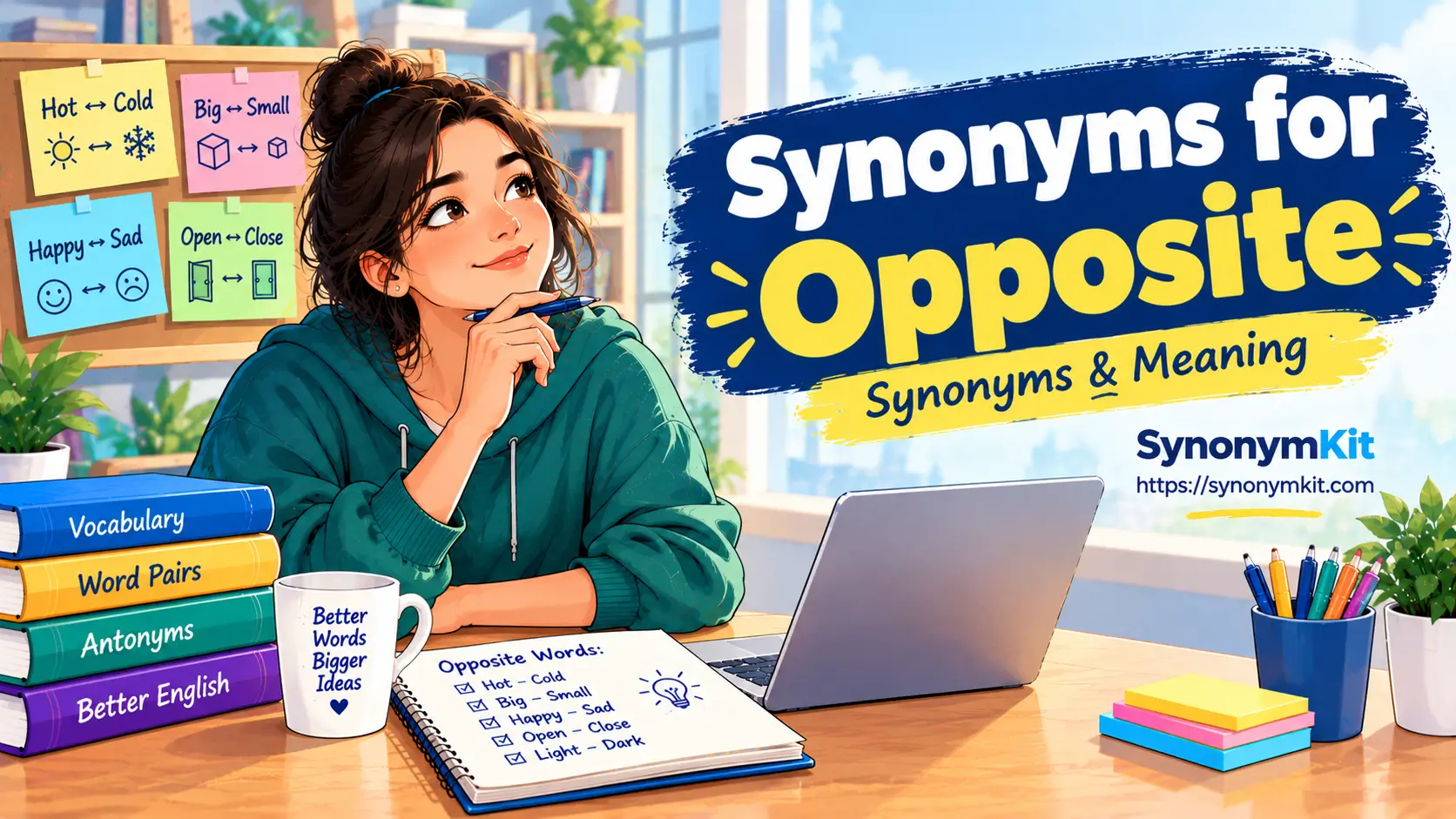
55 Synonyms for Opposite: Words, Meanings, and Examples
Synonyms for opposite include contrary, reverse, inverse, opposing, contrasting, different, and conflicting. These words describe things that face the other way, disagree, or have very different meanings. The best choice depends on your sentence, such as describing directions, opinions, actions, or ideas.
Imagine two friends choosing where to go for lunch. One wants pizza, while the other wants burgers.
Their choices are different, and their opinions may point in opposite directions. Moments like these happen every day, at home, at school, and at work.
Choosing the right word helps you explain these differences with ease. Instead of using the same word again and again, you can choose a word that fits your meaning. For example, you might describe two teams as rivals or two ideas as contrasting.
Students can use these words to write better essays and answer questions. Bloggers can make their posts more interesting and clear.
Content writers can explain differences without repeating identical terms. Daily English users can express their thoughts with greater care.
“Words are, of course, the most powerful drug used by people.”
Learning new words takes practice, but you do not need to learn them all at once. Start with a few useful choices, then try them in your own sentences.
“The difference between the right word and the almost right word is the difference between lightning and a lightning bug.”
In this guide, you will find useful alternatives, simple meanings, and real life examples to help you choose the right word.
1. Contrary
- Meaning: Contrary describes something that is completely different from another thing.
- Examples: His actions were contrary to his words. The results were contrary to our hopes.
2. Reverse
- Meaning: Reverse means going backward or being the other way around.
- Examples: Please reverse the order of these names. The car moved in reverse slowly.
3. Inverse
- Meaning: Inverse describes something that changes in the opposite way.
- Examples: Their scores showed an inverse relationship. The inverse pattern surprised our science teacher.
4. Opposing
- Meaning: Opposing describes people or things that stand against each other.
- Examples: The opposing teams played a fair game. They shared opposing views during the meeting.
5. Contrasting
- Meaning: Contrasting describes things that show clear differences from each other.
- Examples: The artist used contrasting colors in her painting. We compared two contrasting ideas today.
6. Different
- Meaning: Different means not the same as another person or thing.
- Examples: My answer was different from yours. We have different plans for Saturday.
7. Conflicting
- Meaning: Conflicting describes ideas or facts that cannot easily agree with each other.
- Examples: The reports gave conflicting details about the event. Their schedules were conflicting this week.
8. Antithetical
- Meaning: Antithetical describes ideas that are directly against each other.
- Examples: His actions were antithetical to kindness. The plans seemed antithetical to our goals.
9. Opposed
- Meaning: Opposed means against an idea, action, plan, or person.
- Examples: Many parents were opposed to the change. She opposed the plan during the meeting.
10. Divergent
- Meaning: Divergent describes ideas or paths that move apart from each other.
- Examples: Their views became divergent over time. We followed divergent paths after school.
11. Dissimilar
- Meaning: Dissimilar means not alike in appearance, nature, or quality.
- Examples: The twins had dissimilar tastes in music. These two designs look dissimilar to me.
12. Incompatible
- Meaning: Incompatible describes things that cannot work or exist well together.
- Examples: Their goals were incompatible from the start. This charger is incompatible with my phone.
13. Contrary minded
- Meaning: Contrary minded describes someone who often disagrees with other people’s ideas.
- Examples: He seemed contrary minded during the class discussion. She gave a contrary minded answer again.
14. Reverse side
- Meaning: Reverse side describes the back or other face of something.
- Examples: Write your name on the reverse side. The answer appears on the reverse side.
15. Counter
- Meaning: Counter describes an action or idea that works against another.
- Examples: They made a counteroffer yesterday. The team planned a counter attack quickly.
16. Antipodal
- Meaning: Antipodal describes places or points that lie directly opposite each other.
- Examples: The islands sit at antipodal points on Earth. Their views seemed antipodal during the debate.
17. Antagonistic
- Meaning: Antagonistic describes behavior that shows strong dislike or opposition.
- Examples: His antagonistic tone upset the whole team. They became antagonistic during the long debate.
18. Contradictory
- Meaning: Contradictory describes statements or facts that cannot both be true.
- Examples: The witness gave contradictory answers to questions. These instructions seem contradictory to me.
19. Polar
- Meaning: Polar describes two things that are far apart in nature or opinion.
- Examples: They held polar views about the new rule. The characters had polar personalities in the story.
20. Reverse facing
- Meaning: Reverse facing describes something pointing away from the usual direction.
- Examples: The reverse facing seat looked toward the back. We chose the reverse facing camera setting.
21. Counteractive
- Meaning: Counteractive describes something that reduces or works against another effect.
- Examples: The new steps had a counteractive effect. This medicine may have counteractive effects with others.
22. Contrary to
- Meaning: Contrary to means different from or against what someone expects.
- Examples: Contrary to rumors, the school stayed open. Contrary to my guess, she won easily.
23. In opposition
- Meaning: In opposition means standing against an idea, choice, or action.
- Examples: Several workers stood in opposition to the cuts. The group acted in opposition to the plan.
24. Antagonistic to
- Meaning: Antagonistic to means strongly against someone or something.
- Examples: His comments were antagonistic to the proposal. The policy seemed antagonistic to their needs.
25. At odds
- Meaning: At odds describes people or ideas that do not agree.
- Examples: Their accounts were at odds with each other. The brothers were at odds about money.
26. Conflicting with
- Meaning: Conflicting with means not matching or agreeing with something else.
- Examples: Her story was conflicting with the evidence. My work hours conflict with the class.
27. Diametric
- Meaning: Diametric describes things that are directly opposite in position or nature.
- Examples: They took diametric positions on the issue. The friends had diametric views about success.
28. Diametrical
- Meaning: Diametrical means completely opposite in nature, direction, or meaning.
- Examples: Their plans were diametrical in every way. She offered a diametrical view of the problem.
29. Contrary mindedness
- Meaning: Contrary mindedness means a habit of disagreeing with common ideas or views.
- Examples: His contrary mindedness made group work difficult. Her contrary mindedness often started lively debates.
30. Antipodean
- Meaning: Antipodean relates to places or people on the opposite side of Earth.
- Examples: They studied antipodean regions in geography class. The book explored antipodean societies and environments.
31. Antithesis
- Meaning: Antithesis means a person or thing that is the exact opposite.
- Examples: Cruelty is the antithesis of kindness. His calm nature was the antithesis of mine.
32. Polarity
- Meaning: Polarity describes a state with two opposite sides or qualities.
- Examples: The debate showed the polarity of their views. The lesson explained polarity in simple terms.
33. Contradiction
- Meaning: Contradiction means a statement or fact that disagrees with another.
- Examples: His latest claim was a clear contradiction. We found a contradiction in the report.
34. Counterpart
- Meaning: Counterpart means a matching person or thing in another group or role.
- Examples: She met her counterpart from another school. The two leaders spoke with each other.
35. Antipole
- Meaning: Antipole describes a point directly opposite another point.
- Examples: The map showed the antipole of that location. We learned about antipoles in geography class.
36. Diverging
- Meaning: Diverging describes things moving away from each other in different directions.
- Examples: The diverging roads led to two towns. Their views kept diverging during the talk.
37. Disagreeing
- Meaning: Disagreeing means having a different view or opinion from someone.
- Examples: The friends kept disagreeing about the movie. We were disagreeing over where to eat.
38. Disparate
- Meaning: Disparate describes things that are very different from each other.
- Examples: The report combined disparate ideas into one plan. They came from disparate backgrounds and places.
39. Unalike
- Meaning: Unalike means not similar in looks, actions, or qualities.
- Examples: The two houses were unalike in style. Their tastes were unalike, but they remained friends.
40. Antonymous
- Meaning: Antonymous describes words that have opposite meanings.
- Examples: Hot and cold are antonymous words. Our teacher explained antonymous terms with examples.
41. Contradistinct
- Meaning: Contradistinct describes something set apart through a clear difference from another.
- Examples: The writer used contradistinct ideas in the essay. Their roles were contradistinct in the play.
42. Unrelated
- Meaning: Unrelated means having no clear link or connection with something else.
- Examples: These two problems are unrelated to each other. His comment was unrelated to our discussion.
43. Reverse order
- Meaning: Reverse order means arranging things from the end toward the beginning.
- Examples: Read the names in reverse order, please. The teacher listed the steps in reverse order.
44. Contrary direction
- Meaning: Contrary direction means moving away from or against the usual path.
- Examples: The boat sailed in the contrary direction. We walked in the contrary direction by mistake.
45. Antagonism
- Meaning: Antagonism means strong dislike or active opposition between people or groups.
- Examples: Antagonism grew between the rival teams. Their long history of antagonism hurt both sides.
46. Opposition
- Meaning: Opposition means resistance to a plan, belief, person, or action.
- Examples: The plan faced opposition from local residents. She spoke in opposition to the new rule.
47. Contrast
- Meaning: Contrast means a clear difference between two people or things.
- Examples: The contrast between them was easy to see. We noticed a strong contrast in color.
48. Disagreement
- Meaning: Disagreement means a difference in views, thoughts, or choices between people.
- Examples: Their disagreement ended after a calm talk. We had a small disagreement about dinner.
49. Antipathy
- Meaning: Antipathy means a strong feeling of dislike toward someone or something.
- Examples: He felt antipathy toward unfair rules. Her antipathy toward gossip was well known.
50. Reversal
- Meaning: Reversal means a change that turns something the other way.
- Examples: The team made a sudden reversal in strategy. The court ordered a reversal of the decision.
51. Counterpoint
- Meaning: Counterpoint is an idea that offers a clear difference or contrast.
- Examples: Her comment offered a counterpoint to his claim. The essay included a useful counterpoint to the argument.
52. Antipodal opposite
- Meaning: Antipodal opposite describes something positioned directly across from another thing.
- Examples: The points were antipodal opposites on the globe. Their beliefs seemed like antipodal opposites at first.
53. Contradictor
- Meaning: Contradictor describes someone who challenges or denies another person’s statement.
- Examples: The contradictor questioned each claim in the debate. A contradictor raised doubts about the report.
54. Reverse image
- Meaning: Reverse image describes a flipped version of a picture or design.
- Examples: She printed a reverse image for the shirt. The reverse image made the text readable.
55. Opposite number
- Meaning: Opposite number means a person with a similar role on the other side.
- Examples: The coach spoke with his opposite number. She called her opposite number to discuss plans.
Synonyms for Opposite Side
Words for the opposite side include other side, reverse side, far side, opposing side, and across from. Use these terms when describing locations, objects, or groups facing each other.
For example, “The library stands on the other side of the road.” Choose a phrase that makes the position clear to your reader.
Synonyms for Opposite Direction
Useful alternatives include reverse direction, contrary direction, opposite way, backward, and the other way. These phrases explain movement or position.
For example, “We drove in the opposite direction after missing the turn.” In formal writing, “reverse direction” may sound more precise, while “the other way” works well in daily conversation.
Synonyms for Opposite Opinion
You can describe a different view as a contrary opinion, opposing view, conflicting belief, or differing viewpoint. These phrases are useful in essays, debates, and workplace discussions.
For example, “Her opposing view helped the group consider another option.” Pick a phrase that shows whether people simply disagree or strongly reject an idea.
Synonyms for Opposite Meaning
Words and phrases such as contrary meaning, reverse meaning, conflicting sense, and antonym can help explain word differences. An antonym is a word with the opposite meaning of another word, such as “early” and “late.”
In language lessons, use “antonym” when discussing vocabulary and “contrary meaning” when explaining a wider idea.
Fancy Synonyms for Opposite
More advanced choices include antithetical, diametrical, inverse, antipodal, and antagonistic. These words suit academic writing, formal discussion, and detailed analysis, but each has a different use.
“Antithetical” often describes ideas, while “antipodal” can describe opposite points. Select a fancy word only when its meaning fits your sentence.
Synonyms and Antonyms for Opposite
A synonym is a word with a similar meaning, while an antonym has an opposite meaning. For example, “contrary” and “opposing” can be synonyms of “opposite.”
Words such as “same,” “similar,” and “identical” can express the reverse idea in suitable contexts. Understanding both types helps you compare ideas and choose words that fit your sentence.
Frequently Asked Questions
1. What are some fancy synonyms for “opposite”?
Fancy synonyms for “opposite” include antithetical, diametrical, antipodal, inverse, and contrary. “Antithetical” works well when two ideas strongly disagree. “Diametrical” describes a complete difference between views or positions.
“Antipodal” often refers to points on opposite sides of Earth. “Inverse” is useful in mathematics and science. Choose a word based on the subject and tone of your writing.
2. What are the synonyms of opposed?
Synonyms for “opposed” include against, contrary, resistant, opposing, conflicting, and antagonistic. The best option depends on the sentence. For example, “against” is simple and common, while “antagonistic” suggests strong dislike or hostility.
You can say, “The workers opposed the change,” or “The workers were against the change.” Both sentences express disagreement, but the second uses easier language.
3. What is a formal synonym for “opposite”?
Contrary is a useful formal synonym for “opposite,” especially when discussing ideas, statements, or results. “Antithetical” is another strong choice when two concepts directly conflict. For example, “The findings were contrary to earlier reports” sounds suitable for academic writing.
In a more detailed essay, you might write, “The proposal was antithetical to the team’s main goals.” Always check that the replacement preserves your intended meaning.
4. What is a fancy word for “reverse”?
Inverse is a good advanced word for “reverse,” especially in mathematics, science, and technical writing. Reversal works when describing a change in direction, order, or outcome. For example, “The two numbers have an inverse relationship” explains how they relate.
You could also say, “The decision marked a reversal in policy.” Use “inverse” for an opposite relationship and “reversal” for a change back or around.
How to Choose the Right Synonym
The word “opposite” can describe a direction, an opinion, a relationship, or a difference. Therefore, no single synonym fits every sentence.
- For everyday English: Use different, reverse, against, or unlike.
- For essays: Try contrary, contrasting, conflicting, or opposing.
- For academic writing: Consider antithetical, inverse, or diametrical when the meaning fits.
- For directions: Use reverse direction, other side, or the other way.
- For word study: Use antonym when referring to a word with the opposite meaning.
“The limits of my language mean the limits of my world.”
A wider vocabulary gives you more ways to explain what you think. However, using a complex word does not always make writing better. Clear, accurate language is usually the strongest choice.
Conclusion
Learning synonyms for opposites helps you express differences in a clear and natural way. Instead of using the same word in every sentence, you can choose terms such as contrary, reverse, contrasting, opposing, and inverse. Each word has its own use, so understanding its meaning helps you avoid mistakes.
Students can use these words in essays, homework, and class discussions. Bloggers can make their articles easier to read and more interesting. Content writers can explain comparisons without repeating the same expressions. Daily English users can also share opinions and describe differences with greater confidence.
“A word after a word after a word is power.”
Start by learning three new words each day. Write a short sentence for each one, then try using those words in emails, school assignments, and daily conversations. You can also practice by replacing repeated words in your own writing.
“The more that you read, the more things you will know.”
Remember, the goal is not to use the fanciest word every time. It is to choose the word that best matches your meaning. With regular practice, your vocabulary will grow, your writing will become clearer, and you will feel more confident expressing your ideas in English.

James is a former English teacher turned content strategist who’s passionate about making language learning less intimidating. At SynonymKit, he focuses on curating word lists that are practical for everyday writing, essays, and professional communication.