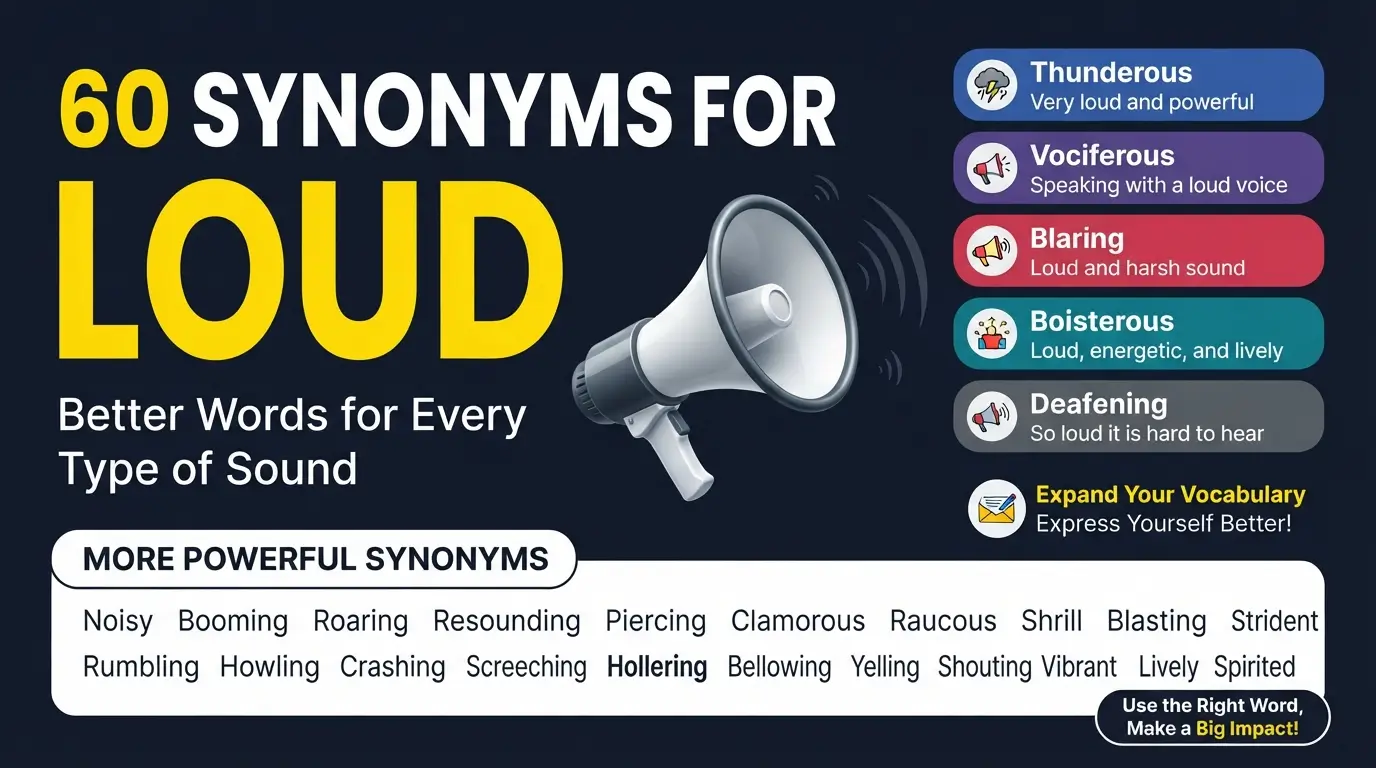
60 Synonyms for Loud: Better Words for Every Type of Sound
Common synonyms for loud include noisy, booming, deafening, thunderous, blaring, and clamorous. The best choice depends on the sound, its strength, and your feeling about it. Some words sound positive, while others suggest that a sound is annoying, harsh, or too strong for comfort.
The music starts at a party, and suddenly everyone turns toward the speaker. The room fills with sound. Some people smile and dance, while others cover their ears. The word loud works, but it may not show exactly how the sound feels.
For example, a cheering crowd can be boisterous, while a car horn may be blaring. A storm can sound thunderous, and a soft voice can become audible when someone speaks louder.
Learning different words gives your writing more life. Students can use them to make essays clearer. Bloggers can avoid using the same word again and again.
Content writers can create stronger descriptions. Daily English users can explain sounds more clearly.
“Words become stronger when we choose them with care.”
Good word choice also helps readers picture a scene. The right synonym can show volume, mood, emotion, or even a person’s behavior.
“A clear word can make a simple idea easy to see.”
60 Synonyms for Loud
1. Noisy
- Meaning: Making a lot of sound that can be hard to ignore.
- Examples: The classroom became noisy after lunch.
The busy street was noisy today.
2. Booming
- Meaning: Making a deep, strong sound that carries over distance.
- Examples: His booming voice filled the hall.
The speaker gave a booming announcement.
3. Deafening
- Meaning: So loud that the sound makes hearing difficult or uncomfortable.
- Examples: The fireworks were deafening last night.
The concert became deafening near midnight.
4. Thunderous
- Meaning: Very loud and deep, like powerful thunder during a storm.
- Examples: Thunderous applause filled the theater.
The crowd gave a thunderous cheer.
5. Blaring
- Meaning: Making a loud, harsh sound that feels difficult to ignore.
- Examples: A blaring horn woke me.
The radio was blaring all morning.
6. Roaring
- Meaning: Making a very loud, deep, powerful, continuous sound.
- Examples: The engine was roaring.
We heard roaring waves outside.
7. Clamorous
- Meaning: Filled with many loud sounds happening at the same time.
- Examples: The market was clamorous at noon.
Children made a clamorous noise nearby.
8. Boisterous
- Meaning: Very noisy, energetic, and full of lively activity or excitement.
- Examples: The boisterous crowd cheered loudly.
His boisterous laugh filled the room.
9. Raucous
- Meaning: Having a loud, rough, and unpleasant sound or quality.
- Examples: Raucous cheers came from outside.
The party grew raucous after dinner.
10. Vociferous
- Meaning: Expressing strong feelings with a very loud voice.
- Examples: The vociferous fans demanded answers.
She became vociferous during the debate.
11. Piercing
- Meaning: Extremely sharp and loud, often causing discomfort to your ears.
- Examples: A piercing alarm rang suddenly.
Her piercing whistle stopped everyone.
12. Shrill
- Meaning: Having a high, sharp sound that can feel unpleasant.
- Examples: The shrill bell rang twice.
His shrill voice surprised everyone.
13. Ear splitting
- Meaning: Extremely loud and almost painful for your ears.
- Examples: The music was ear splitting.
An ear splitting scream broke the silence.
14. Thunderous
- Meaning: Extremely loud, powerful, and deep like the sound of thunder.
- Examples: Thunderous applause followed her speech.
The drums sounded thunderous tonight.
15. Resounding
- Meaning: Very loud, clear, and strong enough to echo around.
- Examples: A resounding cheer filled the stadium.
His resounding voice reached everyone.
16. Explosive
- Meaning: Suddenly very loud, powerful, and full of strong energy.
- Examples: The explosive sound shocked us.
His explosive laugh surprised everyone.
17. Intense
- Meaning: Very strong in volume, feeling, or effect on people nearby.
- Examples: The intense music shook windows.
An intense noise came outside.
18. Powerful
- Meaning: Producing a strong sound that people can easily hear.
- Examples: Her powerful voice impressed everyone.
The singer has a powerful voice.
19. Vibrant
- Meaning: Full of lively sound, energy, and strong positive feeling.
- Examples: The vibrant music lifted everyone.
We enjoyed the vibrant street sounds.
20. Energetic
- Meaning: Full of lively sound, movement, excitement, and strong activity.
- Examples: The energetic crowd kept cheering.
His energetic voice sounded happy.
21. Lively
- Meaning: Full of cheerful sound, movement, and active social energy.
- Examples: The lively party lasted hours.
We heard lively music nearby.
22. Spirited
- Meaning: Full of strong energy, excitement, and cheerful expression.
- Examples: The spirited crowd sang loudly.
She gave a spirited speech.
23. Animated
- Meaning: Showing strong excitement through lively speech, movement, or sound.
- Examples: His animated voice filled the room.
The children had animated conversations.
24. Boisterous
- Meaning: Loud, cheerful, and energetic, especially during social activities.
- Examples: Boisterous friends filled the cafe.
Their boisterous laughter echoed outside.
25. Bellowing
- Meaning: Shouting or making a deep, very loud sound.
- Examples: He was bellowing across the field.
The coach kept bellowing instructions.
26. Shouting
- Meaning: Speaking with a much stronger voice than normal.
- Examples: Stop shouting across the room.
They were shouting over music.
27. Yelling
- Meaning: Speaking or calling with a very loud voice.
- Examples: Someone was yelling outside.
She kept yelling for help.
28. Screaming
- Meaning: Making a very loud, high sound because of fear, pain, or excitement.
- Examples: Fans were screaming with joy.
The child started screaming suddenly.
29. Hollering
- Meaning: Calling or shouting, often from far away.
- Examples: He was hollering from upstairs.
We heard someone hollering nearby.
30. Crying
- Meaning: Calling out loudly to get attention or express strong emotion.
- Examples: She was crying for help.
The baby was crying loudly.
31. Calling
- Meaning: Using your voice loudly enough for someone farther away to hear.
- Examples: He was calling my name.
She kept calling from outside.
32. Exclaiming
- Meaning: Speaking suddenly and loudly because of surprise or strong emotion.
- Examples: “Wow!” she shouted, exclaiming loudly.
He was exclaiming with excitement.
33. Outspoken
- Meaning: Speaking openly and strongly without hiding personal opinions.
- Examples: She is an outspoken leader.
His outspoken style attracts attention.
34. Forceful
- Meaning: Using strong speech that clearly shows confidence and power.
- Examples: She made a forceful argument.
His forceful voice gained attention.
35. Emphatic
- Meaning: Expressing something strongly so people understand its importance.
- Examples: She gave an emphatic answer.
His emphatic reply ended the debate.
36. Strident
- Meaning: Loud, harsh, and unpleasant because of its sharp sound.
- Examples: A strident alarm sounded nearby.
His strident voice annoyed listeners.
37. Harsh
- Meaning: Having a strong, rough sound that may feel unpleasant.
- Examples: The harsh alarm woke everyone.
His harsh tone sounded angry.
38. Rattling
- Meaning: Making a quick series of loud, hard sounds.
- Examples: The windows were rattling loudly.
Rattling pipes woke the baby.
39. Clattering
- Meaning: Making repeated loud sounds when hard things hit together.
- Examples: Plates were clattering in the kitchen.
The dishes came clattering down.
40. Crashing
- Meaning: Making a sudden, very loud sound from impact or breaking.
- Examples: We heard crashing glass downstairs.
Waves came crashing against rocks.
41. Bang
- Meaning: A sudden loud sound caused by hitting, closing, or exploding.
- Examples: The door made a bang.
A loud bang startled everyone.
42. Blasting
- Meaning: Playing or producing sound at an extremely high volume.
- Examples: Music was blasting upstairs.
His speakers were blasting all night.
43. Roaring
- Meaning: Making a deep, powerful noise that continues with great force.
- Examples: The crowd was roaring loudly.
The waterfall sounded roaring nearby.
44. Rumbling
- Meaning: Making a deep, low sound that continues or moves along.
- Examples: Thunder was rumbling overhead.
Trucks kept rumbling past us.
45. Howling
- Meaning: Making a long, loud sound like wind, animals, or people.
- Examples: The wind was howling outside.
Dogs were howling all night.
46. Screeching
- Meaning: Making a very high, sharp, and unpleasant loud sound.
- Examples: The brakes were screeching loudly.
We heard screeching tires nearby.
47. Squawking
- Meaning: Making a loud, rough, repeated sound like certain birds.
- Examples: The parrots were squawking loudly.
Birds kept squawking near breakfast.
48. Honking
- Meaning: Making a loud warning sound with a vehicle horn.
- Examples: Cars were honking outside.
Someone kept honking behind us.
49. Tooting
- Meaning: Making a short, light sound from a horn.
- Examples: The bus was tooting nearby.
The driver kept tooting his horn.
50. Ringing
- Meaning: Making a clear sound that continues after the source stops.
- Examples: The phone kept ringing loudly.
Bells were ringing across town.
51. Resounding
- Meaning: Making a strong, clear sound that seems to echo widely.
- Examples: Her resounding laugh filled the room.
A resounding cheer followed the goal.
52. Echoing
- Meaning: Repeating a loud sound after it bounces from surfaces.
- Examples: Our voices were echoing inside.
Loud footsteps kept echoing downstairs.
53. Reverberating
- Meaning: Producing a strong sound that continues through a space.
- Examples: Music was reverberating through walls.
The drums kept reverberating outside.
54. Din
- Meaning: A continuous mixture of loud, unpleasant, and confusing sounds.
- Examples: The traffic created a din.
We escaped the noisy din.
55. Uproarious
- Meaning: Extremely noisy, excited, and full of laughter or activity.
- Examples: The audience became uproarious quickly.
An uproarious crowd filled the hall.
56. Tumultuous
- Meaning: Full of loud, confused, and excited sounds or activity.
- Examples: The crowd became tumultuous quickly.
Tumultuous cheers filled the stadium.
57. Discordant
- Meaning: Having sounds that clash and do not blend well together.
- Examples: The band played discordant notes.
Discordant sounds filled the room.
58. Overpowering
- Meaning: So strong or loud that it takes attention from everything else.
- Examples: The music was overpowering inside.
An overpowering alarm filled the hallway.
59. Thunderclap
- Meaning: A sudden, explosive sound that resembles a powerful burst of thunder.
- Examples: A thunderclap shook the windows.
The sudden thunderclap startled everyone.
60. Loudmouthed
- Meaning: Talking too loudly or expressing opinions without enough care.
- Examples: The loudmouthed guest annoyed everyone.
His loudmouthed jokes caused trouble.
“The best synonym is the one that matches the exact feeling you want.”
Synonyms for loud person
A loud person may be boisterous, vociferous, outspoken, bellowing, or loudmouthed. The best word depends on the reason behind the person’s volume. For a cheerful person, “boisterous” can work well. For someone who speaks too strongly, “vociferous” or “loudmouthed” may fit better. The simple everyday English, “noisy person,” is easy and clear.
Synonyms for loud noise
For a loud noise, useful choices include deafening, booming, blaring, thunderous, piercing, roaring, crashing, and ear splitting. Choose the word based on the sound itself. “Blaring” fits horns or music. “Crashing” works for sudden impacts.
Thunderous suggests a deep and powerful sound, while “piercing” suggests a sharp sound that hurts your ears.
Synonyms for loud voice
A loud voice can be described as booming, powerful, forceful, vociferous, bellowing, or resounding. “Booming” suggests a deep voice that carries far. “Forceful” focuses on strength. “Vociferous” often describes someone speaking loudly because of strong feelings.
For simple writing, “strong voice” is natural and easy for most readers to understand.
Synonyms for loud music
When describing loud music, try words such as blaring, blasting, booming, thunderous, deafening, or overpowering. “Blaring music” often suggests that the volume is unpleasant. “Blasting music” sounds casual and common.
“Thunderous music” creates a dramatic feeling. If the music is loud but enjoyable, powerful or energetic may sound more positive.
Synonyms for loud and obnoxious
Words for loud and obnoxious include loudmouthed, boisterous, raucous, strident, clamorous, and overbearing. “Loudmouthed” works well for a person who talks too much or too loudly. “Raucous” can describe a noisy group.
“Strident” is better for a harsh voice or sound. Choose carefully because these words usually carry a negative feeling.
Frequently Asked Questions
How to say “loud” in a positive way?
If you want a positive word for loud, try energetic, lively, vibrant, spirited, powerful, or booming. These words can show strength without making the sound seem annoying. For example, a singer can have a “powerful voice,” while a party can have a “lively atmosphere.” The best positive synonym depends on whether you are describing music, a person, a crowd, or another sound.
What is a fancy word for “very loud”?
A more advanced word for very loud is deafening when the sound is extremely strong and uncomfortable. Other choices include thunderous, resounding, clamorous, vociferous, and reverberating.
“Thunderous” works especially well for applause, cheers, or deep sounds. “Vociferous” is usually used for people who speak loudly and strongly, especially when they are expressing opinions.
What’s a better word for noisy?
A better word for noisy depends on what you are describing. Use clamorous for many loud sounds together, raucous for rough and unpleasant noise, or boisterous for cheerful, energetic noise. “Blaring” works well for loud music or horns.
If you simply need an easy everyday word, “loud” or “noisy” is often clearer than a more advanced synonym.
What’s another word for loud and obnoxious?
For loud and obnoxious, useful words include loudmouthed, overbearing, raucous, strident, and boisterous. “Loudmouthed” is especially useful for a person who talks too much and too loudly. “Overbearing” adds the idea of being pushy.
“Raucous” describes rough, unpleasant noise. If you want a less harsh description, “boisterous” can suggest someone loud but energetic and cheerful.
Conclusion
Learning synonyms for loud can make your English much more useful. Instead of using “loud” for every sound, you can choose a word that shows exactly what you mean. A booming voice sounds different from a shrill voice.
Blaring music feels different from vibrant music. A deafening explosion creates a very different picture from a lively party.
These small word choices can make essays stronger and blog posts more interesting. They can also help content writers create clearer descriptions. When speaking, the right synonym helps you explain what you heard and how it felt.
Try using these words in simple sentences. Write an essay with “thunderous” instead of “very loud.” Describe music as “blasting” or “energetic.” Call a busy street “clamorous.” Use “booming” for a deep voice. Practice a few new words each day.
You do not need to memorize all 60 at once. Start with five. Then use them in emails, schoolwork, stories, blog posts, and daily conversations.
“Better vocabulary gives your ideas more room to speak.”
The goal is not to use difficult words. The goal is to use the right word at the right time. With regular practice, these synonyms will become natural parts of your English.
“Strong communication begins with choosing words that fit.”

Amelia is a linguistics graduate and lifelong word nerd who believes the right word can change how a sentence feels. She writes and edits vocabulary guides for SynonymKit, helping readers sound sharper and more confident in their writing.