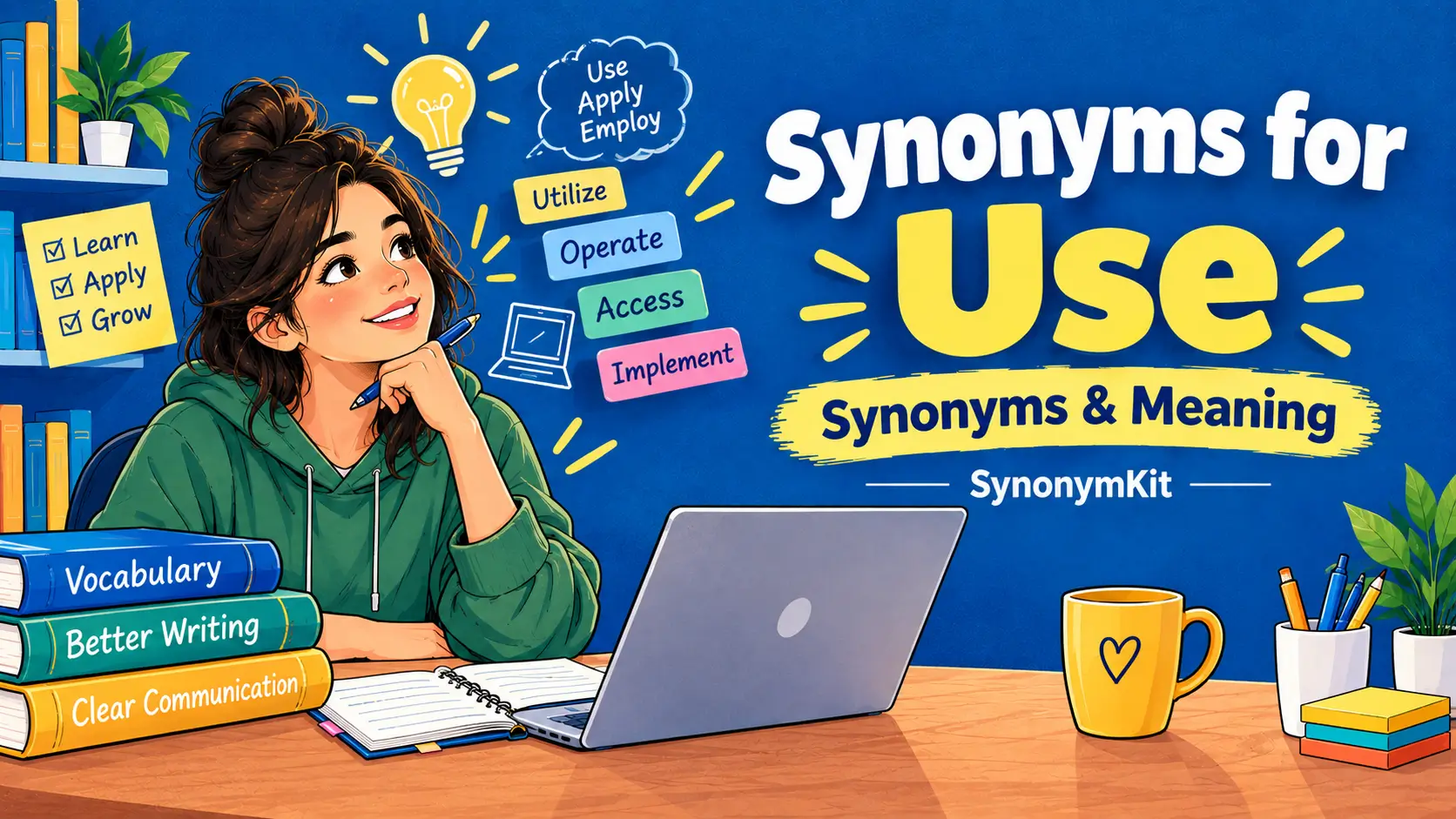
50 Synonyms for Use: Better Words for Use in English
Common synonyms for use include employ, utilize, apply, operate, handle, consume, apply, practice, access, and deploy. The best choice depends on context. You may use a tool, apply a method, employ a person, consume a resource, or practice a skill. Each word gives your sentence a slightly different meaning.
Sara is writing an essay for school. She notices that she has written the word use many times. Her teacher asks her to make the sentences more varied and exact. Sara changes a few words, and her writing becomes easier to read.
For example, she can apply a method, operate a machine, employ a strategy, or consume a resource. Each word gives the reader a clearer idea of the action.
Students can use these alternatives to make essays more varied and precise. Bloggers can make articles smoother by choosing words that fit each idea.
Content writers can avoid repetition and explain actions more clearly. Daily English users can choose natural words for different situations.
“The right word can make a simple idea much clearer.”
You do not need to replace use every time. The goal is to understand different choices and pick the one that fits your meaning.
“Good vocabulary gives your sentences more ways to speak.”
1. Employ
- Meaning: Employ means to use something or someone for a particular purpose.
- Examples: We employ simple tools daily.
She employed a clever method.
2. Utilize
- Meaning: Utilize means to use something in a practical or effective way.
- Examples: We utilize modern technology daily.
They utilized every available resource.
3. Apply
- Meaning: Apply means to use an idea, method, rule, or skill.
- Examples: Apply this rule carefully.
She applied her knowledge well.
4. Operate
- Meaning: Operate means to control or use a machine or system.
- Examples: He operates the machine safely.
She operates the computer easily.
5. Handle
- Meaning: Handle means to use, manage, or deal with something properly.
- Examples: She handles the equipment carefully.
He handles customer requests well.
6. Consume
- Meaning: Consume means to use something such as food, energy, time, or resources.
- Examples: Cars consume lots of fuel.
The project consumed valuable time.
7. Practice
- Meaning: Practice means to use a skill regularly to improve it.
- Examples: She practices English every morning.
He practices new writing skills.
8. Exercise
- Meaning: Exercise means to use a right, ability, or power.
- Examples: Citizens exercise their legal rights.
She exercises good judgment.
9. Wield
- Meaning: Wield means to use power, influence, or a tool effectively.
- Examples: She wields great influence.
He wielded the tool carefully.
10. Deploy
- Meaning: Deploy means to use something effectively for a specific purpose.
- Examples: They deployed new software today.
We deployed extra staff quickly.
11. Exploit
- Meaning: Exploit means to use something fully for a particular advantage.
- Examples: We exploited the available opportunity.
She exploited the tool’s features.
12. Leverage
- Meaning: Leverage means to use something to gain a useful advantage.
- Examples: We leveraged our experience wisely.
She leveraged technology for growth.
13. Adopt
- Meaning: Adopt means to begin using a method, idea, or system.
- Examples: The school adopted new software.
They adopted a better method.
14. Implement
- Meaning: Implement means to put a plan, idea, or system into action.
- Examples: They implemented the new policy.
She implemented a simple plan.
15. Utilize
- Meaning: Utilize means to make practical use of something available.
- Examples: Utilize the space wisely.
We utilized unused classroom space.
16. Engage
- Meaning: Engage means to use or involve something for a purpose.
- Examples: Students engage useful learning tools.
She engaged the audience well.
17. Access
- Meaning: Access means to reach or use information, systems, or resources.
- Examples: Students access online lessons.
He accessed the shared file.
18. Exploit
- Meaning: Exploit can mean to make full use of an opportunity or resource.
- Examples: They exploited every available chance.
She exploited the market gap.
19. Draw on
- Meaning: Draw on means to use knowledge, experience, or resources.
- Examples: She drew on past experience.
He drew on his training.
20. Make use of
- Meaning: Make use of means to use something that can help you.
- Examples: Make use of these notes.
We made use of sunlight.
21. Take advantage of
- Meaning: Take advantage of means to use an opportunity or resource.
- Examples: Take advantage of free lessons.
She took advantage of support.
22. Put to use
- Meaning: Put to use means to start using something for a purpose.
- Examples: We put the tools to use.
She put her skills to use.
23. Manipulate
- Meaning: Manipulate means to control or handle something in a particular way.
- Examples: He manipulated the settings carefully.
She manipulated the controls smoothly.
24. Administer
- Meaning: Administer means to give, manage, or apply something officially.
- Examples: Nurses administer the medicine.
Teachers administer the test.
25. Manage
- Meaning: Manage means to use or control something successfully.
- Examples: She manages the budget well.
He manages resources carefully.
26. Spend
- Meaning: Spend means to use time, money, or energy for something.
- Examples: We spent two hours studying.
She spent money on books.
27. Invest
- Meaning: Invest means to use money, time, or effort for future benefit.
- Examples: She invested time in learning.
They invested money in training.
28. Devote
- Meaning: Devote means to use time, effort, or attention for something.
- Examples: He devoted time to study.
She devoted energy to work.
29. Apply
- Meaning: Apply can mean to use knowledge or skills in real situations.
- Examples: Apply your skills at work.
He applied the lesson successfully.
30. Implement
- Meaning: Implement means to use a plan by putting it into action.
- Examples: The team implemented new rules.
She implemented the safety plan.
31. Exercise
- Meaning: Exercise can mean to use judgment, control, or authority.
- Examples: Leaders exercise careful judgment.
She exercised her legal rights.
32. Exploit
- Meaning: Exploit can describe making full practical use of something available.
- Examples: We exploited the available space.
They exploited new technology.
33. Tap
- Meaning: Tap means to use a source of knowledge, money, or support.
- Examples: She tapped her network.
We tapped local resources.
34. Harness
- Meaning: Harness means to control and use something for a useful purpose.
- Examples: We harness solar energy.
She harnessed her creativity well.
35. Channel
- Meaning: Channel means to direct energy, effort, or resources toward something.
- Examples: He channeled his energy wisely.
She channeled funds into research.
36. Direct
- Meaning: Direct means to guide or use something toward a specific purpose.
- Examples: They directed funds toward education.
She directed her efforts carefully.
37. Employ
- Meaning: Employ can mean to use a method, skill, or approach.
- Examples: He employed a simple strategy.
She employed careful reasoning.
38. Resort to
- Meaning: Resort to means to use something after other choices fail.
- Examples: They resorted to stronger measures.
He resorted to simple tools.
39. Rely on
- Meaning: Rely on means to use or depend on something for support.
- Examples: We rely on online tools.
She relies on careful notes.
40. Depend on
- Meaning: Depend on means to need or use something for support.
- Examples: They depend on public transport.
He depends on this software.
41. Access
- Meaning: Access means to enter, reach, or use something available.
- Examples: Users access the online portal.
She accessed useful information.
42. Consult
- Meaning: Consult means to use a source for information or advice.
- Examples: She consulted the dictionary.
He consulted an expert.
43. Refer to
- Meaning: Refer to means to look at or use information from something.
- Examples: Refer to the guide first.
She referred to her notes.
44. Cite
- Meaning: Cite means to use information from a source as evidence.
- Examples: Students cite reliable sources.
He cited the research correctly.
45. Quote
- Meaning: Quote means to use another person’s exact words.
- Examples: She quoted the author directly.
He quoted a famous speaker.
46. Incorporate
- Meaning: Incorporate means to include something as part of a larger whole.
- Examples: We incorporated new ideas.
She incorporated images into her article.
47. Integrate
- Meaning: Integrate means to combine something so it works well together.
- Examples: They integrated new software.
She integrated examples into lessons.
48. Adopt
- Meaning: Adopt means to choose and begin using something new.
- Examples: The company adopted new tools.
She adopted a fresh approach.
49. Utilize
- Meaning: Utilize means to use available resources in a practical manner.
- Examples: We utilized the available space.
They utilized extra materials.
50. Employ
- Meaning: Employ means to use a particular method, tool, or approach.
- Examples: She employed clear examples.
He employed a useful technique.
“A synonym works best when it matches the exact action in your sentence.”
Synonyms for Use in an Essay
In an essay, alternatives to use can make your writing more precise. Try words such as apply, employ, utilize, incorporate, cite, refer to, and draw on. For example, you can “apply a theory,” “cite a source,” or “draw on research.”
Do not replace every use of “use,” because simple words can often make academic writing clearer.
Synonyms for Use Case
A use case describes how something can be used in a particular situation or for a specific goal. Depending on the sentence, related terms include application, purpose, function, role, scenario, and practical use.
“Application” works well in technical writing, while “purpose” is simpler. Choose the term that explains what the tool, product, or method does.
Synonyms for Use Up
Use up means to finish or consume all of something. Useful alternatives include consume, exhaust, deplete, spend, drain, and finish. For example, you can “consume all the fuel,” “deplete the supplies,” or “finish the paper.”
The best word depends on the resource. “Deplete” often suggests that a supply becomes very low, while “finish” sounds simpler.
Synonyms for Use or Utilize
Use and utilize are closely related, but “use” is usually simpler and more natural. Other choices include employ, apply, operate, deploy, leverage, and make use of. “Apply” fits methods and knowledge, while “operate” fits machines.
“Deploy” often fits systems or resources. “Utilize” is suitable in some formal contexts, but it should not replace “use” when no extra meaning is needed.
Synonyms for Use in English
In English, the best synonym for use depends on the object and action. You can operate a machine, apply knowledge, consume energy, employ a method, practice a skill, or access information. Learning these differences helps you avoid awkward sentences.
Instead of searching for one replacement for “use,” first ask what action you are describing.
People Also Ask
What can I say instead of “use” in an essay?
In an essay, you can use words such as apply, employ, utilize, incorporate, cite, refer to, draw on, or adopt. The correct choice depends on your sentence. For example, “apply a theory” and “cite a source” are more precise than simply saying “use.”
However, do not force a synonym into every sentence. Clear academic writing often benefits from simple and direct vocabulary.
What is a synonym for “use”?
A common synonym for use is employ, but several other words may fit depending on the meaning. You can apply a method, operate equipment, consume resources, practice a skill, access information, or deploy a system. Words such as utilize, handle, exercise, leverage, and adopt can also work in specific contexts.
The object of the verb usually helps determine the best choice.
How do you say “used professionally”?
Instead of used professionally, you can say used in a professional setting, applied professionally, employed professionally, used in professional practice, or utilized in the workplace. The best phrase depends on what you are describing.
For example, a skill can be “applied professionally,” while software can be “used in a professional setting.” These phrases sound natural in resumes, reports, and workplace writing.
What words can I use instead?
If you want alternatives to the word use, consider employ, apply, utilize, operate, handle, consume, practice, access, deploy, incorporate, and adopt. Choose based on the action you mean.
For example, use “operate” for equipment, “consume” for resources, and “incorporate” when adding something to a larger piece of work. This approach makes your writing more accurate instead of simply more complicated.
Conclusion
Learning synonyms for use can improve your writing, speaking, and everyday communication. The word “use” is simple and useful, but it can describe many different actions. When you choose a more exact word, your reader can understand your meaning faster.
For example, you can apply knowledge, operate a machine, consume energy, employ a method, practice a skill, access information, or incorporate an idea. Each word gives your sentence a slightly different meaning.
Students can use these alternatives to make essays clearer and less repetitive. Bloggers can make articles more varied and natural.
Content writers can explain actions with greater precision. Daily English users can choose words that fit work, study, travel, technology, and normal conversations.
Start by learning five or six words from this list. Then write your own sentences with them. Try using them in emails, essays, blog posts, reports, and daily conversations. Over time, you will learn which words sound natural in each situation.
“Better vocabulary helps you say exactly what you mean.”
Remember that a synonym is not always a perfect replacement. Check the meaning and context before changing the word.
“Choose the word that makes your message clear, not simply complex.”

Amelia is a linguistics graduate and lifelong word nerd who believes the right word can change how a sentence feels. She writes and edits vocabulary guides for SynonymKit, helping readers sound sharper and more confident in their writing.