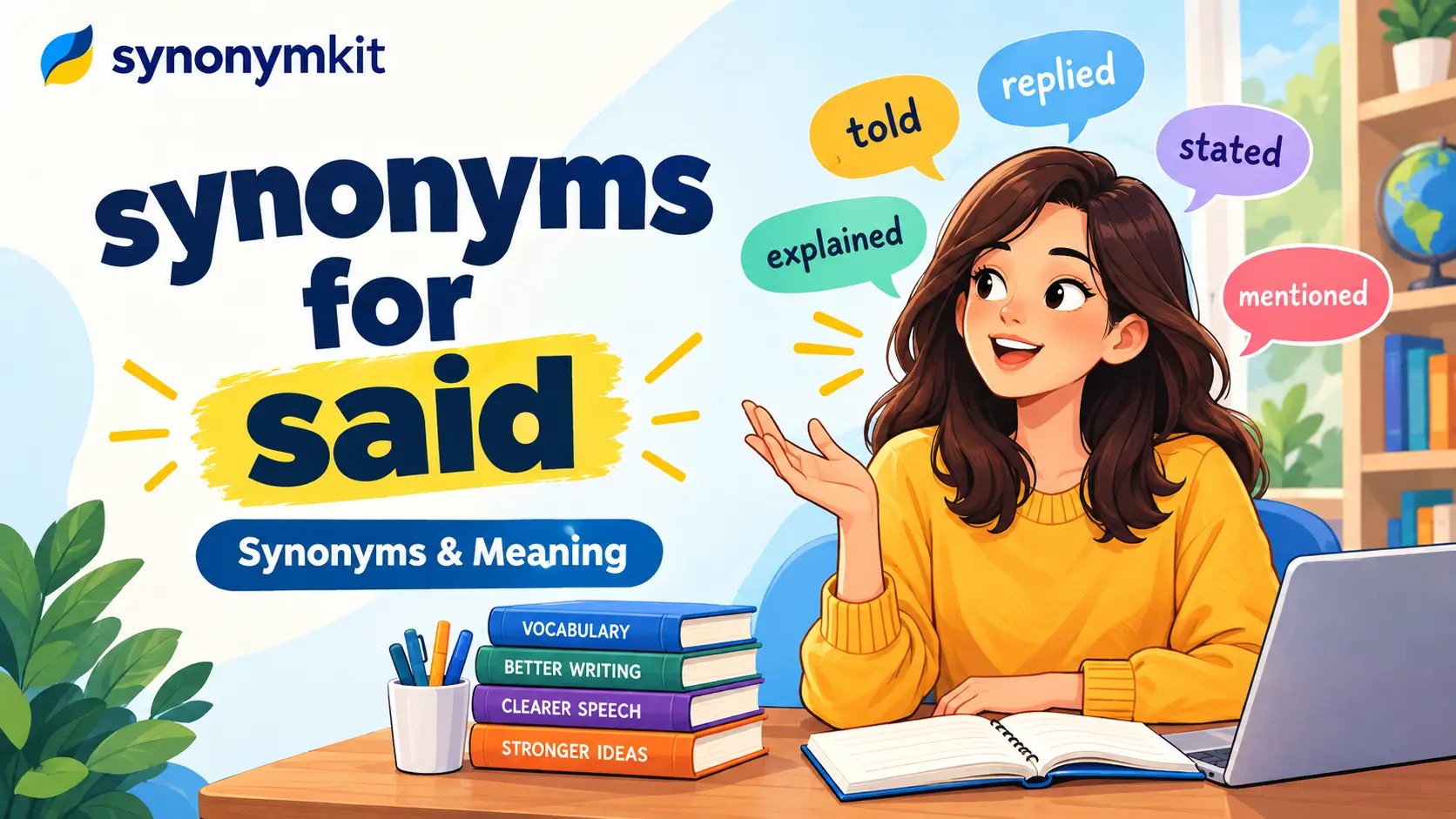
55 Synonyms for Said: Better Words for Speaking and Writing
Common synonyms for said include told, stated, mentioned, replied, answered, explained, asked, whispered, shouted, and announced. The best choice depends on the speaker’s tone, emotion, volume, and purpose. Using different words can make dialogue, stories, essays, emails, and everyday communication clearer and more interesting.
Imagine a story where every character says something, and every line ends with “said.” After a while, the writing can feel flat. A reader may understand the words, but the scene can lose some life.
For example, instead of writing, “I won the game,” Sara said, you could write, “I won the game!” Sara cheered. The second sentence gives the reader a stronger feeling.
Learning alternatives to said helps students make stories clearer. Bloggers can create smoother and more engaging content. Content writers can choose stronger verbs for different situations. Daily English users can also express tone more clearly in messages and conversations.
The goal is not to replace “said” every time. In fact, said is often the best choice. The key is knowing when another word gives useful meaning.
“Words can open doors to new ideas.”
A good vocabulary gives you more ways to show what a person means, feels, or intends.
“The right word can make a simple sentence stronger.”
1. Told
- Meaning: Told means giving information or something important to another person.
- Examples: Mia told me the truth.
Dad told us to wait.
2. Stated
- Meaning: Stated means saying something clearly, directly, or officially.
- Examples: He stated his opinion clearly.
She stated the main reason.
3. Mentioned
- Meaning: Mentioned means talking briefly about someone, something, or an idea.
- Examples: Tom mentioned your new job.
She mentioned the meeting yesterday.
4. Replied
- Meaning: Replied means giving an answer after someone speaks or asks.
- Examples: “Yes,” Anna replied calmly.
“Not today,” he replied.
5. Answered
- Meaning: Answered means responding to a question or request.
- Examples: “I know,” Ben answered.
She answered my question quickly.
6. Explained
- Meaning: Explained means making something easier for someone to understand.
- Examples: Jake explained the problem simply.
She explained how it worked.
7. Asked
- Meaning: Asked means using words to request information or an answer.
- Examples: “Where are you going?” she asked.
He asked about dinner.
8. Whispered
- Meaning: Whispered means speaking very quietly so others cannot easily hear.
- Examples: “Stay here,” Lily whispered softly.
He whispered a secret.
9. Shouted
- Meaning: Shouted means speaking very loudly because of excitement, anger, or distance.
- Examples: “Stop!” Mark shouted loudly.
She shouted across the room.
10. Yelled
- Meaning: Yelled means speaking or calling in a very loud voice.
- Examples: “Come back!” Dad yelled.
She yelled for help.
11. Screamed
- Meaning: Screamed means speaking or crying with a very loud voice.
- Examples: “Watch out!” he screamed.
The child screamed in fear.
12. Cried
- Meaning: Cried means speaking loudly or emotionally, often because of strong feelings.
- Examples: “Please wait!” she cried.
He cried for help.
13. Muttered
- Meaning: Muttered means speaking quietly in a hard to understand way.
- Examples: He muttered something under his breath.
“Fine,” she muttered sadly.
14. Mumbled
- Meaning: Mumbled means speaking unclearly and too quietly for easy understanding.
- Examples: “I am tired,” he mumbled.
She mumbled an unclear answer.
15. Announced
- Meaning: Announced means telling people important news in a clear way.
- Examples: The teacher announced the winner.
Dad announced our travel plans.
16. Declared
- Meaning: Declared means saying something strongly and with confidence.
- Examples: “I will win,” he declared.
She declared her final choice.
17. Reported
- Meaning: Reported means giving information about something that happened.
- Examples: She reported the accident quickly.
He reported what he saw.
18. Remarked
- Meaning: Remarked means making a short comment about something.
- Examples: “That looks nice,” she remarked.
He remarked on the weather.
19. Added
- Meaning: Added means saying something more after giving another statement.
- Examples: “I agree,” she added.
He added one final thought.
20. Continued
- Meaning: Continued means speaking again after a short pause or break.
- Examples: She continued with her story.
He continued explaining the plan.
21. Suggested
- Meaning: Suggested means giving an idea or possible choice.
- Examples: “Try this,” she suggested.
He suggested meeting after lunch.
22. Admitted
- Meaning: Admitted means saying that something is true, often unwillingly.
- Examples: “I broke it,” he admitted.
She admitted her mistake.
23. Confessed
- Meaning: Confessed means honestly telling someone about a secret or wrong action.
- Examples: He confessed the truth.
She confessed that she lied.
24. Argued
- Meaning: Argued means giving reasons to support an opinion or disagree.
- Examples: “That is unfair,” he argued.
She argued against the plan.
25. Claimed
- Meaning: Claimed means saying something is true, especially without proof.
- Examples: He claimed he was innocent.
She claimed the bag was hers.
26. Insisted
- Meaning: Insisted means saying something firmly and refusing to change your view.
- Examples: “I can do it,” he insisted.
She insisted on paying.
27. Promised
- Meaning: Promised means saying that you will certainly do something.
- Examples: “I will return,” he promised.
She promised to help me.
28. Warned
- Meaning: Warned means telling someone about possible danger or trouble.
- Examples: “Be careful,” Dad warned.
She warned him about traffic.
29. Advised
- Meaning: Advised means giving someone helpful information about what to do.
- Examples: “Get some rest,” she advised.
He advised me to wait.
30. Reminded
- Meaning: Reminded means helping someone remember something important.
- Examples: She reminded me about school.
He reminded us to leave early.
31. Requested
- Meaning: Requested means politely asking someone to do something.
- Examples: She requested more time.
He requested a quiet room.
32. Ordered
- Meaning: Ordered means telling someone firmly that they must do something.
- Examples: “Sit down,” the guard ordered.
She ordered him to stop.
33. Demanded
- Meaning: Demanded means asking for something strongly and without accepting refusal.
- Examples: “Tell me now,” he demanded.
She demanded an explanation.
34. Begged
- Meaning: Begged means asking strongly because something feels very important.
- Examples: “Please stay,” she begged.
He begged for another chance.
35. Pleaded
- Meaning: Pleaded means asking earnestly because you feel worried or desperate.
- Examples: “Please help me,” he pleaded.
She pleaded for forgiveness.
36. Complained
- Meaning: Complained means saying that something is wrong or unpleasant.
- Examples: “This is too hard,” he complained.
She complained about the noise.
37. Protested
- Meaning: Protested means strongly saying that you disagree with something.
- Examples: “That is not fair!” she protested.
He protested against the decision.
38. Laughed
- Meaning: Laughed means speaking while showing amusement or happiness through laughter.
- Examples: “That was funny,” she laughed.
He laughed at the joke.
39. Joked
- Meaning: Joked means saying something funny for amusement.
- Examples: “You owe me lunch,” he joked.
She joked about being late.
40. Teased
- Meaning: Teased means saying something playful to make someone laugh.
- Examples: “You are so slow,” he teased.
She teased her brother kindly.
41. Groaned
- Meaning: Groaned means speaking with a low sound showing pain, annoyance, or tiredness.
- Examples: “Not another test,” he groaned.
She groaned after hearing that.
42. Sighed
- Meaning: Sighed means speaking after making a long breath from emotion.
- Examples: “I am tired,” she sighed.
He sighed before answering.
43. Gasped
- Meaning: Gasped means speaking suddenly after surprise, fear, or shock.
- Examples: “You won!” she gasped.
He gasped at the news.
44. Exclaimed
- Meaning: Exclaimed means saying something with strong excitement, surprise, or emotion.
- Examples: “What a view!” she exclaimed.
He exclaimed with delight.
45. Cheerfully Said
- Meaning: Cheerfully said shows that someone speaks with a happy and friendly mood.
- Examples: “Good morning!” she cheerfully said.
He cheerfully said hello.
46. Happily Said
- Meaning: Happily said shows that someone speaks while feeling pleased or joyful.
- Examples: “We won!” she happily said.
He happily said yes.
47. Softly Said
- Meaning: Softly said shows that someone uses a gentle, quiet voice.
- Examples: “It is okay,” she softly said.
He softly said goodbye.
48. Calmly Said
- Meaning: Calmly said shows that someone speaks without anger, fear, or excitement.
- Examples: “Please sit down,” she calmly said.
He calmly said the truth.
49. Angrily Said
- Meaning: Angrily said shows that someone speaks while feeling strong anger.
- Examples: “Leave me alone,” he angrily said.
She angrily said no.
50. Sadly Said
- Meaning: Sadly said shows that someone speaks while feeling unhappy or hurt.
- Examples: “I miss you,” she sadly said.
He sadly said goodbye.
51. Excitedly Said
- Meaning: Excitedly said shows that someone speaks with strong happiness or excitement.
- Examples: “We are going!” she excitedly said.
He excitedly said the news.
52. Quietly Said
- Meaning: Quietly said shows that someone speaks in a low, gentle voice.
- Examples: “Come with me,” she quietly said.
He quietly said okay.
53. Formally Said
- Meaning: Formally said shows that someone uses careful language in a serious setting.
- Examples: “We accept,” the manager formally said.
She formally said goodbye.
54. Openly Said
- Meaning: Openly said means sharing thoughts clearly without trying to hide them.
- Examples: She openly said what she wanted.
He openly said he disagreed.
55. Clearly Said
- Meaning: Clearly said means expressing something in a way that people easily understand.
- Examples: She clearly said her name.
He clearly said what happened.
“Strong writing is often about choosing simple words well.”
Synonyms for said in dialogue
Dialogue needs words that help readers understand how characters speak. Replied, asked, whispered, shouted, muttered, and exclaimed can show different actions or emotions. Still, “said” remains useful because it does not distract from the conversation.
Choose a stronger verb when it adds important information about the speaker’s voice, feeling, or action.
Synonyms for said in writing
In essays and formal writing, useful choices include stated, explained, reported, mentioned, argued, noted, declared, and suggested. The best option depends on the source and purpose.
For academic work, choose precise words instead of emotional dialogue verbs. This makes your writing sound clear, controlled, and professional.
Synonyms for said angrily
When a person speaks with anger, words such as shouted, yelled, demanded, protested, argued, insisted, and snapped can work well. These words give readers a stronger picture of the scene. However, use them carefully.
If the character is only slightly annoyed, “said angrily” may be more accurate than “screamed.”
Synonyms for said happily
For happy speech, writers can use cheered, exclaimed, laughed, joked, celebrated, or happily said. These choices can make a scene feel warmer and more active. Pick a word that matches the strength of the emotion.
Someone who is quietly pleased should not sound as if they are shouting with excitement.
Synonyms for said quietly
Words such as whispered, murmured, muttered, mumbled, quietly said, and softly said can describe quiet speech. They are not exactly the same. A whisper is very quiet, while a mumble may be unclear.
Choose the word that shows both the speaker’s volume and the way the words are delivered.
Frequently Asked Questions
What can I say instead of “said”?
You can use told, stated, replied, answered, explained, mentioned, asked, whispered, shouted, announced, admitted, warned, suggested, or declared. The right choice depends on the situation.
For example, use “whispered” for very quiet speech and “demanded” for a strong request. In many cases, however, “said” is still the clearest and most natural choice.
How to say “said” in a formal way?
For formal writing, use words such as stated, reported, explained, noted, declared, confirmed, mentioned, or argued. The best word depends on the meaning. “Stated” works well for a clear opinion, while “reported” fits information about an event.
In academic writing, avoid replacing “said” with a dramatic word unless that word truly matches the speaker’s action.
What is the powerful verb for said?
There is no single powerful verb that works in every sentence. Declared, demanded, insisted, argued, proclaimed, and announced can sound stronger than “said” when the situation supports them. For example, “I will never give up,” she declared, shows confidence.
The important rule is to choose a verb that adds meaning rather than using a stronger word just to sound impressive.
What are 300 different ways to say “said”?
English has hundreds of ways to replace or describe “said,” but not all are true synonyms. Useful choices include told, stated, replied, answered, explained, asked, whispered, shouted, admitted, argued, insisted, warned, announced, joked, and exclaimed. Many others describe tone or emotion rather than the act of speaking itself.
Good writing focuses on accuracy instead of simply collecting the largest number of alternatives.
Conclusion
Learning synonyms for said gives you more control over your writing and speaking. Instead of using the same word again and again, you can choose a word that shows the speaker’s tone, feeling, purpose, or volume.
For students, these words can make stories and essays more interesting. Bloggers and content writers can use them to create smoother articles and stronger examples. In everyday communication, better word choices can help you explain ideas and feelings more clearly.
You do not need to remove “said” from your writing. It is a simple and useful word. The real skill is knowing when another word gives the reader more information.
Start by practicing five or ten alternatives. Try using them in an email, school assignment, short story, or daily conversation. Then notice how each word changes the feeling of a sentence.
Vocabulary grows through regular use. The more you practice, the easier it becomes to choose the right word naturally.
“Every new word gives you another way to express yourself.”
Keep these alternatives nearby when you write. With practice, your sentences can become clearer, more natural, and more expressive.
“Good communication begins with words that fit the moment.”

James is a former English teacher turned content strategist who’s passionate about making language learning less intimidating. At SynonymKit, he focuses on curating word lists that are practical for everyday writing, essays, and professional communication.