

50 Synonyms for Pride (With Meanings & Examples)
A synonym for pride is a word that means almost the same thing. Good synonyms for pride are dignity, self respect, satisfaction, and honor. Some synonyms show a bad kind of pride too, like vanity, arrogance, and conceit.
You can pick the word that best fits the feeling you want to describe.
Sarah stood outside the classroom door, holding her son’s science trophy. Her chest felt tight, and a small smile would not leave her face.
Maybe you are proud of finishing a hard project at work. Maybe you feel proud of your team, your family, or your own hard effort. English gives us dozens of words for that feeling, and each one carries its own shade of meaning.
Students, learning these words builds a stronger vocabulary for essays and exams. For bloggers, fresh synonyms keep writing from sounding repetitive and dull.
For content writers, the right word choice makes copy sharper and far more persuasive. Daily English users, new synonyms make everyday talk feel more natural and expressive.
“Pride goeth before destruction, and a haughty spirit before a fall.” Old Proverb
That old warning still holds true today. Pride can lift us up, or it can trip us if we let it grow too big.
“Pride is the never failing vice of fools.” Alexander Pope
Keep that thought in mind as we explore fifty powerful synonyms for pride, from gentle self respect to bold arrogance.
It is a whole family of feelings, some warm and healthy, some cold and unhelpful.
“Pride is the crown of the virtues.” Aristotle
With that balance in mind, here are fifty words that capture every shade of pride, from quiet dignity to loud boastfulness.
50 Synonyms for Pride
1. Self respect
- Meaning: A feeling that you deserve care and good treatment.
- Examples: She kept her self respect during the hard interview. He walked away with quiet self respect.
2. Dignity
- Meaning: Calm, honorable behavior that shows you value yourself.
- Examples: The old man spoke with great dignity. She lost the game with real dignity.
3. Self esteem
- Meaning: How much you value and believe in yourself.
- Examples: Sports helped build her strong self esteem. His self esteem grew after that speech.
4. Honor
- Meaning: Deep respect earned by doing what is right.
- Examples: The soldier fought with great honor. He kept his family’s honor intact.
5. Self worth
- Meaning: The sense that you matter and have value.
- Examples: Therapy helped him find his self worth. Her self worth grew after graduation day.
6. Satisfaction
- Meaning: A happy feeling when something turns out well.
- Examples: She felt satisfaction after finishing the marathon. He smiled with quiet satisfaction today.
7. Confidence
- Meaning: A strong belief in your own skills and abilities.
- Examples: Practice gave her real confidence on stage. His confidence grew with every match.
8. Vanity
- Meaning: Too much focus on your own looks or importance.
- Examples: His vanity made him check every mirror. Her vanity annoyed most of her friends.
9. Arrogance
- Meaning: Acting like you are better than everyone else.
- Examples: His arrogance pushed away most of his friends. Nobody liked her constant arrogance at work.
10. Conceit
- Meaning: A strong, unfair belief that you are important.
- Examples: His conceit showed in every single sentence. She hid her conceit behind fake smiles.
11. Egotism
- Meaning: Talking or thinking mostly about yourself and success.
- Examples: His egotism filled every conversation at dinner. Her egotism grew after the big win.
12. Haughtiness
- Meaning: A cold, proud manner that looks down on others.
- Examples: Her haughtiness made new coworkers feel small. He answered with a haughtiness nobody liked.
13. Smugness
- Meaning: A pleased look that shows you feel very superior.
- Examples: His smugness showed after winning the debate. She wiped the smugness off her face.
14. Self importance
- Meaning: Believing your opinions matter more than others’ opinions.
- Examples: His self importance grew after the promotion. Nobody enjoyed her constant self importance at meetings.
15. Superiority
- Meaning: A feeling that you are better than other people.
- Examples: His superiority annoyed the entire study group. She spoke with quiet superiority all night.
16. Boastfulness
- Meaning: Talking too proudly and too often about success.
- Examples: His boastfulness got old after the first minute. Her boastfulness scared off several new friends.
17. Snobbery
- Meaning: Looking down on people who seem less important.
- Examples: His snobbery showed at the fancy dinner party. Her snobbery made the new intern nervous.
18. Hubris
- Meaning: Extreme pride that often leads to a mistake.
- Examples: His hubris caused the whole plan to fail. Ancient stories often warn against dangerous hubris.
19. Pomposity
- Meaning: A showy, self important way of speaking or acting.
- Examples: His pomposity filled the entire staff meeting. She rolled her eyes at his pomposity.
20. Disdain
- Meaning: A feeling that something is not worth respect.
- Examples: She looked at the mess with open disdain. His disdain for rules caused constant trouble.
21. Condescension
- Meaning: Talking down to people as if they know less.
- Examples: His condescension made the new hire feel small. She hated his condescension during the meeting.
22. Self admiration
- Meaning: Looking at your own actions with great pleasure.
- Examples: His self admiration showed in every selfie taken. Her self admiration grew after the award ceremony.
23. Narcissism
- Meaning: Loving yourself so much others barely seem to matter.
- Examples: His narcissism made teamwork almost impossible sometimes. Her narcissism showed in endless mirror selfies.
24. Cockiness
- Meaning: Showing too much confidence in a bold, careless way.
- Examples: His cockiness before the exam worried his teacher. Her cockiness faded after the tough loss.
25. Bravado
- Meaning: A bold, confident show that hides real fear.
- Examples: He walked in with loud, confident bravado. Her bravado covered how nervous she felt.
26. Swagger
- Meaning: A confident, proud way of walking or acting.
- Examples: He entered the room with a cool swagger. Her swagger returned after the big win.
27. Glory
- Meaning: Great honor and praise earned through an achievement.
- Examples: The team celebrated their hard earned glory together. She basked in the glory of victory.
28. Triumph
- Meaning: A great joy felt after winning something important.
- Examples: Her triumph brought tears to her eyes. The whole town celebrated the team’s triumph.
29. Fulfillment
- Meaning: A deep, happy feeling after reaching a goal.
- Examples: Finishing the book gave her real fulfillment. He found fulfillment in helping his students.
30. Gratification
- Meaning: A pleasant feeling of pride after doing well.
- Examples: She felt gratification after the difficult presentation ended. His gratification grew with every kind comment.
31. Delight
- Meaning: A strong feeling of happiness and pride together.
- Examples: Her face lit up with pure delight. He watched his daughter graduate with delight.
32. Joy
- Meaning: A deep, warm happiness that pride can bring.
- Examples: Winning the award filled her with joy. His son’s success brought him real joy.
33. Elation
- Meaning: A strong, excited feeling of happy, proud energy.
- Examples: Elation filled the room after the announcement. She felt elation crossing the finish line.
34. Self satisfaction
- Meaning: A calm, pleased feeling about your own good work.
- Examples: He smiled with quiet self satisfaction after class. Her self satisfaction grew after the clean kitchen.
35. Self glorification
- Meaning: Praising yourself loudly for your own achievements.
- Examples: His self glorification filled every single interview given. She avoided self glorification during the award speech.
36. Elitism
- Meaning: The belief that some people deserve special treatment.
- Examples: His elitism showed at the expensive private club. Her elitism made new members feel unwelcome.
37. Presumption
- Meaning: An overconfident belief you already deserve something special.
- Examples: His presumption about the promotion surprised the whole office. Her presumption made the request feel rude.
38. Pretension
- Meaning: Acting more important or fancy than you really are.
- Examples: His pretension showed in every fancy word choice. She dropped the pretension once friends arrived.
39. Ostentation
- Meaning: Showing off wealth or success in a loud way.
- Examples: His ostentation filled the driveway with shiny cars. Her ostentation embarrassed most of the guests.
40. Grandiosity
- Meaning: An exaggerated sense of your own importance or plans.
- Examples: His grandiosity showed in every business pitch made. Her grandiosity grew with each social post.
41. Self conceit
- Meaning: An unfair, overly high opinion of your own value.
- Examples: His self conceit blocked every piece of feedback given. Her self conceit surprised old friends from school.
42. Self love
- Meaning: Caring about and valuing yourself in a healthy way.
- Examples: Therapy taught her real, gentle self love. His self love grew after quitting that job.
43. Vainglory
- Meaning: Excessive pride shown through boasting about small wins.
- Examples: His vainglory filled every casual conversation lately. She avoided vainglory despite her big win.
44. Complacency
- Meaning: Feeling too pleased and comfortable with current success.
- Examples: His complacency led to a surprising, quick loss. Her complacency slowed the whole team down.
45. Self congratulation
- Meaning: Praising yourself for something you did well recently.
- Examples: His self congratulation filled the group chat instantly. She kept her self congratulation short and simple.
46. Panache
- Meaning: A stylish, confident way of doing something impressive.
- Examples: He finished the speech with real panache. Her outfit showed panache at the gala.
47. Chutzpah
- Meaning: Bold, confident nerve that can seem a bit rude.
- Examples: It took real chutzpah to ask that question. Her chutzpah impressed even the strict manager.
48. Mettle
- Meaning: Inner strength and courage shown during tough moments.
- Examples: The climb tested every ounce of mettle. She showed her mettle during the storm.
49. Amour propre
- Meaning: A French term for self respect and personal dignity.
- Examples: His amour propre would not allow that insult. Her amour propre grew after the promotion news.
50. Self regard
- Meaning: The general respect and opinion you hold for yourself.
- Examples: Healthy self regard helped her set firm boundaries. His self regard suffered after the tough breakup.
Words Related to “Pride and Joy”
The phrase “pride and joy” describes a person, thing, or achievement that gives you great happiness and makes you feel proud. It is often used for children, family members, personal achievements, pets, or something you have worked hard to create.
Here are some useful words and phrases related to “pride and joy”:
| Word or Phrase | Meaning | Example |
|---|---|---|
| Cherished | Loved and valued deeply | Her daughter is her most cherished person. |
| Beloved | Loved very much | His dog is a beloved member of the family. |
| Treasured | Considered very valuable and special | The old photo is a treasured memory. |
| Delight | Something that gives great happiness | Her new baby is a source of delight. |
| Happiness | A feeling of joy and pleasure | His success brought great happiness to his family. |
| Joy | A strong feeling of happiness | Her children are her greatest joy. |
| Accomplishment | Something achieved through effort | Winning the award was a major accomplishment. |
| Achievement | Something successfully completed or gained | Graduating from college was his proudest achievement. |
| Source of pride | Something that makes you feel proud | Her students are a source of pride for their teacher. |
| Source of joy | Someone or something that brings happiness | Her garden has become a wonderful source of joy. |
Examples of “Pride and Joy”
- My daughter is my pride and joy.
- His new business became his pride and joy.
- The championship trophy was the team’s pride and joy.
- Her garden is her pride and joy.
In short, “pride and joy” can be connected with words such as cherished, beloved, treasured, delight, happiness, achievement, accomplishment, and source of pride. The best choice depends on whether you want to emphasize love, happiness, or a sense of achievement.
When something makes you both happy and proud, plain “pride” can feel flat. Try delight, joy, elation, or triumph instead. A parent might feel delight watching a child’s first steps, while a coach might feel triumph after a championship win.
These warmer words capture the mix of happiness and satisfaction that “pride and joy” usually describes, making your writing feel far more alive and specific.
Synonyms for Pride in Work
Feeling proud of your job well done deserves better words than a tired “pride.” Reach for satisfaction, fulfillment, gratification, or self respect. A designer might describe deep satisfaction after finishing a project on time.
A teacher might feel fulfillment watching students succeed. These synonyms show genuine, earned pride in effort and skill, without sounding boastful or repetitive across your resume, cover letter, or blog content.
Pride Synonym Slang

A pride synonym slang is usually more casual and expressive than a formal synonym. Depending on the situation, words such as swagger, cockiness, flex, big-headedness, and ego can describe a proud attitude in informal speech.
For example, someone might say that a person has a lot of swagger when they act confidently and stylishly. Cockiness suggests too much confidence, while ego can describe an inflated sense of self-importance. Slang choices can vary by region and situation, so use them mainly in casual conversation, dialogue, or informal writing.
Synonyms for Pride Myself
When you want alternatives to “pride myself,” the best phrase depends on the sentence. You can use take satisfaction in, value, appreciate, excel at, be proud of, or take care in.
For example:
- I pride myself on my writing → I take satisfaction in my writing.
- I pride myself on being reliable → I value being reliable.
- I pride myself on my work → I take great care in my work.
- I pride myself on helping others → I find fulfillment in helping others.
These alternatives make your writing more natural while keeping the meaning of personal satisfaction or confidence.
Synonyms for Pride and Arrogance
Pride and arrogance sit close together, but arrogance always feels colder and less likeable. Words like conceit, haughtiness, superiority, and condescension describe that unpleasant, self centered version of pride.
Someone who constantly interrupts to talk about themselves shows egotism. A manager who dismisses every idea shows condescension.
These synonyms help writers clearly separate healthy confidence from the kind of pride that pushes other people away.
Positive Synonyms for Pride

Not all pride is negative. Healthy, positive pride sounds like dignity, self respect, self esteem, honor, and self worth. These words describe a calm, grounded confidence rather than showing off.
Describing someone who acts too proud needs sharper, more specific words than “prideful.” Try arrogant, conceited, smug, haughty, or self-absorbed as adjectives, or describe them using nouns like egotist or snob. A coworker who brags about every small win might be called smug. A classmate who ignores others’ feelings might seem self-absorbed. Choosing the right word makes character descriptions in stories, reviews, or essays feel sharper and clearer
Positive vs. Negative Synonyms for Pride
| Type | Synonym | Meaning |
|---|---|---|
| Positive | Dignity | A calm sense of self-respect |
| Positive | Self-respect | Respect and value for yourself |
| Positive | Self-esteem | Belief in your own value and abilities |
| Positive | Satisfaction | Pleasure from doing something well |
| Positive | Honor | Respect connected with good actions |
| Positive | Fulfillment | A deep feeling from achieving something meaningful |
| Negative | Arrogance | Believing you are better than others |
| Negative | Conceit | An excessive opinion of your own importance |
| Negative | Vanity | Excessive pride in your appearance or importance |
| Negative | Haughtiness | Acting as though you are better than others |
| Negative | Smugness | Being too pleased with yourself |
| Negative | Egotism | Excessive focus on yourself and your achievements |
Synonyms for Prideful Person
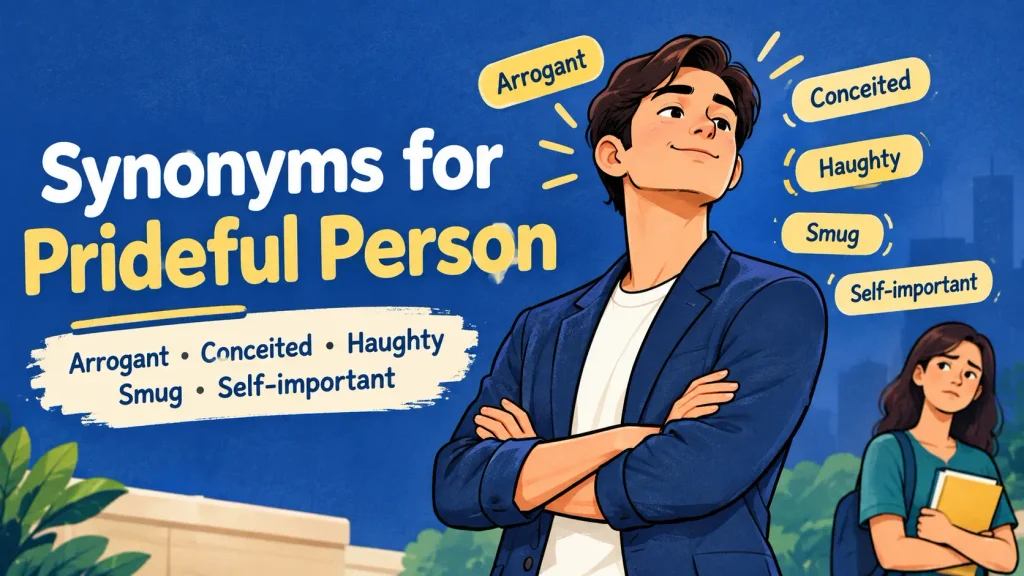
Describing someone who acts too proud needs sharper, more specific words than “prideful.” Try arrogant, conceited, smug, haughty, or self absorbed as adjectives, or describe them using nouns like egotist or snob. A coworker who brags about every small win might be called smug. A classmate who ignores others’ feelings might seem self absorbed. Choosing the right word makes character descriptions in stories, reviews, or essays feel sharper and clearer.
Choosing the right word makes character descriptions in stories, reviews, or essays feel sharper and clearer.
Pride Antonyms
The main pride antonyms are words that show humility, modesty, or a lack of excessive self-importance. Common antonyms include humility, modesty, meekness, selflessness, unpretentiousness, and diffidence.
Humility means having a modest view of your own importance. Modesty suggests that you do not boast about your abilities or achievements. Selflessness focuses more on other people than on yourself.
For example, “His pride made him boast about his success” has a different meaning from “His humility made him grateful for the opportunity.” Choose the antonym that best matches the kind of behavior or attitude you want to describe.
When comparing pride synonyms and antonyms, remember that synonyms can describe different shades of pride, while antonyms move toward humility or modesty. Positive synonyms include dignity, honor, self respect, and satisfaction, while negative synonyms include arrogance, vanity, and conceit. Common antonyms include humility and modesty.
FAQ People Also Ask
What is another word for pride?
Common alternatives include dignity, in emotional respect, honor, and satisfaction for the positive kind of pride. For the negative kind, try arrogance, conceit, or vanity. The best word depends on your meaning.
Are you describing a healthy sense of self worth, or a boastful, unpleasant attitude? Picking the right synonym keeps your writing accurate, natural, and far more interesting than repeating “pride” over and over in the same paragraph.
What is a better word than pride?
“Better” depends on context and tone. For formal writing, dignity or self respect often sound more professional than plain “pride.” Emotional writing, fulfillment or satisfaction capture warmth and depth.
For describing a flaw, arrogance or conceit work better than a vague “too much pride.” Always match the synonym to the feeling and setting of your sentence for the clearest, most natural result.
What can I say instead of take pride?
Instead of “take pride in,” try expressions like feel satisfaction in, take joy in, find fulfillment in, or hold yourself with dignity about. For example, “She takes pride in her garden” could become “She finds real satisfaction in her garden” or “She feels fulfillment tending her garden.”
These small swaps keep repeated phrases fresh across blog posts, essays, and everyday conversation.
What is a positive word for pride?
Strong positive choices include dignity, self respect, self esteem, honor, and self worth. These words all describe a calm, healthy sense of value without sounding boastful or unkind. Unlike words such as arrogance or conceit, they focus on quiet confidence rather than showing off.
Use them when praising someone’s character, effort, or achievements in a warm, respectful, and genuinely encouraging way.
What is the difference between pride and confidence?
Pride is a feeling of satisfaction or pleasure in your achievements, qualities, or the achievements of someone you care about. Confidence is the belief that you can do something well. Pride usually comes from something you have achieved, while confidence helps you take action and face challenges. For example, you may feel pride after winning a competition, but confidence helps you believe you can win it.
Conclusion
Learning synonyms for pride does more than fill up a word list. It sharpens how you write, speak, and connect with other people every single day. A stronger vocabulary helps students write clearer essays, helps bloggers avoid dull repetition, and helps content writers craft copy that actually holds atention.
Even in daiy conversation, the right word can turn a flat sentence into one that truly captures how you feel.
Try using a new synonym this week. Swap “proud” for fulfilled in an email, or describe a friend’s dignity instead of just saying they handled things well.
“Pride is increased by ignorance.” Alexander Pope
That line is a helpful reminder to stay humble even while learning new, powerful words.
“Self respect is the root of discipline.” Confucius
Keep practicing, keep reading, and keep choosing words that truly fit the feeling behind them. Your writing, and your confidence, will both grow stronger with every new word you learn.

James is a former English teacher turned content strategist who’s passionate about making language learning less intimidating. At SynonymKit, he focuses on curating word lists that are practical for everyday writing, essays, and professional communication.