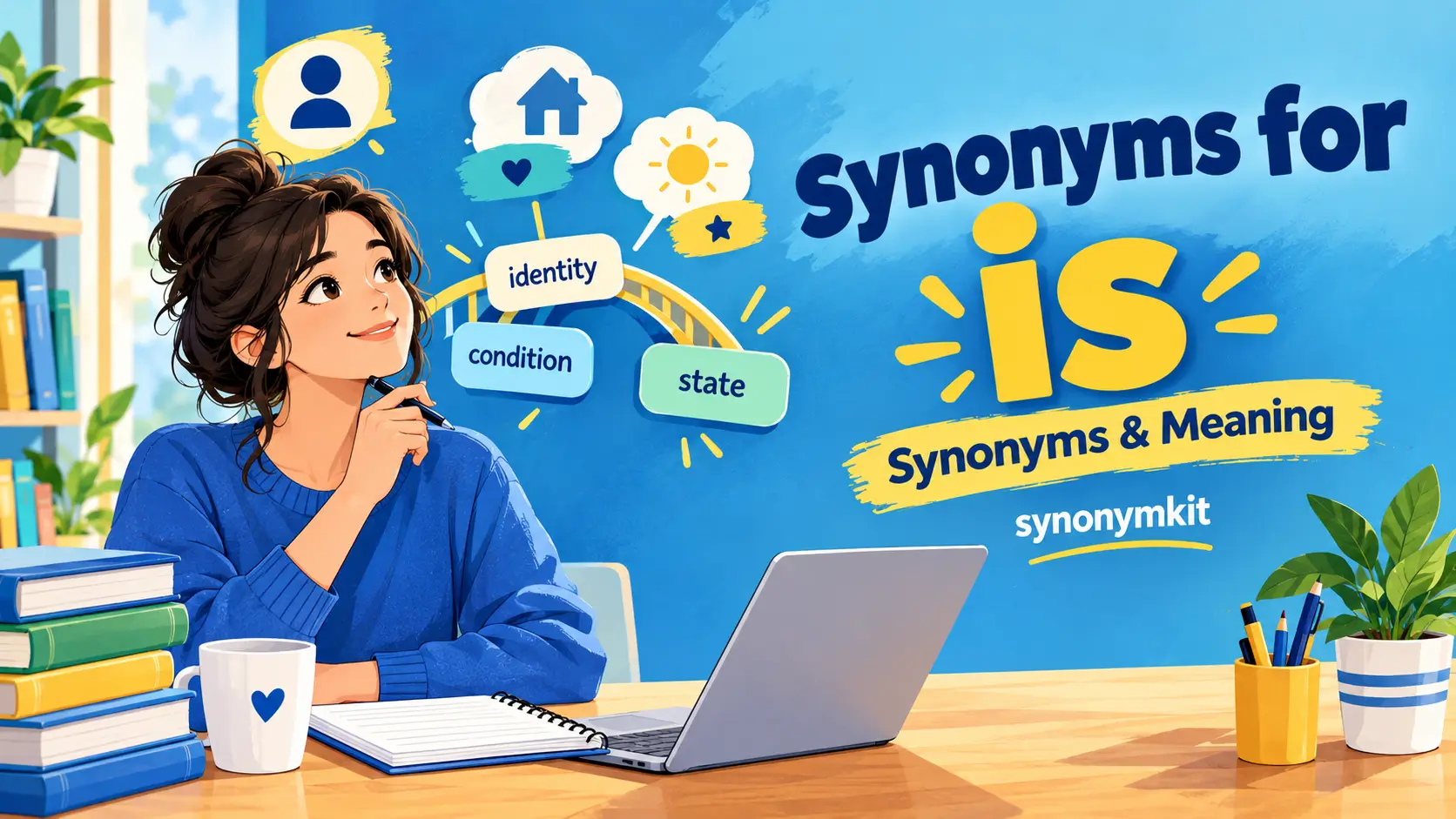
50 Synonyms for “Is” to Make Your English Clearer
Common alternatives to “is” include equals, means, exists, remains, stands, and becomes. The best choice depends on the sentence and meaning. These words can show identity, condition, location, change, or existence while helping writers avoid repeating “is” too often in essays, articles, emails, and everyday English.
Imagine reading a short paragraph where almost every sentence uses the word “is.” The writing may be correct, but it can soon sound flat. A small change can make the same idea feel clearer and more natural.
For example, instead of saying, “The result is a success,” you might say, “The result proves successful.” The right replacement depends on what you want the sentence to show.
Learning alternatives to “is” can help students make essays more varied. Bloggers can use them to make posts smoother.
Content writers can choose words that fit each sentence. Daily English users can make conversations sound more natural.
“Clear words help simple ideas travel farther.”
Good word choice does not mean replacing “is” every time. Sometimes is is still the best and clearest word. The goal is to understand your choices and use each one correctly.
“Strong writing grows from small choices made well.”
50 Synonyms and Alternatives for “Is”
1. Equals
- Meaning: Equals shows that two values, amounts, or ideas are the same.
- Examples: Two plus two equals four exactly.
One dollar equals one hundred cents.
2. Means
- Meaning: Means explains what a word, sign, action, or idea represents.
- Examples: This red light means stop now.
Her smile means she feels happy.
3. Exists
- Meaning: Exists shows that someone or something is real or present.
- Examples: A solution exists for this problem.
Hope exists even during hard times.
4. Remains
- Meaning: Remains shows that something continues in the same state.
- Examples: The door remains open all night.
Her answer remains the same today.
5. Stands
- Meaning: Stands can describe a position, condition, or current situation.
- Examples: The old house stands near town.
His record stands after many years.
6. Becomes
- Meaning: Becomes shows that someone or something changes into another state.
- Examples: The sky becomes dark before sunset.
Practice becomes easier with time.
7. Seems
- Meaning: Seems shows how something appears without claiming complete certainty.
- Examples: The answer seems correct to me.
She seems ready for school.
8. Appears
- Meaning: Appears shows that something looks true, visible, or present.
- Examples: The moon appears bright tonight.
He appears calm during meetings.
9. Represents
- Meaning: Represents shows that something stands for another person, idea, or thing.
- Examples: The dove represents peace worldwide.
This symbol represents our school.
10. Signifies
- Meaning: Signifies means that something clearly shows or points to another meaning.
- Examples: A bell signifies the class ending.
Red signifies danger in many places.
11. Indicates
- Meaning: Indicates means that something gives information about another fact or condition.
- Examples: The arrow indicates the correct direction.
Her face indicates some surprise.
12. Denotes
- Meaning: Denotes means that something officially or clearly means something else.
- Examples: This mark denotes a special note.
The star denotes an important item.
13. Defines
- Meaning: Defines explains the exact meaning or nature of something.
- Examples: This rule defines proper online behavior.
The term defines a clear process.
14. Describes
- Meaning: Describes tells what someone or something looks like or involves.
- Examples: The sentence describes her new home.
This word describes a quiet person.
15. Reflects
- Meaning: Reflects shows a quality, feeling, condition, or situation clearly.
- Examples: Her work reflects great care.
His answer reflects deep thought.
16. Suggests
- Meaning: Suggests gives an idea without stating something as completely certain.
- Examples: His tone suggests some concern.
The evidence suggests a simple answer.
17. Shows
- Meaning: Shows tells or makes a fact, quality, or condition clear.
- Examples: Her work shows real progress.
The chart shows strong growth.
18. Proves
- Meaning: Proves provides strong evidence that something is true or correct.
- Examples: The test proves the answer correct.
Her actions prove her true care.
19. Indicates That
- Meaning: Indicates that introduces information supported by signs, facts, or evidence.
- Examples: The report indicates that sales increased.
His actions indicate that he cares.
20. Occurs
- Meaning: Occurs means that an event happens at a certain time or place.
- Examples: The meeting occurs every Friday.
This event occurs during winter.
21. Happens
- Meaning: Happens means that an event takes place or comes about.
- Examples: The change happens very quickly.
This problem happens quite often.
22. Takes Place
- Meaning: Takes place means that an event happens in a particular setting.
- Examples: The festival takes place downtown.
The meeting takes place tomorrow morning.
23. Lies
- Meaning: Lies describes where something is located or positioned.
- Examples: The village lies beside the river.
The answer lies within this section.
24. Sits
- Meaning: Sits describes something located or positioned in a particular place.
- Examples: The cafe sits near campus.
Her house sits beside ours.
25. Rests
- Meaning: Rests describes something positioned quietly on or against another surface.
- Examples: The book rests on my desk.
His hand rests beside mine.
26. Contains
- Meaning: Contains means that something has another thing inside it.
- Examples: This box contains several old letters.
The recipe contains fresh vegetables.
27. Includes
- Meaning: Includes means that something has another item as part of it.
- Examples: The price includes free delivery.
The course includes weekly practice tasks.
28. Holds
- Meaning: Holds means that something keeps, carries, or has something inside.
- Examples: This bag holds many books.
The bottle holds enough water.
29. Has
- Meaning: Has shows possession, features, qualities, or something connected to another thing.
- Examples: The room has two windows.
She has a friendly voice.
30. Features
- Meaning: Features means that something contains or presents an important person, thing, or quality.
- Examples: The article features helpful writing tips.
The cover features a young student.
31. Offers
- Meaning: Offers shows that something provides a useful thing, service, or opportunity.
- Examples: The course offers useful practice.
This plan offers better value.
32. Provides
- Meaning: Provides means that something gives or supplies something useful.
- Examples: The guide provides simple examples.
This website provides free lessons.
33. Gives
- Meaning: Gives means that someone or something supplies, presents, or provides something.
- Examples: This book gives clear advice.
Her answer gives useful information.
34. Brings
- Meaning: Brings shows that something causes or carries a result, feeling, or change.
- Examples: Exercise brings many health benefits.
Her kindness brings people together.
35. Creates
- Meaning: Creates means that someone or something makes something new happen.
- Examples: Good planning creates better results.
Music creates a calm mood.
36. Causes
- Meaning: Causes means that something makes another event, condition, or result happen.
- Examples: Heavy rain causes road delays.
Stress causes many sleep problems.
37. Leads To
- Meaning: Leads to shows that one thing results in another thing.
- Examples: Practice leads to better skills.
Hard work leads to success.
38. Results In
- Meaning: Results in shows that something produces a particular outcome.
- Examples: Careful planning results in fewer mistakes.
Exercise results in greater strength.
39. Makes
- Meaning: Makes shows that someone or something causes a particular state or result.
- Examples: Sunshine makes the room brighter.
Kind words make people feel valued.
40. Forms
- Meaning: Forms means that something creates or becomes a particular shape or structure.
- Examples: Ice forms during cold nights.
These ideas form one clear plan.
41. Builds
- Meaning: Builds means that something develops or strengthens gradually over time.
- Examples: Practice builds strong writing skills.
Trust builds through honest actions.
42. Develops
- Meaning: Develops shows that something grows, changes, or becomes stronger over time.
- Examples: Her confidence develops with practice.
The story develops slowly afterward.
43. Turns Into
- Meaning: Turns into shows that someone or something changes into another form.
- Examples: The caterpillar turns into a butterfly.
Small efforts turn into great results.
44. Changes Into
- Meaning: Changes into describes movement from one form, state, or condition to another.
- Examples: Water changes into ice.
Fear changes into confidence.
45. Becomes Known As
- Meaning: Becomes known as shows that someone or something gains a particular name.
- Examples: The place becomes known as home.
He becomes known as a leader.
46. Belongs To
- Meaning: Belongs to shows ownership or connection with a person, group, or place.
- Examples: This book belongs to Sara.
The land belongs to our family.
47. Consists Of
- Meaning: Consists of explains what parts or items make up something.
- Examples: The team consists of five players.
The meal consists of fresh foods.
48. Is Made Of
- Meaning: Is made of tells what material physically forms something.
- Examples: The table is made of wood.
This bowl is made of glass.
49. Stays
- Meaning: Stays means that someone or something continues in the same place or condition.
- Examples: The shop stays open late.
She stays calm under pressure.
50. Continues To Be
- Meaning: Continues to be shows that a state remains true over time.
- Examples: The area continues to be popular.
He continues to be helpful.
“The best synonym is the word that fits the meaning.”
Synonyms for Is Not
When you need alternatives to “is not,” the best choice depends on the meaning. Words such as isn’t, remains absent, lacks, differs, fails to be, or does not represent can work in different situations.
However, they are not always exact replacements. Always check if you mean absence, disagreement, difference, or a negative condition.
Synonyms for Is Used
The phrase “is used” can often be replaced with serves, functions as, helps, applies to, supports, or operates as. These alternatives can make technical and educational writing more specific.
For example, “This tool is used for editing” can become “This tool serves as an editing aid.” The best option depends on what the subject actually does.
Synonyms for Is Like
For “is like,” alternatives include resembles, compares to, looks like, reminds you of, and is similar to. These choices help you describe similarities more clearly.
“The building is like a castle” could become “The building resembles a castle.” Use resembles when you want a succinct and direct comparison.
Synonyms for Is Important
Instead of repeating “is important,” you can utilize phrases such as matters, is valuable, is essential, is vital, or plays a key role. Each choice has a slightly different strength. Matters sounds natural in daily English, while essential is a stronger choice for formal writing.
Synonyms for Is Responsible for
When “is responsible for” means causing something, alternatives include causes, leads to, produces, creates, and results in. When it means having a duty, alternatives include handles, manages, oversees, or takes care of.
Choose the replacement based on if you mean cause or duty, because these meanings are different.
Frequently Asked Questions
What to say instead of “is”?
You can replace “is” with different words when the sentence has a more specific meaning. For example, exists can describe presence, equals can show two things are the same, becomes can show change, and remains can show continuation.
Words such as seems, appears, represents, indicates, and means can also work when the sentence needs a clearer meaning.
What is a substitute for “is”?
There is no single substitute that works in every sentence. The correct alternative depends on the role of “is.” You might use equals for numbers, exists for presence, becomes for change, or remains for something that stays the same.
In many simple sentences, however, is remains the most natural and correct choice.
What is another way to say “as is”?
“As is” usually means that something is accepted in its current condition, without changes or repairs. Depending on the context, you can say “in its current condition,” “in its present state,” “without changes,” or “without modification.”
For example, “The item is sold as is” can become “The item is sold in its current condition.”
What are some synonyms for “it is”?
The phrase “it is” has several possible alternatives, but the right choice depends on the sentence. In casual English, “it’s” is the common shortened form. In other contexts, you may replace the whole phrase with appears, seems, remains, exists, means, represents, or becomes.
For example, “It is clear” could be rephrased as “The point is clear” or “The answer appears clear.”
Conclusion
Learning alternatives to “is” can make your English more flexible and your writing less repetitive. However, the goal is not to remove is from every sentence. It is one of the most useful words in English, and many sentences sound best when you keep it.
The real skill is knowing when another word conveys a more precise meaning. Equals works well with numbers. Exists focuses on presence.
Becomes shows change. Remains shows that something continues. Represents explains what something stands for. Causes and leads to can explain results.
Students can practice these words in essays and homework. Bloggers can use them to create smoother articles.
Content writers can choose stronger verbs when they explain ideas. Daily English users can practice them in emails, messages, and conversations.
“Practice turns new words into natural language.”
Start with a few alternatives instead of trying to learn all 50 at once. Write one sentence with is, then rewrite it using a more exact word. Read both versions and notice the difference.
“Better vocabulary gives your ideas more room to grow.”
With regular practice, these alternatives will become easier to recognize and use. The more carefully you choose your words, the clearer your writing and communication can become.

Sarah is a freelance content writer and grammar enthusiast with over 6 years of experience helping students and bloggers write with more clarity. She joined SynonymKit to make vocabulary-building simple and accessible for everyone, one word list at a time.