50 Synonyms for Learn: Words for Learning and Understanding
Common synonyms for learn include study, discover, understand, master, grasp, absorb, acquire, explore, memorize, and realize. The best choice depends on your meaning. Some words describe gaining knowledge, while others focus on practice, discovery, memory, or deeper understanding in school, work, writing, and everyday conversations.
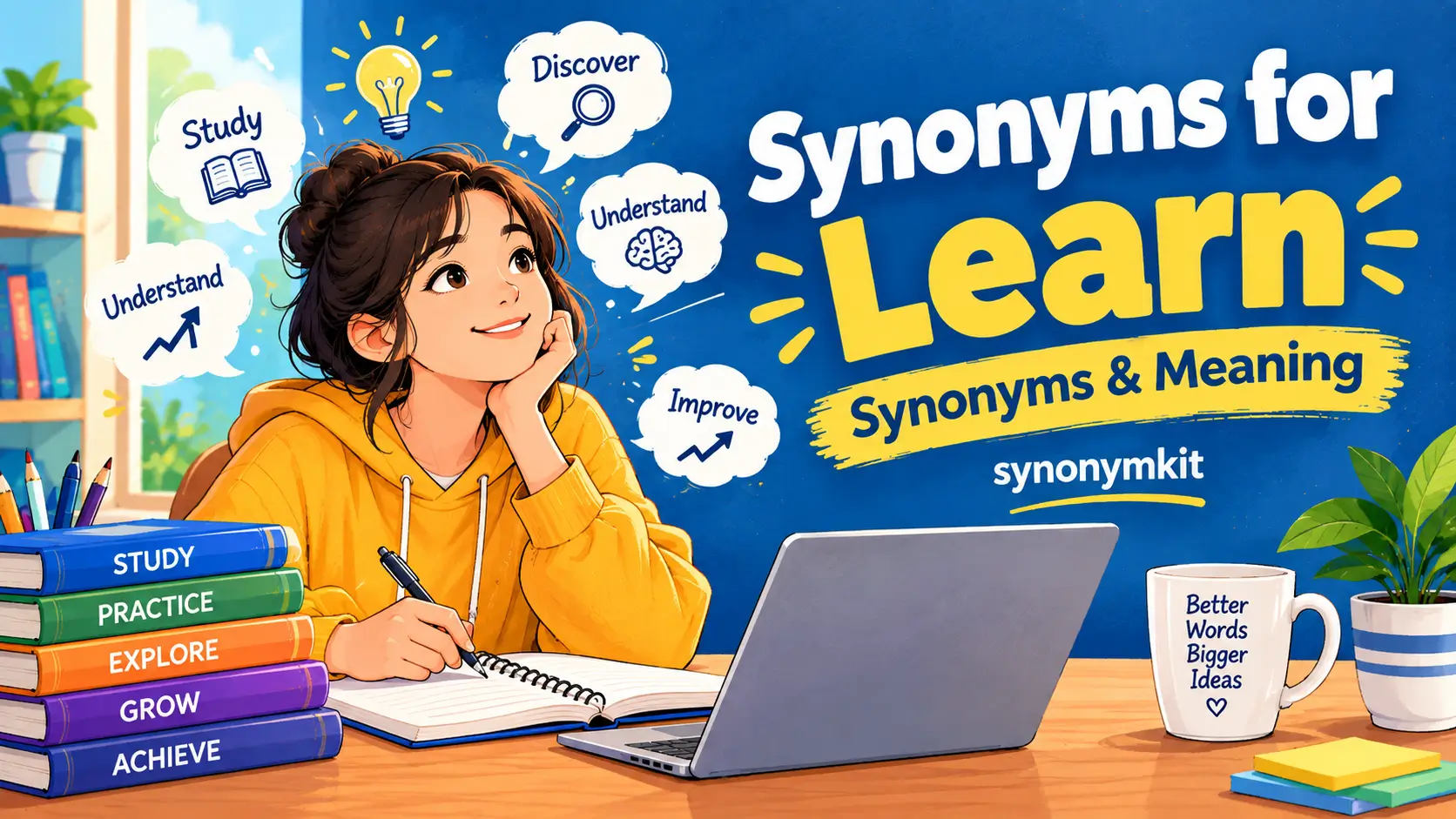
A student sits at a desk, reads a new lesson, and slowly starts to understand it. Later, that same student explains the idea to a friend. This small moment shows how many ways we can talk about gaining knowledge.
For example, someone may discover a new fact while reading a book, while another person may master a skill after weeks of practice.
Good vocabulary helps students write clearer answers and essays. Bloggers can make their articles more natural and interesting.
Content writers can avoid using the same word again and again. Daily English users can choose words that fit each situation.
“The beautiful thing about learning is that nobody can take it away from you.” B. B. King
Using different words also helps you express small differences in meaning. A person can study a topic, grasp an idea, memorize facts, or master a skill. These words are related, but they are not always interchangeable.
“Live as if you were to die tomorrow. Learn as if you were to live forever.” Mahatma Gandhi
50 Synonyms for Learn
1. Study
- Meaning: To spend time reading or practicing something to gain knowledge.
- Examples: I study English every evening.
She studied the lesson before class.
2. Discover
- Meaning: To find new information or something you did not know.
- Examples: We discovered a useful writing trick.
He discovered the answer later.
3. Understand
- Meaning: To know what something means and how it works.
- Examples: I understand the lesson now.
She understood his simple explanation.
4. Master
- Meaning: To learn something very well through practice and effort.
- Examples: He mastered basic grammar quickly.
She mastered the new skill.
5. Grasp
- Meaning: To understand an idea clearly after thinking about it.
- Examples: I grasped the main point.
She quickly grasped the concept.
6. Absorb
- Meaning: To take in new information through reading, listening, or experience.
- Examples: Children absorb new words quickly.
He absorbed every lesson carefully.
7. Acquire
- Meaning: To gain knowledge, skills, or information over time.
- Examples: She acquired useful computer skills.
He acquired knowledge through practice.
8. Memorize
- Meaning: To learn something so you can remember it later.
- Examples: I memorized the new words.
She memorized her speech yesterday.
9. Explore
- Meaning: To study something carefully to learn more about it.
- Examples: We explored a new topic.
She explored different learning methods.
10. Realize
- Meaning: To suddenly understand or become aware of something important.
- Examples: I realized my mistake today.
He realized the answer afterward.
11. Comprehend
- Meaning: To understand something clearly, especially after careful thought.
- Examples: She comprehended the difficult passage.
He finally comprehended the instructions.
12. Familiarize
- Meaning: To learn enough about something to know how it works.
- Examples: I familiarized myself with the rules.
She familiarized herself with the software.
13. Grasp
- Meaning: To quickly understand an idea, fact, or situation.
- Examples: He grasped the basic idea.
They grasped the teacher’s point.
14. Train
- Meaning: To learn a skill through repeated practice and instruction.
- Examples: She trained to become a nurse.
He trained every morning.
15. Practice
- Meaning: To repeat an activity so you can improve your skill.
- Examples: I practice English daily.
She practices new words aloud.
16. Develop
- Meaning: To build knowledge or skill gradually through effort and experience.
- Examples: He developed strong writing skills.
She developed better study habits.
17. Improve
- Meaning: To become better at something through learning and practice.
- Examples: My English improved this year.
She improved her reading skills.
18. Pick up
- Meaning: To learn something naturally without formal lessons or study.
- Examples: He picked up new phrases.
She picked up Spanish quickly.
19. Take in
- Meaning: To understand and remember information that you hear or read.
- Examples: I took in the advice.
She took in every detail.
20. Take on
- Meaning: To learn or accept a new skill, role, or responsibility.
- Examples: He took on new skills.
She took on extra training.
21. Get to know
- Meaning: To learn about someone or something through time and experience.
- Examples: I got to know the process.
She got to know her classmates.
22. Find out
- Meaning: To discover information by asking, searching, or checking.
- Examples: I found out the truth.
She found out the answer.
23. Research
- Meaning: To study information carefully to discover facts or answers.
- Examples: We researched the topic online.
He researched the history carefully.
24. Investigate
- Meaning: To examine something closely to discover useful facts.
- Examples: They investigated the strange problem.
She investigated the cause.
25. Examine
- Meaning: To look at something carefully to understand it better.
- Examples: We examined the results together.
He examined the old document.
26. Observe
- Meaning: To watch something carefully and learn from what happens.
- Examples: She observed the teacher closely.
He observed how the machine worked.
27. Experience
- Meaning: To gain knowledge by doing or living through something.
- Examples: We experienced a new culture.
She experienced many workplace challenges.
28. Gain
- Meaning: To get knowledge, skill, or understanding through time and effort.
- Examples: He gained valuable experience.
She gained confidence through practice.
29. Attain
- Meaning: To successfully reach a desired level of knowledge or skill.
- Examples: She attained advanced language skills.
He attained strong academic results.
30. Develop knowledge
- Meaning: To build a deeper understanding through study, practice, and experience.
- Examples: Reading develops useful knowledge.
Travel develops cultural knowledge.
31. Learn about
- Meaning: To gain information about a person, subject, place, or idea.
- Examples: We learned about ancient Egypt.
She learned about healthy food.
32. Study up
- Meaning: To spend extra time studying a subject before doing something.
- Examples: I studied up before class.
He studied up for the test.
33. Brush up
- Meaning: To review old knowledge so your skills become fresh again.
- Examples: I brushed up on grammar.
She brushed up before traveling.
34. Catch on
- Meaning: To begin understanding something after hearing or seeing it.
- Examples: He caught on very quickly.
She caught on after practice.
35. Get the hang of
- Meaning: To learn how to do something correctly through practice.
- Examples: I got the hang of it.
She got the hang of driving.
36. Pick up knowledge
- Meaning: To gain information naturally while doing ordinary activities.
- Examples: Kids pick up knowledge easily.
He picked up knowledge at work.
37. Internalize
- Meaning: To understand an idea deeply and make it part of your thinking.
- Examples: She internalized the important lesson.
He internalized the new rules.
38. Retain
- Meaning: To remember information after learning or studying it.
- Examples: I retain information better visually.
She retained the main facts.
39. Recall
- Meaning: To remember information that you learned earlier.
- Examples: I recalled the answer later.
She recalled his useful advice.
40. Recognize
- Meaning: To know something because you have seen or learned it before.
- Examples: I recognized the word immediately.
She recognized the familiar pattern.
41. Perceive
- Meaning: To notice or understand something through thought, senses, or experience.
- Examples: He perceived a small change.
She perceived the problem clearly.
42. Enlighten
- Meaning: To give someone useful knowledge or a clearer understanding.
- Examples: The book enlightened me greatly.
Her talk enlightened the audience.
43. Become aware
- Meaning: To begin knowing or noticing something that was previously unknown.
- Examples: I became aware of the issue.
She became aware of her mistake.
44. Understand deeply
- Meaning: To gain a strong and complete understanding of an idea.
- Examples: He understands the topic deeply.
She deeply understood the problem.
45. Familiarize oneself
- Meaning: To study something until you become comfortable with its details.
- Examples: I familiarized myself with the plan.
She familiarized herself with the rules.
46. Educate
- Meaning: To teach someone so they gain knowledge, skills, or understanding.
- Examples: Schools educate young people.
Books educate readers about history.
47. Instruct
- Meaning: To teach someone how to do something through guidance.
- Examples: The coach instructed us carefully.
She instructed new workers.
48. Teach oneself
- Meaning: To gain knowledge without depending mainly on a teacher.
- Examples: He taught himself coding.
She taught herself French.
49. Study closely
- Meaning: To examine a subject carefully to gain detailed knowledge.
- Examples: We studied the map closely.
She studied the results closely.
50. Grow
- Meaning: To gain knowledge, skills, and wisdom through learning and experience.
- Examples: We grow through new experiences.
She grew stronger through study.
“Anyone who stops learning is old, if at twenty or eighty.” Henry Ford
Synonyms for learn more
Words such as discover, explore, investigate, research, and find out work well when you mean gaining additional information. For example, “learn more about the topic” can become “explore the topic further” in an article.
In casual speech, find out more sounds natural, while investigate further fits a more serious or professional setting.
Synonyms for learn and grow
When learning also means personal improvement, employ phrases such as develop, improve, gain experience, mature, and grow. These words show that learning changes a person’s skills or thinking. For example, “We learn and grow from challenges” can become “We develop through challenges.”
The best word depends on if you want to stress knowledge, skills, experience, or personal change.
Synonyms for learn by doing
For learning through action, useful choices include practice, experience, train, develop, and pick up. The phrase learn by doing is especially common in education and workplace training.
You can say, “Students develop skills through practice” or “Workers gain experience through real tasks.” These alternatives focus on active learning rather than reading alone.
Synonyms for learn from mistakes
Useful alternatives include grow, improve, develop, gain experience, and understand. These words show that a mistake can provide a useful lesson. For example, “She learned from her mistakes” could become “She grew through her mistakes” or “She gained experience from past errors.” Choose improve when the focus is on doing better next time.
FAQ: Real People Also Ask
What is a better synonym for “learn”?
There is no single synonym that is always better. Study works when someone spends time gaining knowledge. Discover fits finding something new, while understand focuses on knowing what something means.
Master is stronger when someone becomes highly skilled. For formal writing, acquire can describe gaining knowledge or skills. Choose the word that matches the exact idea you want to express.
What words can I use instead of learning?
You can use study, education, training, discovery, practice, development, understanding, and experience. Each word has a slightly different use. “Learning a language” can become “studying a language,” while “learning through work” can become “gaining experience.”
In professional writing, training and development are useful. In everyday English, study and practice are simple and natural choices.
What is a formal synonym for “learn”?
Acquire is a useful formal synonym when you mean gaining knowledge or skills. For example, “Employees acquire new skills through training” sounds professional. Other formal choices include comprehend, attain, familiarize, and educate, depending on the sentence.
However, formal words should not replace simple words without a reason. Learn itself is clear, correct, and suitable for both everyday and professional English.
What is a stronger word for learning?
The stronger word depends on what you want to emphasize. Mastery suggests a very high level of skill, while education suggests a broader process of gaining knowledge. Development highlights progress over time, and training focuses on building practical abilities.
If someone learns through repeated effort until they become highly skilled, mastery is often the strongest fit.
Conclusion
Using different words for learning can make your writing, blogging, speaking, and communication clearer. Instead of repeating learn many times, you can choose a word that gives your sentence a more exact meaning.
For example, students can study a lesson, memorize important facts, grasp a difficult idea, and master a useful skill. Bloggers can use words such as discover, explore, and understand to make their articles more varied.
Content writers can choose acquire, develop, or gain when a more expert tone’s needed.
The key is not to replace every use of learn. First, think about the meaning. Are you talking about finding information, building a skill, remembering facts, or gaining experience? Then choose the synonym that fits.
Try these words in your emails, essays, blog posts, schoolwork, and daily conversations. Start with a few simple choices and practice them often. Over time, your vocabulary will become more flexible and natural.
“The more you learn, the more you earn.” Warren Buffett
Learning new words is a small habit that can strengthen your communication. Keep reading, practicing, and using new vocabulary in real sentences.
“I am still learning.” Michelangelo

Amelia is a linguistics graduate and lifelong word nerd who believes the right word can change how a sentence feels. She writes and edits vocabulary guides for SynonymKit, helping readers sound sharper and more confident in their writing.