65 Synonyms for Explain: Clear Words, Meanings & Examples
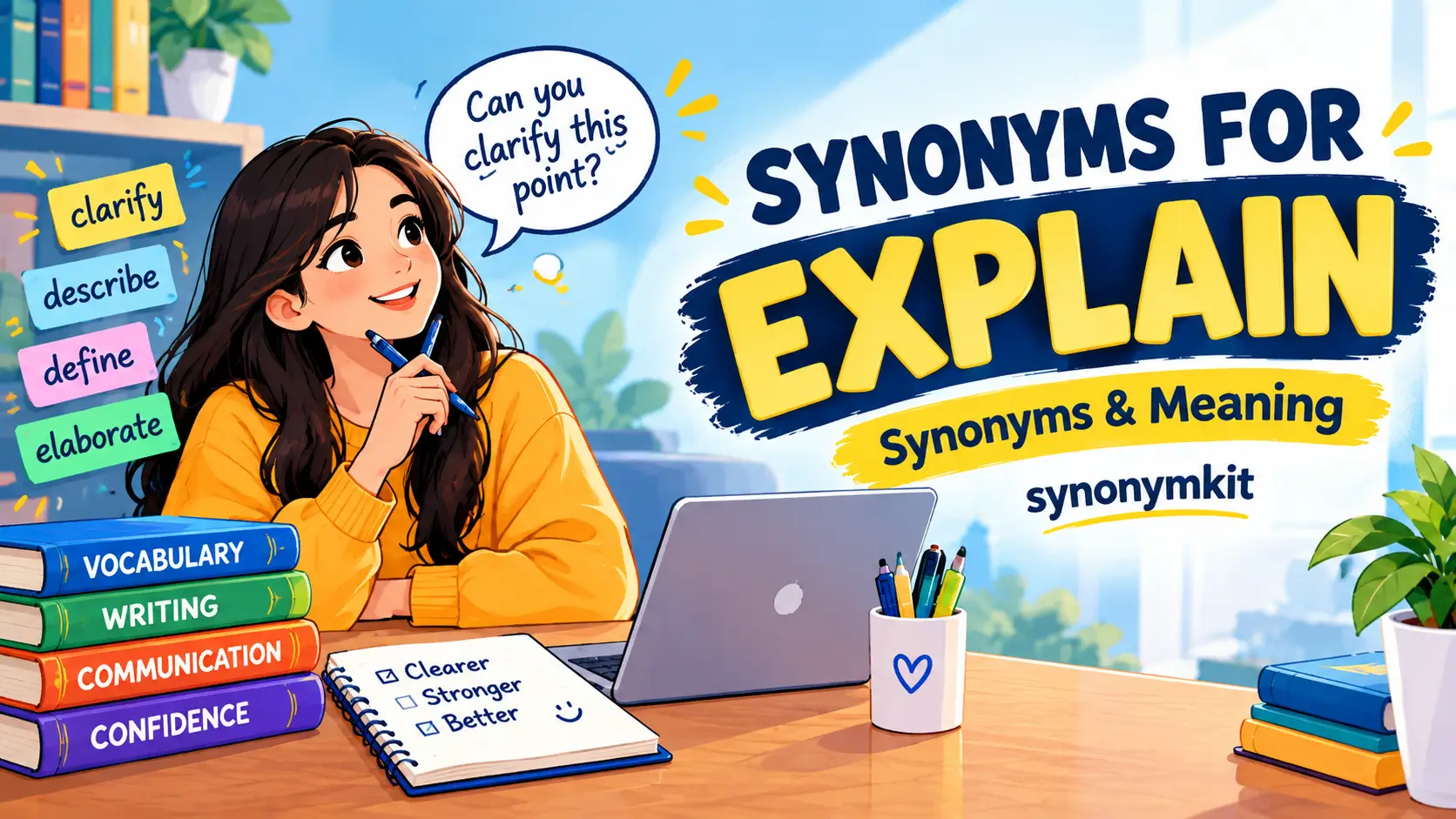
Common synonyms for “explain” include clarify, describe, define, illustrate, interpret, demonstrate, outline, and elaborate. The best choice depends on your meaning and situation. These words can help you make essays, emails, conversations, and everyday writing clearer, more natural, and easier for readers to understand.
A teacher asks a student to explain an answer. A friend asks why a plan changed. At work, someone may need to make a complex idea easy for others to understand. In each case, the right word can make the message clearer.
For example, instead of saying, “Can you explain this rule?” you might say, “Can you clarify this rule?” Both sentences work, but the second one sounds more specific.
Learning different words for explain gives you more ways to share ideas. Students can use them in essays and classwork. Bloggers can make their posts more useful.
Content writers can avoid repeating the same word. Daily English users can speak with more confidence.
Good word choice makes simple ideas easier to follow.
“Clear words make clear thoughts.”
The goal is not to use difficult words all the time. The goal is to choose the word that fits your meaning.
“The simplest words often carry the strongest message.”
Below, you will find useful synonyms with simple meanings and examples.
1. Clarify
- Meaning: To make something easier to understand or less confusing.
- Examples: Please clarify your last point.
Could you clarify this rule?
2. Describe
- Meaning: To tell someone what something is like using clear words.
- Examples: Please describe the picture.
She described her new job.
3. Define
- Meaning: To state the exact meaning of a word, idea, or thing.
- Examples: Can you define this term?
The teacher defined the word.
4. Illustrate
- Meaning: To make an idea clear by giving an example.
- Examples: This story illustrates kindness.
She illustrated her point well.
5. Demonstrate
- Meaning: To show clearly how something works or how something happens.
- Examples: He demonstrated the new method.
The teacher demonstrated each step.
6. Elaborate
- Meaning: To give more details about an idea or answer.
- Examples: Please elaborate on that point.
She elaborated on her plan.
7. Interpret
- Meaning: To explain the meaning of something in your own words.
- Examples: Can you interpret this message?
He interpreted the speaker’s words.
8. Outline
- Meaning: To give the main points without adding many small details.
- Examples: She outlined the project plan.
Please outline your main ideas.
9. Expound
- Meaning: To explain an idea carefully with many details and supporting points.
- Examples: The professor expounded his theory.
He expounded on the topic.
10. Account for
- Meaning: To give a reason that explains why something happened.
- Examples: How do you account for this?
His actions account for the delay.
11. Justify
- Meaning: To give reasons that show why something is right or reasonable.
- Examples: Please justify your answer.
She justified her decision clearly.
12. Interpretate
- Meaning: This form is uncommon; use “interpret” when explaining meaning instead.
- Examples: Please interpret the message.
She interpreted his answer correctly.
13. Decode
- Meaning: To work out the meaning of something difficult or hidden.
- Examples: Can you decode this note?
They decoded the secret message.
14. Translate
- Meaning: To change words or ideas into another language or easier form.
- Examples: Please translate this sentence.
She translated the idea simply.
15. Paraphrase
- Meaning: To express the same idea using different and simpler words.
- Examples: Please paraphrase this paragraph.
He paraphrased the teacher’s answer.
16. Explicate
- Meaning: To explain something difficult by giving careful details about its meaning.
- Examples: The writer explicated the poem.
She explicated the main argument.
17. Analyze
- Meaning: To study something closely so its parts and meaning become clear.
- Examples: Students analyzed the poem.
We analyzed the main problem.
18. Break down
- Meaning: To explain something complex by dividing it into smaller parts.
- Examples: Please break down the process.
He broke down the lesson.
19. Spell out
- Meaning: To explain something fully so there is little chance of confusion.
- Examples: Please spell out the rules.
She spelled out each step.
20. Show
- Meaning: To make an idea clear through words, actions, facts, or examples.
- Examples: Let me show you.
The chart shows the difference.
21. Present
- Meaning: To give information or ideas clearly to another person or group.
- Examples: She presented her findings.
He presented the main idea.
22. State
- Meaning: To express an idea or fact clearly and directly.
- Examples: Please state your reason.
He stated his opinion.
23. Express
- Meaning: To communicate an idea, feeling, or thought through words.
- Examples: She expressed her concern.
He expressed the idea clearly.
24. Convey
- Meaning: To communicate an idea, feeling, or message to someone else.
- Examples: Her words conveyed hope.
The image conveys a message.
25. Communicate
- Meaning: To share information, thoughts, or feelings with another person.
- Examples: We communicate by email.
She communicated the plan clearly.
26. Relay
- Meaning: To pass information from one person or place to another.
- Examples: Please relay the message.
He relayed the news quickly.
27. Inform
- Meaning: To give someone useful facts or information about something.
- Examples: Please inform the team.
The notice informed everyone.
28. Educate
- Meaning: To teach someone facts, skills, or ideas about a subject.
- Examples: Books educate young readers.
The course educates new workers.
29. Teach
- Meaning: To help someone learn about a subject, skill, or idea.
- Examples: She teaches English online.
He taught us the basics.
30. Instruct
- Meaning: To give someone clear information about what they should do.
- Examples: The guide instructed visitors.
Please instruct him carefully.
31. Advise
- Meaning: To give someone helpful information about what they should do.
- Examples: She advised me to wait.
The doctor advised more rest.
32. Elucidate
- Meaning: To make a difficult idea clear through careful explanation.
- Examples: The guide elucidated the issue.
He elucidated the complex rule.
33. Shed light on
- Meaning: To provide information that helps people understand something better.
- Examples: The report sheds light on problems.
Her answer shed light on events.
34. Make clear
- Meaning: To remove confusion by giving simple and understandable information.
- Examples: Please make your point clear.
She made the rules clear.
35. Make sense of
- Meaning: To understand something that first seems confusing or difficult.
- Examples: I cannot make sense of this.
She made sense of everything.
36. Clarify further
- Meaning: To give extra information when the first explanation is not enough.
- Examples: Please clarify further.
He clarified the issue further.
37. Detail
- Meaning: To describe or explain something by giving many specific facts.
- Examples: She detailed the process.
He detailed every important step.
38. Expand on
- Meaning: To add more information to something that was already mentioned.
- Examples: Can you expand on that?
She expanded on her idea.
39. Develop
- Meaning: To explain an idea more fully by adding useful supporting information.
- Examples: Develop your main argument.
He developed the topic carefully.
40. Discuss
- Meaning: To talk or write about something while sharing important information.
- Examples: We discussed the problem.
She discussed the new plan.
41. Review
- Meaning: To look at something again and explain its main points.
- Examples: Let’s review the lesson.
He reviewed the basic rules.
42. Summarize
- Meaning: To give the main ideas of something using fewer words.
- Examples: Please summarize the article.
She summarized the meeting well.
43. Recap
- Meaning: To briefly repeat the most important information about something.
- Examples: Let me recap the plan.
He recapped the main points.
44. Illustrate with examples
- Meaning: To make an idea easier by showing real or simple examples.
- Examples: Illustrate your answer with examples.
She illustrated the rule with examples.
45. Demonstrate
- Meaning: To show something clearly so another person can see how it works.
- Examples: Please demonstrate the technique.
He demonstrated the correct method.
46. Prove
- Meaning: To show with facts or evidence that something is true.
- Examples: The facts prove his claim.
She proved her point.
47. Support
- Meaning: To give facts or reasons that make an idea stronger.
- Examples: Support your answer with evidence.
The data supports her view.
48. Substantiate
- Meaning: To support a statement with facts, evidence, or strong proof.
- Examples: Can you substantiate this claim?
The report substantiated his argument.
49. Reason
- Meaning: To think carefully and give logical reasons for an idea.
- Examples: She reasoned through the problem.
He reasoned with the team.
50. Account
- Meaning: To give a spoken or written description of an event.
- Examples: She gave an account of events.
His account explained everything.
51. Clarification
- Meaning: Extra information given to make something easier to understand.
- Examples: I need some clarification.
Her clarification helped everyone.
52. Explanation
- Meaning: Information that helps someone understand a reason, idea, or process.
- Examples: His explanation was simple.
We need a better explanation.
53. Interpretation
- Meaning: An explanation of what something means or how it should be understood.
- Examples: Her interpretation was interesting.
The poem allows different interpretations.
54. Description
- Meaning: Words that tell someone what a person, place, thing, or event is like.
- Examples: His description was very clear.
She gave a short description.
55. Definition
- Meaning: A clear statement that gives the exact meaning of something.
- Examples: Read the definition first.
The definition is easy.
56. Elaboration
- Meaning: Extra details added to make an idea more complete or clear.
- Examples: Her elaboration helped us.
The teacher asked for elaboration.
57. Demonstration
- Meaning: A practical showing of how something works or should be done.
- Examples: The demonstration was useful.
We watched a short demonstration.
58. Illustration
- Meaning: An example or picture that helps make an idea easier to understand.
- Examples: This story is a good illustration.
The example gives a clear illustration.
59. Clarification of
- Meaning: Extra information that removes doubt about a particular point or matter.
- Examples: We need clarification of this rule.
She gave clarification of the issue.
60. Elucidation
- Meaning: A clear explanation that helps people understand a difficult subject.
- Examples: His elucidation was helpful.
The book offers useful elucidation.
61. Explication
- Meaning: A detailed explanation that carefully shows the meaning of something.
- Examples: Her explication was detailed.
The essay gives an explication.
62. Rationale
- Meaning: The reason or set of reasons behind a decision, action, or idea.
- Examples: Explain the rationale behind this.
His rationale was easy to follow.
63. Interpretation
- Meaning: A person’s understanding or explanation of the meaning of something.
- Examples: I liked her interpretation.
His interpretation changed my view.
64. Clarifying
- Meaning: Making an idea, statement, or situation easier to understand.
- Examples: She is clarifying the issue.
He is clarifying the instructions.
65. Explaining
- Meaning: Giving information that helps another person understand something better.
- Examples: She is explaining the lesson.
He kept explaining the problem.
“A good explanation does not make things harder; it makes them easier.”
Synonyms for explain in detail
When you need synonyms for explain in detail, useful choices include elaborate, expand on, detail, explicate, elucidate, and spell out. These words suggest that you should give extra information rather than only a short answer.
For example, “Please elaborate on your idea” asks someone to provide more details about the idea.
Synonyms for explain further
For synonyms for explain further, you can use elaborate, expand on, clarify further, discuss, detail, or shed more light on. These choices work when someone has already given an answer, but you want more information.
In a friendly conversation, “Could you explain further?” can also become “Could you elaborate?”
Synonyms for explain in an essay
Good synonyms for explain in an essay include describe, clarify, illustrate, demonstrate, analyze, discuss, interpret, and elaborate. The best word depends on the task.
Use “analyze” when you study parts closely, “illustrate” when you use examples, and “demonstrate” when evidence helps prove a point.
Academic synonyms for explain
Useful academic synonyms for explain include clarify, analyze, demonstrate, interpret, illustrate, elaborate, explicate, and elucidate. These words can make academic writing more precise.
Still, simple words are often best when they communicate your point clearly. Choose a stronger word only when its meaning matches your sentence.
People Also Ask
What is a better word than “explain”?
A better word than explain depends on what you want to say. Use clarify when something is confusing, describe when you tell what something is like, and elaborate when you want more details.
For formal writing, elucidate or explicate may work. In everyday English, however, “explain” is natural, clear, and completely correct.
What’s a better word for explanation?
A good alternative to explanation is clarification when you are making something easier to understand. Other choices include description, interpretation, account, rationale, and elaboration.
Each has a slightly different use. “Rationale” focuses on the reason behind an action, while “interpretation” focuses on the meaning someone gives to an idea, text, or event.
How do you say “explain” in a fancy way?
For a more formal or sophisticated style, you can use elucidate, explicate, expound, interpret, or elaborate instead of “explain.” For example, “The professor elucidated the theory” sounds more formal than “The professor explained the theory.”
However, fancy words should fit the audience. Clear language is usually better than difficult language.
What are some synonyms for the word “explain”?
Some common synonyms are clarify, describe, define, illustrate, demonstrate, interpret, outline, elaborate, discuss, and detail. More formal options include elucidate, explicate, and expound.
The correct choice depends on your sentence. If something is confusing, “clarify” is useful. If you need more details, “elaborate” may be better.
Conclusion
Learning synonyms for explain gives you more control over your English. Instead of using one word again and again, you can choose a word that matches your exact meaning. This makes your writing smoother and your speech more natural.
For students, these words can improve essays, answers, reports, and presentations. Bloggers can use them to create clearer articles without repeating the same terms. Content writers can choose stronger words for different topics and audiences. In daily conversations, words such as clarify, describe, elaborate, and demonstrate can help you communicate your ideas with confidence.
You do not need to memorize all 65 words at once. Start with a few common choices. Try clarify when something needs to become clearer. Use describe when telling what something is like. Choose elaborate when you need more details. Use demonstrate when showing how something works.
Practice these words in emails, essays, blog posts, schoolwork, and daily conversations. The more you use them, the easier they will become.
“Strong communication begins with the right words.”
Keep practicing, stay curious, and let your vocabulary grow one useful word at a time.
“Every new word gives you another way to express an idea.”

Amelia is a linguistics graduate and lifelong word nerd who believes the right word can change how a sentence feels. She writes and edits vocabulary guides for SynonymKit, helping readers sound sharper and more confident in their writing.