60 Synonyms for Highlights: Better Words for Writing and Speaking
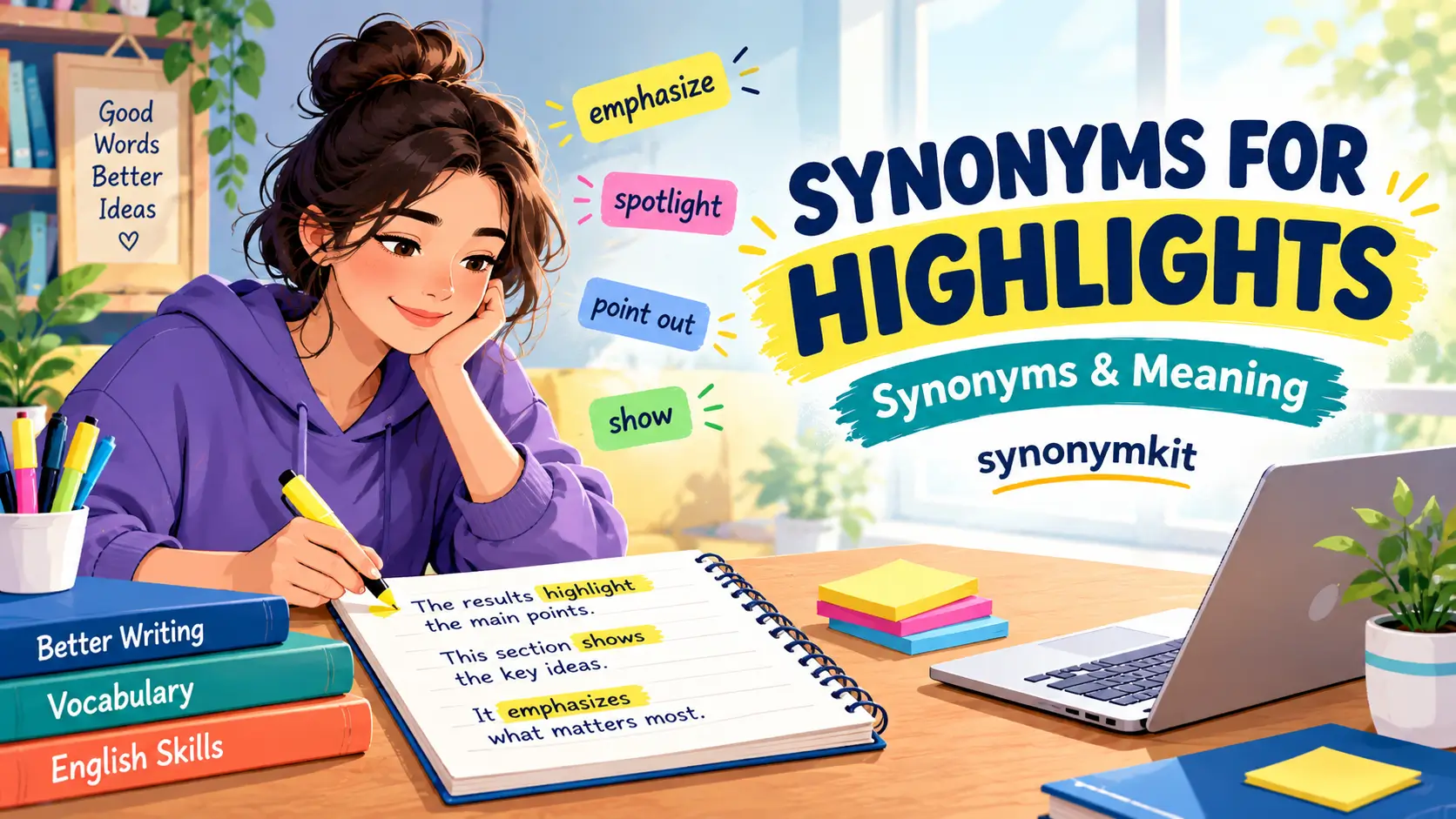
A synonym for highlights can be “emphasizes,” “shows,” “points out,” or “spotlights.” The best choice depends on what you mean. For example, “highlights” may describe showing an important fact, drawing attention to a feature, or marking something with color.
Imagine reading a long report and finding one sentence that suddenly stands out. It tells you the most important part without making you read every line again. That is where highlights becomes a useful word. Still, using the same word again and again can make your writing feel plain.
For example, a teacher may highlight a key idea in a lesson, while a writer may highlight an important result in an article. Both uses are simple, but each can have a better word depending on the situation.
Students can use these words to make essays clearer. Bloggers can make articles more varied and engaging.
Content writers can choose stronger words for each context. Daily English users can sound more natural when speaking or writing.
“Good words make simple ideas easier to understand.”
Learning alternatives also helps you notice small differences in meaning. A word such as emphasizes sounds different from reveals, even when both can replace highlights.
“The right word gives your message the right shape.”
60 Synonyms for Highlights
1. Emphasizes
- Meaning: Shows that something is especially important or worthy of attention.
- Examples: The report emphasizes the main problem.
Her speech emphasizes teamwork and trust.
2. Shows
- Meaning: Makes an idea, fact, or feature clear to someone.
- Examples: The chart shows rising sales.
This example shows the main difference.
3. Stresses
- Meaning: Gives special importance to one particular idea or point.
- Examples: The teacher stresses good study habits.
The guide stresses the need for care.
4. Underscores
- Meaning: Makes an important fact or idea stand out clearly.
- Examples: The result underscores the problem.
Her comment underscores their shared goal.
5. Spotlights
- Meaning: Brings special attention to a person, idea, or feature.
- Examples: The article spotlights young artists.
The event spotlights local talent.
6. Draws Attention To
- Meaning: Makes people notice something that deserves their attention.
- Examples: The sign draws attention to safety.
Her post draws attention to pollution.
7. Points Out
- Meaning: Directs attention toward a specific fact or detail.
- Examples: He points out one mistake.
The guide points out hidden costs.
8. Calls Attention To
- Meaning: Makes people notice something important or useful.
- Examples: The study calls attention to risks.
She calls attention to unfair rules.
9. Accentuates
- Meaning: Makes a particular quality or feature more noticeable.
- Examples: The lighting accentuates her dress.
This design accentuates the room.
10. Magnifies
- Meaning: Makes something appear more important, serious, or noticeable.
- Examples: The photo magnifies tiny details.
Stress can magnify small problems.
11. Features
- Meaning: Gives special space or attention to someone or something.
- Examples: The page features useful tips.
The magazine features local writers.
12. Presents
- Meaning: Shows information or ideas clearly for people to understand.
- Examples: The report presents key findings.
The teacher presents new ideas.
13. Reveals
- Meaning: Makes something previously unknown or hidden become known.
- Examples: The survey reveals surprising results.
His answer reveals the truth.
14. Displays
- Meaning: Shows something clearly so people can see or notice it.
- Examples: The screen displays important data.
The store displays new products.
15. Demonstrates
- Meaning: Shows clearly how something works or why it matters.
- Examples: This example demonstrates the process.
Her work demonstrates strong skills.
16. Illustrates
- Meaning: Makes an idea easier to understand through an example or image.
- Examples: This story illustrates the problem.
The picture illustrates their main point.
17. Indicates
- Meaning: Gives a sign that something is true or likely.
- Examples: The data indicates strong growth.
His answer indicates real concern.
18. Identifies
- Meaning: Shows or names something clearly for people to recognize.
- Examples: The report identifies major causes.
The list identifies common errors.
19. Notes
- Meaning: Mentions or draws attention to an important fact.
- Examples: The author notes several changes.
She notes the rising costs.
20. Mentions
- Meaning: Refers to someone or something briefly in speech or writing.
- Examples: The article mentions climate change.
He mentions the new project.
21. Brings Out
- Meaning: Makes a quality, detail, or idea easier to notice.
- Examples: The color brings out her eyes.
Good lighting brings out details.
22. Brings To Light
- Meaning: Makes hidden information known or easier to understand.
- Examples: The audit brings problems to light.
Her research brings new facts to light.
23. Calls Out
- Meaning: Clearly points to a problem, mistake, or important issue.
- Examples: The report calls out unfair practices.
She calls out the main issue.
24. Marks
- Meaning: Shows or identifies a particular point, place, or event.
- Examples: The symbol marks the entrance.
A star marks important sections.
25. Flags
- Meaning: Signals that something needs attention or careful review.
- Examples: The system flags unusual activity.
The editor flags several errors.
26. Signals
- Meaning: Gives a clear sign that something is happening or important.
- Examples: The result signals major change.
His silence signals concern.
27. Expresses
- Meaning: Clearly communicates an idea, feeling, or opinion to others.
- Examples: Her letter expresses deep gratitude.
The poem expresses strong emotions.
28. Clarifies
- Meaning: Makes an idea or statement easier to understand.
- Examples: The example clarifies the rule.
His answer clarifies the situation.
29. Explains
- Meaning: Gives information that helps someone understand something better.
- Examples: The guide explains each step.
She explains the main reason.
30. Describes
- Meaning: Gives details about someone, something, or an experience.
- Examples: The article describes the process.
He describes his first trip.
31. Summarizes
- Meaning: Gives the main points without including every small detail.
- Examples: The final section summarizes the findings.
She summarizes the main ideas.
32. Recaps
- Meaning: Briefly reviews the main events, facts, or points.
- Examples: The host recaps yesterday’s news.
He recaps the meeting quickly.
33. Reviews
- Meaning: Looks at important information again to explain or assess it.
- Examples: The chapter reviews key concepts.
She reviews the main results.
34. Examines
- Meaning: Looks at something carefully to understand its details or meaning.
- Examples: The study examines customer behavior.
This section examines common causes.
35. Explores
- Meaning: Looks closely at an idea, topic, or possibility.
- Examples: The article explores modern trends.
Her essay explores family life.
36. Investigates
- Meaning: Carefully studies something to discover facts or reasons.
- Examples: The team investigates the complaint.
Researchers investigate possible causes.
37. Addresses
- Meaning: Gives attention to a problem, question, or important topic.
- Examples: The report addresses workplace safety.
This guide addresses common concerns.
38. Focuses On
- Meaning: Gives most attention to one particular subject or idea.
- Examples: The article focuses on education.
Her research focuses on language.
39. Centers On
- Meaning: Makes one topic the main subject of attention.
- Examples: The discussion centers on cost.
The story centers on friendship.
40. Showcases
- Meaning: Presents something in a way that makes its best qualities noticeable.
- Examples: The website showcases new designs.
The event showcases local talent.
41. Highlights
- Meaning: Gives special attention to an important idea, detail, or feature.
- Examples: The report highlights key risks.
This photo highlights the landscape.
42. Illuminates
- Meaning: Makes an idea clearer by giving useful information or insight.
- Examples: Her research illuminates the issue.
The example illuminates the main point.
43. Elucidates
- Meaning: Makes something difficult easier to understand through clear explanation.
- Examples: The guide elucidates complex ideas.
His answer elucidates the problem.
44. Brings Forward
- Meaning: Presents an idea or fact so people can consider it.
- Examples: She brings forward new evidence.
The report brings forward useful ideas.
45. Promotes
- Meaning: Gives support or attention to an idea, product, or cause.
- Examples: The campaign promotes healthy habits.
The website promotes local businesses.
46. Celebrates
- Meaning: Gives positive attention to something valued or admired.
- Examples: The article celebrates young leaders.
The event celebrates local culture.
47. Honors
- Meaning: Shows respect and special attention toward someone or something.
- Examples: The award honors brave workers.
The ceremony honors community heroes.
48. Reflects
- Meaning: Shows a quality, feeling, idea, or condition through words or actions.
- Examples: Her work reflects great care.
The painting reflects peaceful feelings.
49. Represents
- Meaning: Shows or stands for a particular idea, group, or quality.
- Examples: This symbol represents hope.
The image represents modern life.
50. Signifies
- Meaning: Shows that something has a particular meaning or importance.
- Examples: The color signifies danger.
This change signifies progress.
51. Denotes
- Meaning: Shows or means something in a clear and specific way.
- Examples: The mark denotes a warning.
This term denotes careful planning.
52. Characterizes
- Meaning: Describes a main quality that makes someone or something recognizable.
- Examples: Kindness characterizes her leadership.
Bright colors characterize the design.
53. Embodies
- Meaning: Clearly shows a particular quality, idea, or feeling.
- Examples: Her actions embody true courage.
The project embodies creative thinking.
54. Exemplifies
- Meaning: Shows a good or clear example of something.
- Examples: Her work exemplifies careful planning.
This case exemplifies strong teamwork.
55. Accentuates
- Meaning: Gives extra attention to a quality or feature.
- Examples: The border accentuates the design.
Music accentuates the emotional scene.
56. Underlines
- Meaning: Gives extra importance to a fact, idea, or statement.
- Examples: The result underlines the need.
His words underline their concern.
57. Reinforces
- Meaning: Makes an idea or message stronger and more convincing.
- Examples: The example reinforces her argument.
The results reinforce earlier findings.
58. Supports
- Meaning: Provides evidence that helps prove or strengthen an idea.
- Examples: The data supports his claim.
These facts support the argument.
59. Proves
- Meaning: Shows that something is true through facts or strong evidence.
- Examples: The evidence proves the claim.
This result proves the method works.
60. Demonstrates
- Meaning: Clearly shows a fact, skill, quality, or result through evidence.
- Examples: Her project demonstrates careful research.
The result demonstrates real progress.
“Choose the word that fits your meaning, not simply the word that sounds impressive.”
Another Word for Highlights in Research
In research writing, useful alternatives include emphasizes, underscores, indicates, reveals, identifies, demonstrates, and points out. The best choice depends on the evidence. For example, “the study reveals a new pattern” suggests discovery, while “the study underscores a major concern” gives extra weight to an existing point. These choices can make academic writing more precise.
Synonym for Highlight or Emphasize
When you mean giving extra importance to an idea, emphasize, stress, underscore, underline, accentuate, and reinforce work well. For simple writing, “show” or “point out” may sound more natural.
In formal essays, “underscore” and “emphasize” are often stronger choices. Pick the word that matches the level and purpose of your writing.
Highlight Antonyms
The opposite of highlighting something can involve hiding, ignoring, overlooking, minimizing, or downplaying it. These words describe situations where attention is reduced instead of increased.
For example, a writer may “highlight the benefits” but “downplay the risks.” Understanding antonyms helps you express both strong attention and reduced attention clearly.
Another Word for Highlighted the Fact
If you want another phrase for “highlighted the fact,” try pointed out the fact, emphasized the fact, stressed the fact, noted the fact, or underscored the fact. In formal writing, “underscored” sounds polished.
For simple everyday English, “pointed out” is usually clearer and more natural.
Another Word for Highlights or Shows
Depending on the sentence, reveals, demonstrates, indicates, displays, illustrates, presents, and features can replace “highlights” or “shows.” “Reveals” works well for new information, while “illustrates” suits examples.
“Features” is useful when describing something that receives special space or attention, such as a person, product, or topic.
Frequently Asked Questions
What words can I use instead of highlight?
You can use emphasize, stress, underscore, spotlight, point out, show, feature, accentuate, or draw attention to. The best option depends on your sentence. For example, “The report emphasizes the problem” sounds formal, while “The report points out the problem” feels more conversational.
If you are describing color or text, “mark” or “shade” may be more suitable.
What is another word for “highlights” in an essay?
In an essay, strong alternatives include emphasizes, underscores, stresses, points out, demonstrates, reveals, and illustrates. “Emphasizes” is useful when giving importance to an argument. “Demonstrates” works when evidence supports an idea.
“Illustrates” is helpful when an example makes your point clearer. Choosing a specific alternative can make your essay sound more natural and avoid repeating the same verb.
What is another word for highlight or emphasize?
Common alternatives are stress, underscore, accentuate, spotlight, reinforce, underline, and draw attention to. “Stress” is simple and direct. “Underline” can work in both literal and figurative writing.
“Spotlight” has a stronger sense of giving special attention. For formal academic writing, emphasize and underscore are usually safe and clear choices.
What’s another word for “highlights the importance”?
You can say emphasizes the importance, underscores the importance, stresses the importance, shows the importance, or reinforces the importance. For formal writing, “underscores the importance” sounds polished and strong.
For simple writing, “shows the importance” is easier to read. You can also rewrite the sentence completely to avoid repetition and make the main idea more direct.
Conclusion
Learning different synonyms for highlights can make your English more flexible and precise. Instead of using one word in every sentence, you can choose a word that matches your exact meaning. Emphasize gives extra importance.
Reveal suggests new information. Showcase focuses on something impressive. Indicate points toward evidence. Underline gives extra weight to an idea.
These small differences matter in many kinds of writing. Students can make essays stronger and less repetitive. Bloggers can create smoother articles.
Content writers can choose words that fit search intent and reader expectations. In daily conversations, varied vocabulary can help you explain your thoughts more naturally.
Try practicing these words in your emails, essays, blog posts, reports, and everyday conversations. Start with a few easy choices, such as show, emphasize, point out, stress, and underline. Then slowly add more advanced words when they fit.
“Better vocabulary gives you more ways to say what you mean.”
You do not need to memorize all 60 words at once. Learn a few, use them often, and notice how native speakers use them.
“Practice turns new words into natural language.”
The goal is not to use difficult words. The goal is to choose the right word for the right situation. That is what makes your writing clearer, stronger, and more effective.

James is a former English teacher turned content strategist who’s passionate about making language learning less intimidating. At SynonymKit, he focuses on curating word lists that are practical for everyday writing, essays, and professional communication.