50 Synonyms for Because (Formal & Strong Examples
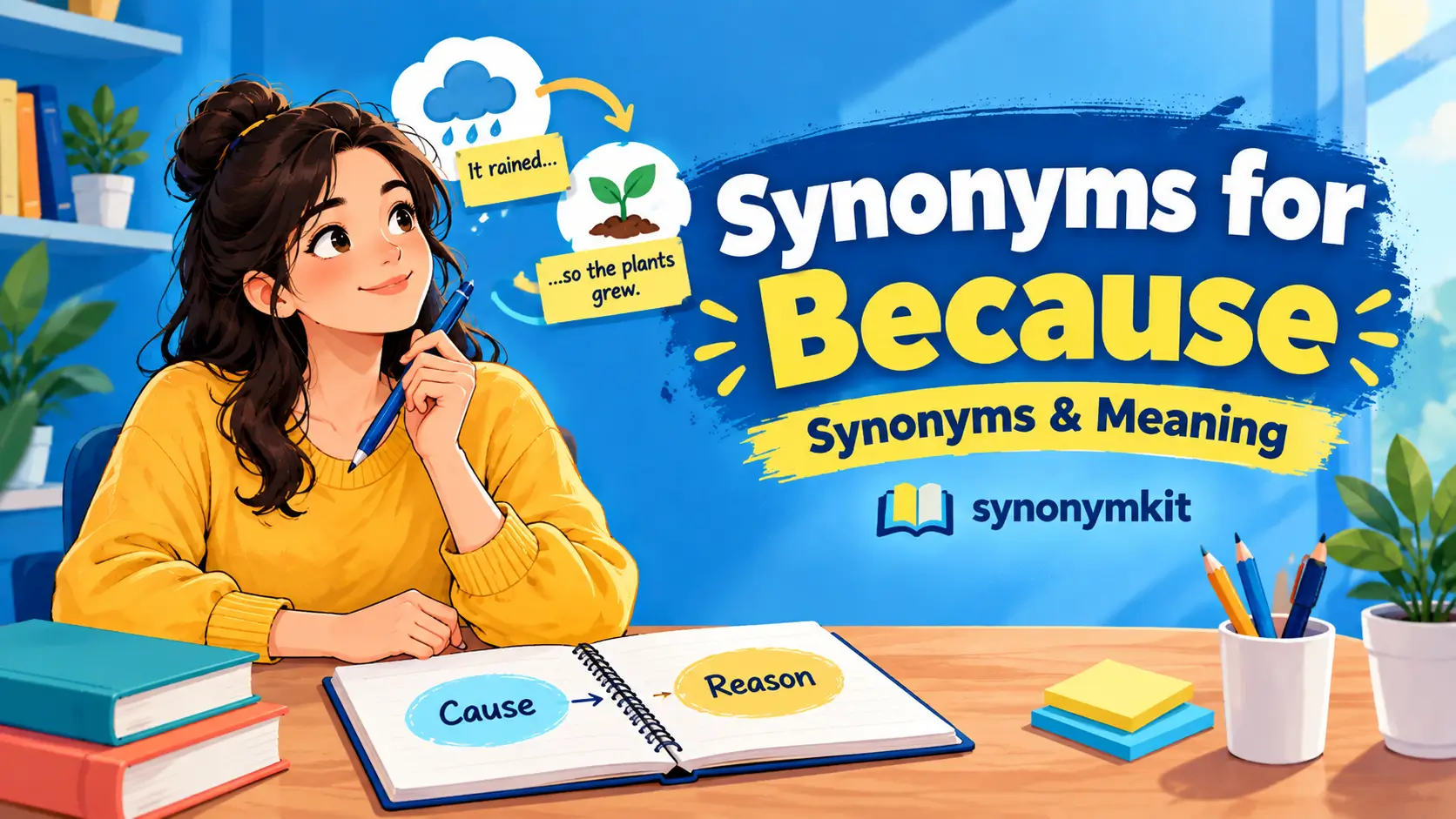
Since, as, for, due to, owing to, and thanks to are common synonyms for because. Each word or phrase shows the reason something happens. They link a cause to its result, so you can avoid repeating “because” and make your sentences sound clearer, smoother, and more polished.
Maya reads her essay aloud and frowns. The word “because” shows up five times in one paragraph. It feels dull, like a song stuck on repeat. She knows there must be better choices, but which ones?
“The difference between the almost right word and the right word is really a large matter.” Mark Twain
Here is a simple example. Instead of saying, “We stayed home because it rained,” you can say, “We stayed home owing to the rain.” The meaning stays the same, but the sentence sounds fresh.
Better word choices help everyone. Students write stronger essays. Bloggers keep readers interested. Content writers sound clear and professional. Daily English users speak with more confidence.
In this guide, you will find 50 easy synonyms, clear meanings, and short examples you can use today. Pick a few favorites and try them in your next sentence.
“Words are, of course, the most powerful drug used by people.” Rudyard Kipling
1. Since
- Meaning: Shows the reason for something, often a known or clear one.
- Examples: Since it rained, we stayed home today. I smiled since the test was finally over.
2. As
- Meaning: A short, simple word that gives the reason for an action.
- Examples: As it was late, Mom drove us home. She left early as she felt very tired.
3. For
- Meaning: A formal, old style word that explains why something happened or is true.
- Examples: He wept, for his old friend had gone. We waited, for the bus was running late.
4. Due to
- Meaning: Points to the cause of a problem or an event.
- Examples: The game ended due to heavy rain. Flights were late due to thick fog today.
5. Owing to
- Meaning: A polite phrase that names the cause of a result.
- Examples: Owing to snow, the school closed early. Owing to illness, he missed the meeting.
6. Thanks to
- Meaning: Gives credit to someone or something for a good result.
- Examples: Thanks to your help, we finished on time. Thanks to her advice, I passed the exam.
7. On account of
- Meaning: A common phrase that explains the reason behind an event.
- Examples: We stayed inside on account of the storm. He was absent on account of a cold.
8. Because of
- Meaning: The plain phrase that links a result to its cause.
- Examples: We were late because of heavy traffic. She won because of her hard work.
9. Given that
- Meaning: Tells the reader to think about a fact before a conclusion.
- Examples: Given that it’s cold, wear a warm coat. Given that he’s new, please be patient.
10. Seeing that
- Meaning: Notes a clear fact that explains why something is done.
- Examples: Seeing that you’re tired, let’s rest now. Seeing that it’s Friday, we can leave early.
11. Seeing as
- Meaning: A casual way to give a reason in everyday talk.
- Examples: Seeing as you’re here, please help me. Seeing as it’s cheap, I’ll buy two.
12. Considering that
- Meaning: Explains a choice by looking at an important fact first.
- Examples: Considering that he’s young, he plays well. Considering that it’s Monday, the road is quiet.
13. In view of
- Meaning: A formal phrase that points to a fact behind a decision.
- Examples: In view of the risk, we changed plans. In view of his age, he retired.
14. By reason of
- Meaning: A very formal phrase that names the cause of something.
- Examples: He was excused by reason of illness. The road closed by reason of flooding.
15. In light of
- Meaning: Shows that new facts led to a new plan or choice.
- Examples: In light of the news, we delayed the trip. In light of recent events, we stay alert.
16. Inasmuch as
- Meaning: A formal phrase that gives a reason for a statement.
- Examples: The plan is good inasmuch as it saves money. Inasmuch as you asked, I will explain.
17. In that
- Meaning: Explains in what way or for what reason a statement is true.
- Examples: The test was easy in that everyone passed. She is lucky in that she has friends.
18. Now that
- Meaning: Gives a reason based on something that has just changed.
- Examples: Now that school is out, I can relax. Now that you’re here, we can begin.
19. On the grounds that
- Meaning: A formal phrase that states the reason for a claim or act.
- Examples: He refused on the grounds that it was unsafe. She left on the grounds that she was ill.
20. On the strength of
- Meaning: Shows that something good gave you a reason to act.
- Examples: She got hired on the strength of her essay. We bought it on the strength of reviews.
21. For the reason that
- Meaning: A clear phrase that says exactly why something is true.
- Examples: I called for the reason that you were worried. He left for the reason that he was bored.
22. In consequence of
- Meaning: A formal phrase showing that one thing came from another.
- Examples: Prices rose in consequence of the drought. He limped in consequence of an old injury.
23. As a result of
- Meaning: Shows that an event happened because of an earlier action.
- Examples: As a result of practice, she improved fast. As a result of the delay, we hurried.
24. Courtesy of
- Meaning: Means something happened thanks to help from someone or something.
- Examples: We arrived safely, courtesy of a kind driver. Lunch was free, courtesy of the school.
25. By virtue of
- Meaning: A formal phrase saying a quality or right gives the reason.
- Examples: She leads by virtue of her long experience. He won by virtue of his speed.
26. On the basis of
- Meaning: Shows the main facts or ideas that support a choice.
- Examples: They chose him on the basis of merit. Grades are given on the basis of effort.
27. Due to the fact that
- Meaning: A longer phrase that gives a full reason before a clause.
- Examples: We stayed due to the fact that it snowed. He won due to the fact that he trained.
28. Owing to the fact that
- Meaning: A formal, wordy phrase that leads into the exact reason.
- Examples: Owing to the fact that he’s ill, he rests. We left owing to the fact that it’s late.
29. In view of the fact that
- Meaning: A formal phrase that points to a known fact as the reason.
- Examples: In view of the fact that you’re ill, rest. In view of the fact that it’s raining, hurry.
30. On the grounds of
- Meaning: An older formal phrase that gives the reason behind a decision.
- Examples: He was freed on the grounds of poor health. She declined on the grounds of cost.
31. On that account
- Meaning: A formal phrase that points back to an earlier reason.
- Examples: He was upset, and on that account he left. I don’t blame you on that account.
32. For this reason
- Meaning: Points back to a fact just shared to explain a result.
- Examples: It’s cold, so for this reason, wear gloves. For this reason, we moved the picnic indoors.
33. That is why
- Meaning: Ties a result back to a cause you just explained.
- Examples: I was sick; that is why I stayed home. He practiced daily, and that is why he won.
34. Which is why
- Meaning: Adds a result that follows from the idea before it.
- Examples: She’s kind, which is why everyone likes her. It’s late, which is why I’m leaving.
35. Therefore
- Meaning: Shows the result that comes from something just stated above.
- Examples: We saved money; therefore, we could travel. The road is icy; therefore, drive slowly.
36. Hence
- Meaning: A short, formal word that shows a result or reason.
- Examples: He was tired; hence his early bedtime. Rain fell all week; hence the muddy field.
37. Thus
- Meaning: A formal word that connects a cause to its result.
- Examples: She studied hard, and thus she passed. The bridge broke, thus blocking the road.
38. Consequently
- Meaning: Shows that one event came as a direct result of another.
- Examples: He missed the bus; consequently, he was late. Sales grew; consequently, we hired more staff.
39. Accordingly
- Meaning: Shows that an action fits the facts you just gave.
- Examples: The weather changed, so we acted accordingly. You broke the rules; accordingly, you’ll be fined.
40. So
- Meaning: The simplest word to show a result of something before.
- Examples: I was hungry, so I ate lunch. It was sunny, so we went outside.
41. As a consequence
- Meaning: Links a clear result to an earlier action or event.
- Examples: As a consequence, the shop closed for repairs. He lied, and as a consequence, lost trust.
42. Insofar as
- Meaning: A formal phrase that limits a reason to a certain extent.
- Examples: Insofar as I know, the shop is open. He helps us insofar as time allows.
43. Given
- Meaning: Takes a known fact into account when giving a reason.
- Examples: Given his skill, he should win easily. Given the heat, we drank lots of water.
44. Considering
- Meaning: Thinks about one fact to explain or judge something else.
- Examples: Considering her age, she runs very fast. Considering the cost, it’s a fair deal.
45. In the wake of
- Meaning: Shows something happened right after, and because of, another event.
- Examples: In the wake of the storm, we cleaned up. Rules changed in the wake of the accident.
46. On the back of
- Meaning: A casual phrase showing success or change came from earlier events.
- Examples: The shop grew on the back of good reviews. She earned a raise on the back of results.
47. In response to
- Meaning: Shows that an action happened as a reply to something.
- Examples: In response to complaints, the store changed its rules. He wrote back in response to my letter.
48. The reason being
- Meaning: A spoken phrase that adds the reason after a statement.
- Examples: I skipped lunch, the reason being a deadline. She stayed home, the reason being a headache.
49. Seeing how
- Meaning: An informal way to give a reason based on a clear fact.
- Examples: Seeing how you love pizza, let’s order some. Seeing how she’s nervous, I held her hand.
50. Attributable to
- Meaning: A formal phrase that says something is caused by something else.
- Examples: The delay was attributable to a broken machine. Her success is attributable to steady effort.
“Language is a city to the building of which every human being brought a stone.” Ralph Waldo Emerson
Synonyms for Because to Start a Sentence
Starting a sentence with a strong opener makes your writing flow. Since, as, given that, now that, and considering that all work well at the start. For example: “Since the road was closed, we walked.” Place a comma after the opening phrase.
Avoid starting every sentence this way, though. Mix openers with mid sentence choices so your writing feels natural and never repetitive.
Synonyms for Because and Since
Because and since are close friends, but they are not identical twins. Because stresses the reason itself, while since often points to a reason the reader already knows. Compare: “I left because I was tired” versus “Since you’re tired, let’s leave.” Both work well.
Choose since when the reason is already obvious, and because when the reason is new or important.
Strong Synonyms for Because
Some words add extra power to your reasons. By virtue of, on the strength of, owing to, and as a result of sound firm and confident. Use them when you want your reason to feel weighty, such as in reports or speeches.
For instance: “The team won by virtue of steady practice.” Save these stronger choices for key points so they keep their impact.
Synonyms and Antonyms for Because
Antonyms, or opposites, of because show contrast instead of a cause. Words like despite, in spite of, although, and regardless of work against a reason. For example: “We played despite the rain.” Knowing both sides helps you build balanced sentences.
Every synonym above points toward a reason, while antonyms point away from it. Use synonyms to explain causes, and use antonyms to show surprising or opposite results.
FAQ: Real People Also Ask
What words can replace “because”?
Many words can replace because. Short options include since, as, and for. Longer phrases include due to, owing to, on account of, and thanks to. Choose based on your tone: casual writing suits since and as, while formal writing suits owing to and by reason of. Always check carefully that the new word fits your sentence and keeps the same meaning.
What can I use instead of “because” in an essay?
In an essay, use words that sound academic and clear. Try since, given that, owing to, as a result of, and on the grounds that. Connect them to evidence, such as “Given that prices are rising, fewer people travel.”
Use transitions like therefore and consequently to show results. Vary your choices so your argument sounds smooth, not repetitive. Avoid using more than one in a single sentence.
How to professionally say “because of”?
In professional settings, replace because of with due to, owing to, as a result of, or on account of. These sound polished in emails and reports. For example: “The launch was delayed due to supplier issues.”
Keep the tone calm and factual, and avoid blaming people. Short and specific reasons work best. A clear, respectful reason builds trust with your manager, clients, and team.
How can I say “because” in a formal way?
For a formal tone, use inasmuch as, by reason of, in view of the fact that, or on the grounds that. These phrases suit speeches, legal writing, and official letters. For example: “The request was denied on the grounds that it was late.”
Use them sparingly, because too many long phrases can make writing feel heavy and hard to follow.
Conclusion
Learning synonyms for because is a small step with a big reward. When you swap one repeated word for a fresh choice, your writing becomes smoother, clearer, and more interesting. Bloggers hold readers longer, students earn stronger grades, and speakers sound calm and confident.
“The limits of my language mean the limits of my world.” Ludwig Wittgenstein
A wider vocabulary also improves everyday communication. Every new word you learn is another tool in your toolbox. In emails, you can explain delays politely. In essays, you can build strong arguments. In conversations, you can share your reasons without sounding repetitive or harsh.
Now it is your turn to practice. Pick five synonyms from this list and use them this week. Try one in an email, one in a school or work essay, and one in a chat with a friend. Keep this guide handy, and return whenever you need a better way to explain why. Small habits create strong writers, so keep going.
“Words mean more than what is set down on paper.” Maya Angelou
So write boldly, choose your words with care, and let every reason shine.

James is a former English teacher turned content strategist who’s passionate about making language learning less intimidating. At SynonymKit, he focuses on curating word lists that are practical for everyday writing, essays, and professional communication.