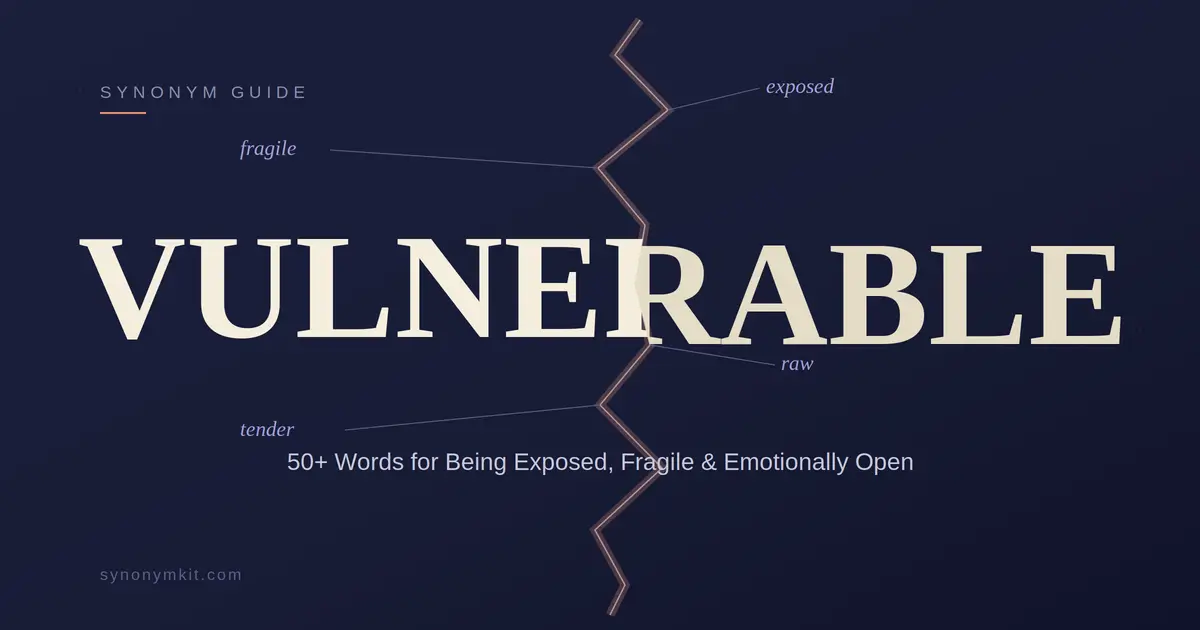
50+ Best Synonyms for Vulnerable (With Meanings & Examples)
A simple word list of synonyms for vulnerable includes exposed, fragile, defenseless, and sensitive. These words describe someone or something that can be easily hurt, harmed, or affected by others.
People use them in daily talk, writing, and stories to show weakness, danger, or emotional openness in a clear way.
Maria stood in front of her small class, hands shaking as she read her poem aloud. She felt open, unsure, and a little scared.
That feeling being seen, being open to hurt is what we often call vulnerable. But writers, teachers, and everyday speakers do not always want to use the same word again and again.
That is why looking for fresh synonyms for vulnerable is so useful. A student writing an essay might need a softer word for a character’s fear.
A blogger telling a personal story might want a word that feels more real. A content writer needs variety so text does not sound repeated.
A daily English user just wants new ways to talk about feelings and danger.
“Vulnerability is not weakness; it is our greatest measure of courage,” wrote researcher Brené Brown.
This one idea changes how we see openness and fear.
“To be alive is to be vulnerable,” said Madeleine L’Engle.
Life itself asks us to accept this truth every single day, in small and big ways.
1. Exposed
Meaning: Exposed means someone or something is not protected from harm.
Examples: The hikers felt exposed on the rocky ridge. He felt exposed without his usual defenses.
2. Fragile
Meaning: Fragile means easily broken, hurt, or damaged in some way.
Examples: Her trust felt fragile after the argument. The old glass vase looked very fragile.
3. Defenseless
Meaning: Defenseless means unable to protect oneself from danger or attack.
Examples: The kitten looked small and defenseless outside. Villagers felt defenseless during the sudden storm.
4. Susceptible
Meaning: Susceptible means likely to be affected or harmed by something.
Examples: Children are susceptible to colds in winter. He seemed susceptible to flattery and praise.
5. Weak
Meaning: Weak means lacking strength, power, or ability to resist harm.
Examples: The bridge looked weak after the flood. Her voice sounded weak and very tired.
6. Sensitive
Meaning: Sensitive means easily affected emotionally or physically by outside things.
Examples: He is sensitive about his old scars. She stayed sensitive to her friend’s mood.
7. Unprotected
Meaning: Unprotected means not covered, guarded, or shielded from possible danger.
Examples: The workers stood unprotected near the fire. Their border remained unprotected during the war.
8. Delicate
Meaning: Delicate means easily damaged, hurt, or upset by small things.
Examples: This is a delicate topic for her. The delicate flower wilted in the sun.
9. Helpless
Meaning: Helpless means unable to help or protect yourself in trouble.
Examples: The baby bird looked helpless on the ground. She felt helpless watching the storm approach.
10. Unguarded
Meaning: Unguarded means not watched, protected, or carefully looked after by anyone.
Examples: He spoke in an unguarded, honest moment. The gate stood unguarded through the night.
11. Powerless
Meaning: Powerless means having no strength, control, or power over events.
Examples: She felt powerless during the long illness. The small team seemed powerless against giants.
12. Frail
Meaning: Frail means weak, thin, or easily hurt in body or mind.
Examples: Her grandmother looked frail after the surgery. His frail hands shook while writing letters.
13. Tender
Meaning: Tender means easily hurt, sore, or emotionally soft in nature.
Examples: The bruise felt tender to the touch. He wrote a tender letter to her.
14. Insecure
Meaning: Insecure means lacking confidence or feeling unsafe about oneself.
Examples: She felt insecure before the big interview. He seemed insecure about his new job.
15. Precarious
Meaning: Precarious means not safe, steady, or certain to last long.
Examples: Their finances were in a precarious state. He stood in a precarious spot high up.
16. Endangered
Meaning: Endangered means at risk of harm, danger, or possible extinction soon.
Examples: The species is endangered due to hunting. Their old traditions felt endangered by change.
17. Unshielded
Meaning: Unshielded means not protected by any cover, barrier, or defense.
Examples: The wires were left dangerously unshielded outside. His heart felt unshielded after the loss.
18. Open to Attack
Meaning: Open to attack means easy for others to criticize, harm, or hurt.
Examples: Sharing secrets left her open to attack. The weak plan was open to attack.
19. At Risk
Meaning: At risk means in a position where harm could easily happen.
Examples: Older patients are often at risk. The old bridge is clearly at risk.
20. Unsafe
Meaning: Unsafe means not safe, secure, or free from possible danger.
Examples: The old ladder looked unsafe to climb. Walking alone at night felt unsafe.
21. Threatened
Meaning: Threatened means facing danger, harm, or possible loss of something important.
Examples: The small shop felt threatened by new stores. She felt threatened by his angry tone.
22. Wounded
Meaning: Wounded means hurt physically or emotionally, often deeply and painfully so.
Examples: His pride felt wounded after the joke. The wounded soldier needed urgent medical care.
23. Easily Hurt
Meaning: Easily hurt means quick to feel pain, sadness, or emotional discomfort.
Examples: She is easily hurt by harsh words. He grew easily hurt during the breakup.
24. Thin Skinned
Meaning: Thin skinned means overly sensitive to criticism, comments, or small remarks.
Examples: He is thin skinned about his old work. She grew thin skinned after harsh reviews.
25. In Danger
Meaning: In danger means facing a real chance of harm or loss.
Examples: The climbers were clearly in danger. Their small business felt truly in danger.
26. Off Guard
Meaning: Off guard means not ready, alert, or prepared for something sudden.
Examples: The question caught him completely off guard. She was off guard during the meeting.
27. Prone to Harm
Meaning: Prone to harm means likely to suffer damage, injury, or unwanted trouble.
Examples: Thin ice is prone to harm skaters. New workers are often prone to harm.
28. Easily Wounded
Meaning: Easily wounded means quick to be hurt physically or emotionally by others.
Examples: His feelings are easily wounded by teasing. She stayed easily wounded after the fight.
29. Soft Hearted
Meaning: Soft hearted means gentle, kind, and easily moved by sadness or pain.
Examples: Grandpa is soft hearted about stray animals. She stayed soft hearted despite tough years.
30. Raw
Meaning: Raw means emotionally open, tender, and not yet fully healed inside.
Examples: Her grief still felt raw and heavy. His words sounded raw and honest.
31. Exposed to Harm
Meaning: Exposed to harm means placed where danger or injury could easily happen.
Examples: Workers stayed exposed to harm daily. Refugees remain exposed to harm often.
32. Under Threat
Meaning: Under threat means facing possible danger, loss, or serious harm soon.
Examples: The forest remains under threat from fires. Small farms felt under threat this year.
33. In a Weak Position
Meaning: This means unable to defend well against pressure or attack.
Examples: The team stood in a weak position. He negotiated from a weak position, sadly.
34. Unable to Defend
Meaning: This means not capable of protecting oneself from harm at all.
Examples: The old fort was unable to defend itself. She felt unable to defend her choice.
35. Easily Affected
Meaning: Easily affected means quickly influenced or changed by outside events or people.
Examples: Crops are easily affected by weather. He is easily affected by loud noise.
36. Susceptible to Attack
Meaning: This means likely to be harmed, hurt, or criticized rather easily.
Examples: The castle was susceptible to attacs. His weak plan was susceptible to attack.
37. In a Precarious Spot
Meaning: This means in an unstable, risky, or uncertain situation currently.
Examples: The company sat in a precarious spot. She found herself in a precarious spot.
38. Left Open
Meaning: Left open means not closed, guarded, or protected against possible harm.
Examples: The door was left open carelessly. Her heart was left open again.
39. Unable to Protect Oneself
Meaning: This means lacking the power or means to stay safe.
Examples: The child was unable to protect himself. Older people are unable to protect themselves easily.
40. At the Mercy of Others
Meaning: This means fully depending on someone else’s choices or actions.
Examples: Renters felt at the mercy of landlords. Patients are at the mercy of doctors.
41. In Harm’s Way
Meaning: In harm’s way means in a place or situation where danger exists.
Examples: Firefighters often stand in harm’s way. She placed herself in harm’s way bravely.
42. Not Safe
Meaning: Not safe means risky, dangerous, or lacking any real form of protection.
Examples: The old wiring is simply not safe. Walking there at midnight feels not safe.
43. Easily Influenced
Meaning: Easily influenced means quick to be persuaded, changed, or swayed by others.
Examples: Young minds are easily influenced by ads. He seemed easily influenced by loud opinions.
44. Weak Willed
Meaning: Weak willed means lacking strong determination or the ability to resist pressure.
Examples: He felt weak willed around old bad habits. She called herself weak willed under stress.
45. Faint Hearted
Meaning: Faint hearted means lacking courage or confidence to face difficult situations bravely.
Examples: This job is not for the faint hearted. He felt faint hearted before the exam.
46. Exploitable
Meaning: Exploitable means able to be used unfairly by someone for their gain.
Examples: His kindness made him easily exploitable, sadly. The system remained exploitable for many years.
47. Shaky
Meaning: Shaky means unstable, uncertain, or lacking firm confidence or physical steadiness.
Examples: Her voice sounded shaky during the speech. The old chair felt shaky and loose.
48. Unstable
Meaning: Unstable means not firm, steady, or likely to stay the same.
Examples: His mood felt unstable after the news. The unstable ground shifted under their feet.
49. Feeble
Meaning: Feeble means very weak in strength, health, or overall physical condition.
Examples: The feeble old dog barked softly outside. His feeble attempt failed to convince anyone.
50. Unfortified
Meaning: Unfortified means without strong walls, defenses, or protection against outside danger.
Examples: The unfortified town fell quickly to raiders. Her unfortified heart broke rather easily.
As you can see, English gives us many ways to describe the same feeling of being open or unprotected.
“The word is half his that speaks, and half his that hears it,” said Michel de Montaigne.
Choosing the right synonym changes how your reader feels the meaning, not just how they read it.
| Synonym (Vulnerable) | Antonym (Vulnerable) |
|---|---|
| Exposed | Protected |
| Fragile | Sturdy |
| Defenseless | Secure |
| Weak | Strong |
| Helpless | Empowered |
| Unprotected | Shielded |
| Powerless | Powerful |
| Precarious | Stable |
| Frail | Robust |
| Unsafe | Safe |
| Insecure | Confident |
| Unguarded | Fortified |
| At Risk | Invincible |
| Susceptible | Resistant |
| Threatened | Secure |
Synonyms for Vulnerable People
When writing about groups who need extra care, words like defenseless, at risk, and unprotected work well. These terms describe people who face higher chances of harm because of age, health, or circumstance.
Reporters, social workers, and students often use them in essays, news stories, and reports. Choosing the right word here shows respect while still being clear and accurate about real risks people face daily.
Synonyms for Vulnerable Populations
When discussing groups facing systemic risk due to poverty, age, health, or displacement writers, researchers, and policymakers often use these terms instead of repeating “vulnerable populations.”
- At Risk Groups Example: Public health programs often target at-risk groups first.
- Marginalized Communities Example: The policy aims to support marginalized communities.
- Underserved Populations Example: Rural clinics serve many underserved populations.
- Disadvantaged Groups Example: The fund provides aid to disadvantaged groups.
Synonyms for Vulnerable Emotionally
To describe someone open with their feelings, try tender, raw, or easily hurt. These words show emotional openness without sounding harsh or clinical.
Bloggers and storytellers often use them to describe a character’s inner world after loss, heartbreak, or honesty.
They help readers connect deeply, because emotional language feels more human than plain, technical descriptions of feelings.
Positive Synonyms for Vulnerable
Not every vulnerable moment is negative. Words like open hearted, honest, and soft hearted show vulnerability as strength, not weakness.
Writers use these when describing courage, trust, or emotional growth. Sharing your true self with others, even when scared, often builds stronger relationships.
This positive framing helps readers see vulnerability as brave rather than shameful in everyday conversations.
Synonyms for Vulnerable in an Essay
Academic and formal writing calls for precise, sophisticated word choices. These synonyms work well in essays, research papers, and reports where a more objective tone is needed.
- Susceptible Example: Individuals in this age group are more susceptible to illness.
- Precarious Example: The community lives in a precarious economic situation.
- At Risk Example: Students from low-income families are often at risk academically.
- Marginalized Example: The essay explores how marginalized groups are affected by policy change.
- Disadvantaged Example: Disadvantaged students may lack access to essential resources.
Synonyms and Antonyms for Vulnerable
Synonyms like fragile, exposed, and weak show openness to harm, while antonyms like strong, protected, and secure show the opposite.
Knowing both helps writers build contrast in stories, essays, and speeches.
This word pair technique makes writing feel balanced and clear. Students especially benefit from learning antonyms alongside synonyms for stronger vocabulary building.
Synonyms for Vulnerable Moments
Life is full of small, tender moments where we feel exposed. Words like raw, unguarded, and open describe these times well.
Think of a quiet confession, a first date, or a hard goodbye. Writers use these synonyms to capture short emotional scenes without sounding overly dramatic, keeping the writing honest, simple, and easy for readers to feel deeply.
Frequently Asked Questions
What is another word for being vulnerable?
Another word for being vulnerable, in the moment, is exposed or unguarded. These words describe a person who has dropped their defenses and feels open to being hurt right now.
This often happens during honest conversations, emotional moments, or times of physical danger.
Writers pick these words to show a temporary state rather than a permanent trait, making a scene feel more immediate and real to readers.
What can I use instead of vulnerable?
Instead of vulnerable, you can use fragile, susceptible, defenseless, or at risk, depending on your context. For emotional writing, try tender or raw.
For danger or safety topics, unprotected or exposed work better. Choosing the right substitute depends on whether you mean physical risk, emotional openness, or social hardship, so always match the word to the specific situation you are describing.
What is another word for “vulnerable”?
A general dictionary style word for “vulnerable” is susceptible, meaning likely to be affected or harmed. Other common choices include weak, sensitive, and helpless.
These words all share the core idea of being open to damage, danger, or influence.
When writing formal content, susceptible and defenseless read as more academic, while weak and sensitive feel more conversational and easy to understand.
What words can I use instead of vulnerability?
For the noun form, try fragility, weakness, openness, or exposure. Each carries a slightly different tone: fragility feels delicate, weakness feels physical, openness feels emotional, and exposure feels risky or unsafe.
Writers exploring mental health or personal growth topics often prefer openness or fragility, since these words feel gentler and less clinical than plain weakness in sensitive, personal writing.
What is another word for vulnerable emotionally?
Another word for vulnerable emotionally is tender or raw. These words describe someone who feels emotionally open, unguarded, and easily affected by hurtful words or difficult situations. Writers use them to show a character’s inner sensitivity without sounding clinical, especially during scenes involving grief, honesty, or personal confession.
What is another word for a vulnerable person?
A vulnerable person can also be called a defenseless individual, an at-risk person, or someone who is exposed to harm. These terms are common in social work, healthcare, and legal writing, where identifying someone’s need for protection or extra care is important and requires clear, respectful language.
What is another word for a vulnerable position?
Another word for a vulnerable position is a precarious position, an exposed position, or a compromised position. These phrases describe a situation where someone lacks safety, stability, or control, often used in business, negotiation, or physical safety contexts to highlight risk or weakness.
Conclusion
Learning new synonyms for vulnerable does more than fill your vocabulary it sharpens how you write, blog, speak, and connect with others. Instead of repeating the same word, you can choose one that fits the exact feeling you want to share, whether that is fear, honesty, danger, or quiet strength.
This small habit makes your essays clearer, your blog posts more engaging, and your daily conversations more colorful and real.
Try using a few of these words in your next email, story, or social post. Notice how a single word change can shift the whole tone of a sentence.
Practice makes this natural over time, and soon these words will simply become part of how you speak and write.
“Words are, of course, the most powerful drug used by humanity,” said Rudyard Kipling.
Choose your words with care, because they shape how others understand you.
“Language is the road map of a culture,” said Rita Mae Brown.
Keep exploring new words, and your writing will only keep growing stronger and richer.

Amelia is a linguistics graduate and lifelong word nerd who believes the right word can change how a sentence feels. She writes and edits vocabulary guides for SynonymKit, helping readers sound sharper and more confident in their writing.