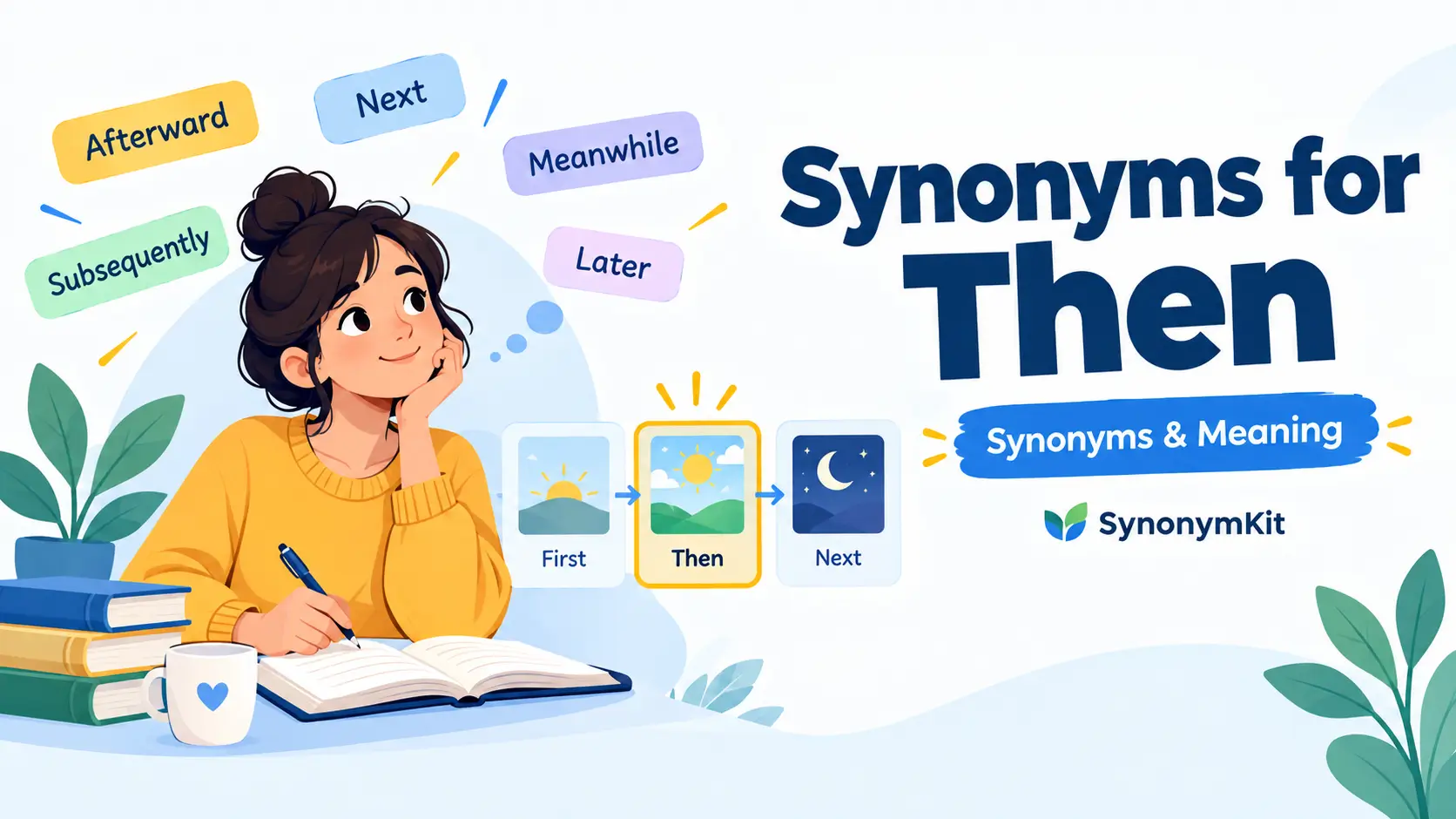
50 Synonyms for Then: Easy Words to Use Instead
Synonyms for then are words that show time or order, such as next, afterward, later, subsequently, or thereafter. These words can replace “then” in sentences about what happens after something else, making your writing smoother, clearer, and less repetitive. Choose the one that fits your tone.
Maya wrote three sentences in a row, and each one started with “then.” She read them aloud and winced. First she packed her bag. Then she locked the door. Then she walked to school. It sounded like a robot reading a list.
One small swap, “Afterward, she walked to school,” made the story flow. Small changes like this make writing feel smooth. It is a tiny change with a big effect.
“Time is what we want most, but what we use worst.” William Penn
Knowing more words for “then” helps everyone. Students can make essays sound smarter. Bloggers can keep readers scrolling. Content writers can avoid repeated words. Daily English users can sound clear and confident when they speak.
This guide gives you 50 easy swaps, with meanings and examples you can copy today. Short words and simple sentences are all you need.
“Variety is the spice of life.” — William Cowper
1. Next
- Meaning: Comes right after something else in a list, order, or time.
- Examples:
- Mix the flour first, and next add eggs.
- Next, we will walk to the market.
2. Afterward
- Meaning: Happens at a later time, after something else has taken place.
- Examples:
- We watched the game and ate pizza afterward.
- Afterward, she called her mom to chat.
3. Later
- Meaning: Means at a time that comes after now or after something.
- Examples:
- I will finish my homework later tonight.
- Two hours later, the rain finally stopped.
4. Subsequently
- Meaning: Describes something that happens after an earlier event, often in formal writing.
- Examples:
- She applied and was subsequently offered the job.
- The data was subsequently checked by two experts.
5. Thereafter
- Meaning: Means from that time on, or after a certain point.
- Examples:
- She joined the club and thereafter attended weekly.
- Thereafter, the town was known for its mangoes.
6. After that
- Meaning: Shows the next event that happens once the first one ends.
- Examples:
- We ate lunch, and after that we napped.
- After that, the teacher handed out the papers.
7. Following that
- Meaning: Introduces what comes next, in a polite and slightly formal way.
- Examples:
- Following that, the manager shared the new plan.
- Following that, we all clapped for the winner.
8. Soon after
- Meaning: Means only a short time after something else has happened.
- Examples:
- Soon after lunch, the bus arrived at school.
- He left soon after the movie began.
9. Shortly after
- Meaning: Describes an event that follows another one in a very short time.
- Examples:
- Shortly after dinner, the lights went out.
- She texted me shortly after she got home.
10. Not long after
- Meaning: Tells us something happened after a brief wait, not much later.
- Examples:
- Not long after, the rain began to fall.
- He sat down, and not long after, fell asleep.
11. Right after
- Meaning: Means at the very next moment that follows something else.
- Examples:
- Call me right after you finish your class.
- We cleaned up right after the party ended.
12. Immediately after
- Meaning: Shows something happened with no gap or wait after another event.
- Examples:
- Immediately after the bell, students rushed outside.
- He apologized immediately after he made the mistake.
13. Presently
- Meaning: Means soon, or in a little while from the time now.
- Examples:
- The guide will arrive presently, so please wait.
- Presently, a soft knock came at the door.
14. Eventually
- Meaning: Means in the end, after a long time or many steps.
- Examples:
- Eventually, the little seed grew into a tree.
- She eventually learned how to ride a bike.
15. In due course
- Meaning: Means at the right time later, as things naturally move forward.
- Examples:
- You will get your results in due course.
- In due course, the team will announce winners.
16. Finally
- Meaning: Marks the last step or the end of a long wait.
- Examples:
- Finally, add a pinch of salt and stir.
- The train finally arrived after two long hours.
17. Lastly
- Meaning: Introduces the final item or point in a list or talk.
- Examples:
- Lastly, remember to thank your guests warmly.
- Lastly, check your spelling before you submit.
18. At last
- Meaning: Shows relief that something has happened after a long wait.
- Examples:
- At last, the summer holidays have begun.
- He found his lost keys at last.
19. Thereupon
- Meaning: Means right after that and often because of it, in formal writing.
- Examples:
- He smiled, and thereupon the shy girl waved.
- The king spoke, thereupon the crowd fell silent.
20. Whereupon
- Meaning: Joins two events, where the second follows the first at once.
- Examples:
- She read the note, whereupon she started laughing.
- The bell rang, whereupon everyone stood up.
21. Straightaway
- Meaning: Means at once, with no delay after something else happens.
- Examples:
- He saw the spill and cleaned it straightaway.
- Straightaway, the nurse ran to help him.
22. At that point
- Meaning: Points to one exact moment in the middle of a story.
- Examples:
- At that point, I decided to ask for help.
- At that point, the room became very quiet.
23. From there
- Meaning: Describes what comes next after reaching a place or a step.
- Examples:
- From there, we walked to the old fort.
- Learn basic words, and from there, build more.
24. Thence
- Meaning: Means from that place or from that point, in old style English.
- Examples:
- They sailed to Spain and thence to Italy.
- The river flows south and thence to the sea.
25. Thenceforth
- Meaning: Means from that time forward, usually seen in formal or legal writing.
- Examples:
- Thenceforth, the school opened at eight sharp.
- She was thenceforth known as the brave captain.
26. Consequently
- Meaning: Shows that one thing happens as the result of another thing.
- Examples:
- He studied hard and consequently passed the test.
- It rained all day; consequently, we stayed home.
27. Therefore
- Meaning: Means for that reason, and links a cause to its effect.
- Examples:
- I was tired; therefore, I went to bed.
- She practiced daily and therefore played very well.
28. Thus
- Meaning: Means in this way or as a result, often in formal writing.
- Examples:
- The plan failed; thus, we tried a new one.
- He saved money and thus bought a bike.
29. Hence
- Meaning: Means for this reason, and often points to a clear result.
- Examples:
- The road was icy, hence the long delay.
- She loves art, hence her colorful room.
30. Accordingly
- Meaning: Means in a way that fits what was just said or done.
- Examples:
- The rules changed, so we acted accordingly.
- Prices rose, and the shops adjusted accordingly.
31. As a result
- Meaning: Shows the outcome that comes from an earlier action or cause.
- Examples:
- As a result, our team won the final.
- As a result, the shop closed early today.
32. In that case
- Meaning: Means if that is true, so here is what follows.
- Examples:
- In that case, I will bring an umbrella.
- In that case, let us leave early.
33. In turn
- Meaning: Shows each event happens one after the other, in a chain.
- Examples:
- She helped him, and he helped others in turn.
- Each student spoke in turn about their hobby.
34. Furthermore
- Meaning: Adds a new point that supports what you already said.
- Examples:
- The park is big; furthermore, it is free.
- Furthermore, the hotel offers free breakfast every day.
35. Moreover
- Meaning: Adds more information to make your earlier point even stronger.
- Examples:
- The phone is cheap; moreover, it lasts long.
- Moreover, the teacher was kind and very patient.
36. In addition
- Meaning: Adds another fact or idea to the one you just gave.
- Examples:
- In addition, we need two more chairs.
- She sings well, and in addition, she dances.
37. Additionally
- Meaning: Adds one more idea to your list in a formal way.
- Examples:
- Additionally, bring a pen and a notebook.
- Additionally, the class will meet on Saturday.
38. Also
- Meaning: Means too or as well, and adds a simple extra idea.
- Examples:
- I like tea, and I also like juice.
- She is also learning to play the guitar.
39. Besides
- Meaning: Adds one more reason, often to support your choice or opinion.
- Examples:
- I cannot go; besides, it is too late.
- Besides, the movie tickets are very cheap today.
40. What is more
- Meaning: Adds a stronger or surprising point after an earlier one.
- Examples:
- What is more, the soup was completely free.
- He won, and what is more, he smiled.
41. Beyond that
- Meaning: Adds something else apart from what has already been said.
- Examples:
- Beyond that, I have nothing else to add.
- Beyond that, the road is quiet and empty.
42. At that time
- Meaning: Points back to a certain moment in the past or story.
- Examples:
- At that time, I lived in a small village.
- We had no phones at that time.
43. Back then
- Meaning: Refers to an earlier period in the past, in a casual way.
- Examples:
- Back then, we played outside until sunset.
- Life felt simple back then, didn’t it?
44. In those days
- Meaning: Talks about a past time, often with a warm or old feeling.
- Examples:
- In those days, letters took weeks to arrive.
- My grandfather walked miles to school in those days.
45. At the time
- Meaning: Describes the exact period when something was happening in the past.
- Examples:
- I was ten years old at the time.
- At the time, nobody knew the secret.
46. Formerly
- Meaning: Means at an earlier time, but no longer true today.
- Examples:
- This café was formerly a small bookshop.
- Mr. Khan, formerly our teacher, now lives abroad.
47. In the past
- Meaning: Refers to a time that has already gone by long ago.
- Examples:
- In the past, travel took much longer.
- I was very shy in the past.
48. Way back when
- Meaning: Means a very long time ago, in a playful tone.
- Examples:
- Way back when, this road was just mud.
- We met way back when we were kids.
49. Following this
- Meaning: Points to the next step that comes after what was just mentioned.
- Examples:
- Following this, students will take a short quiz.
- Following this, the speaker answered our questions.
50. Afterwards
- Meaning: Means the same as afterward and is common in British English.
- Examples:
- Let us rest afterwards and drink some tea.
- Afterwards, everyone went home feeling tired but happy.
“Brevity is the soul of wit.” William Shakespeare
Synonyms for Then and Next
When you want to show order, pair then with next and its friends. Words like next, after that, following that, and afterward guide readers through steps in a recipe, a plan, or a story. Use them in order: first, next, after that, finally.
This simple chain keeps your steps clear and stops you from repeating the same small word again and again.
Synonyms for Then in an Essay
Essays need a more serious voice, so casual words like “and then” can feel weak. Try subsequently, thereafter, consequently, furthermore, and therefore instead. Each one has a job: some show time, while others show cause or add a point.
For example, write “The results were checked; consequently, the plan changed.” Match the word to your meaning, and your essay will sound calm, clear, and confident.
Synonyms for Then Again
Here, then again does not mean time. It means “on the other hand” and shows a change of thought. You can swap it for on the other hand, even so, still, however, or that said.
For example: “The jacket is costly; that said, it will last for years.” Use these words when you weigh two ideas or quickly change your mind.
Synonyms for Thence
Thence is an old, formal word that means “from that place” or “from that time.” You will see it in history books and legal texts. Good swaps include from there, from that point, thereafter, and thenceforth.
For example: “She traveled to Delhi and thence to Agra.” In daily speech, from there is easier and sounds far more natural to most listeners.
FAQ
What Can I Say Instead of “Then”?
You can say next, afterward, later, after that, or subsequently, depending on the sentence. Use next and afterward for simple steps, and subsequently for formal writing. If “then” means “in that case,” try therefore or so.
Reading your sentence aloud quickly helps you pick the word that sounds right, and it also shows where you have repeated “then” far too often.
What Is a Better Transition Word Than “Then”?
The best transition word depends on your goal. For time, choose afterward, subsequently, or in due course. For cause and effect, consequently and as a result work well. To add a point, use moreover or in addition.
Pick one that matches your meaning. Strong transitions guide readers smoothly from one idea to the next, so your writing feels organized instead of choppy.
What Is Another Word for “Then”?
In casual talk, another word for “then” is so or next. In school writing, use afterward or later. For a past time, back then or at that time works. A single word rarely fits every case, because “then” has several meanings: time, order, and result.
Always check the meaning first. Once you know the meaning, choosing a replacement becomes easy and fast.
What Is a Synonym for “Then Onwards”?
A good synonym for “then onwards” is thereafter or from then on. You can also say from that time forward, ever since, or thenceforth in formal writing. For example: “She exercised daily from then on.”
These phrases clearly show that a change started at one point and kept going. They are really perfect for stories, biographies, work updates, and personal news.
Conclusion
Learning synonyms is one of the easiest ways to improve your writing, blogging, speaking, and everyday communication. When you know many words for “then,” you stop repeating yourself, and your sentences begin to flow.
Readers stay longer, listeners follow you better, and your ideas sound clear and sharp. Even a small change, like swapping “then” for “afterward,” can make your work feel more polished and professional.
“The difference between the almost right word and the right word is really a large matter.” Mark Twain
Now it is your turn to practice. Use one new word in an email today. Try another in your next essay or blog post. Say a different one while chatting with a friend. Start small, and add a new word each day. Soon, choosing between next, afterward, and subsequently will feel natural.
“Words are, of course, the most powerful drug used by persons.” Rudyard Kipling
Remember that the best word is not always the fanciest one. It is the one that fits your meaning, your reader, and your tone. Keep this list close, return to it often, and enjoy watching your writing grow stronger. Happy writing!

Sarah is a freelance content writer and grammar enthusiast with over 6 years of experience helping students and bloggers write with more clarity. She joined SynonymKit to make vocabulary-building simple and accessible for everyone, one word list at a time.