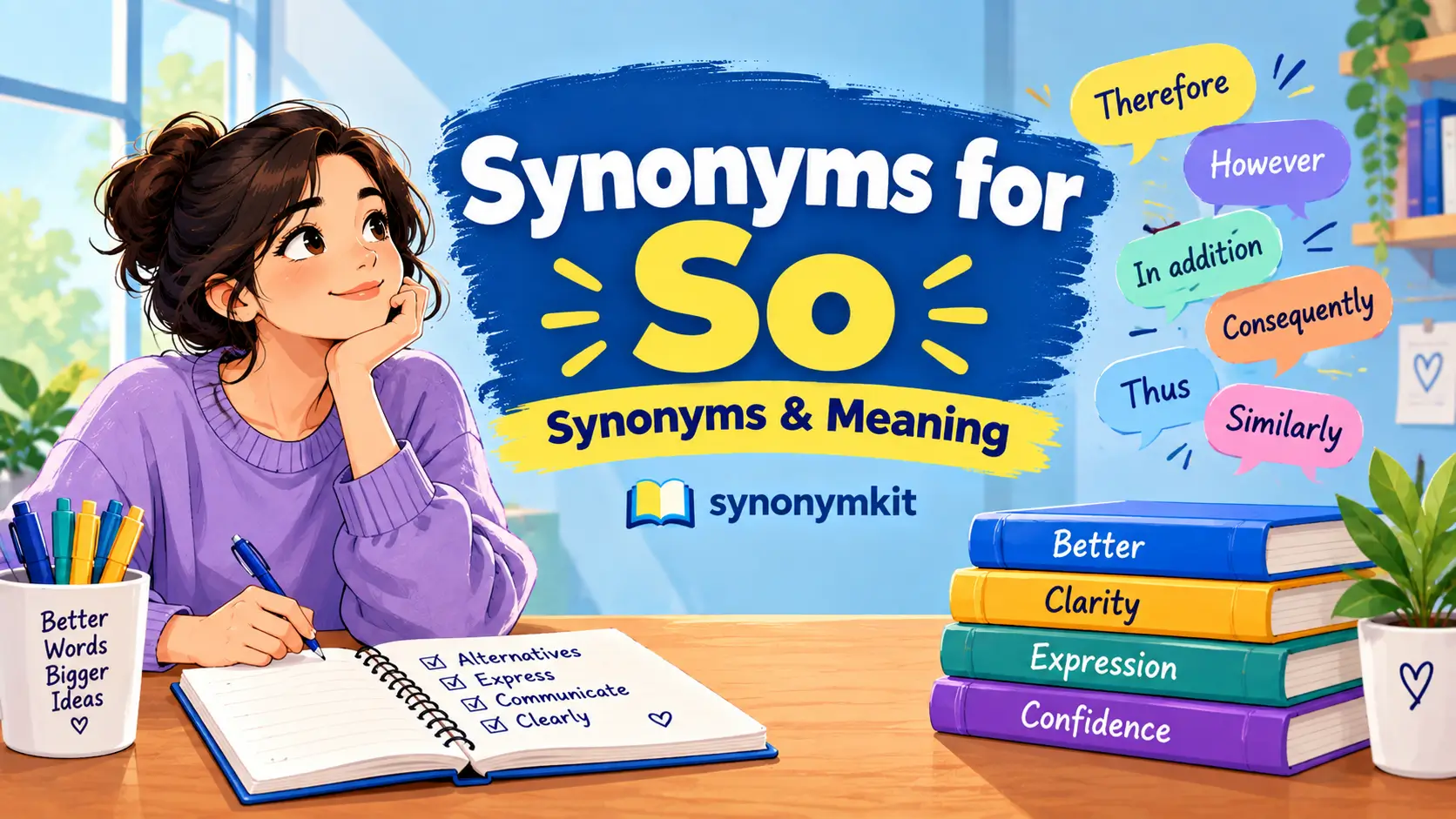
Synonyms for So: 50 Better Words to Use Instead
A good synonym for “so” depends on how you use it. When “so” means “as a result,” you can say therefore, thus, or hence. When it means “very,” try really, extremely, or incredibly. Other words like consequently and accordingly also work well in writing.
Maya read her school essay out loud and winced. Almost every sentence began with the same tiny word: so. It felt flat, like a song stuck on one note.
Then she swapped a few of them for fresher choices, and the page came alive. “It rained, so we stayed home” became “It rained, therefore we stayed home.”
“The difference between the almost right word and the right word is really a large matter.” Mark Twain
Finding new words for “so” helps everyone. Students sound sharper in essays. Bloggers keep readers hooked longer.
Content writers sound more polished and professional. Daily English users sound more confident in conversation.
Because “so” does two jobs, it needs two kinds of replacements. Sometimes it shows a result, and sometimes it adds strength. This guide gives you 50 clear options with simple meanings and short examples.
“The limits of my language mean the limits of my world.” Ludwig Wittgenstein
1. Therefore
- Meaning: Shows that one thing happens because of another thing.
- Examples: It was late; therefore, we went home. She studied hard; therefore, she passed the test.
2. Thus
- Meaning: Shows a result that follows clearly from what you just said.
- Examples: He saved money; thus, he bought a bike. The road closed; thus, traffic moved very slowly.
3. Hence
- Meaning: A formal word that shows why something is true.
- Examples: The shop is cheap, hence its long queues. Prices rose, hence fewer people traveled this year.
4. Consequently
- Meaning: Shows what happened as a direct effect of an earlier event.
- Examples: He missed the bus; consequently, he arrived late. It snowed all night; consequently, schools stayed closed.
5. As a Result
- Meaning: Tells the reader what came out of an earlier action.
- Examples: We practiced daily; as a result, we improved. She skipped breakfast; as a result, she felt weak.
6. Accordingly
- Meaning: Means in a way that fits the situation just described.
- Examples: The rules changed, and we acted accordingly. Read the notice carefully and respond accordingly today.
7. For This Reason
- Meaning: Points back to a cause you have already explained clearly.
- Examples: I forgot my keys; for this reason I waited outside. Milk spoils fast; for this reason we chill it.
8. That Is Why
- Meaning: Introduces the reason behind something in a friendly, simple way.
- Examples: It was raining; that is why I stayed in. You lied to me; that is why I’m upset.
9. Because of This
- Meaning: Links a result directly to the cause just mentioned.
- Examples: The lights failed. Because of this, we lit candles. Rent went up. Because of this, they moved out.
10. So That
- Meaning: Shows the purpose or goal behind an action.
- Examples: She wrote notes so that she would remember. Leave early so that you avoid the traffic.
11. In Order That
- Meaning: A formal way to show the goal of an action.
- Examples: He trained daily in order that he might win. Doors open early in order that guests can enter.
12. Thereby
- Meaning: Shows that one action leads to another result.
- Examples: She saved daily, thereby reaching her goal sooner. He apologized quickly, thereby ending the long argument.
13. Ergo
- Meaning: A short, slightly playful word meaning “for that reason.”
- Examples: The cake is gone, ergo someone ate it. It’s Monday, ergo I need more coffee.
14. Then
- Meaning: Shows what comes next or what follows from a condition.
- Examples: If you’re tired, then take a short break. First we ate, then we watched a movie.
15. And So
- Meaning: Begins a result in a smooth, story like way.
- Examples: The rain stopped, and so we walked outside. He trusted her, and so he told everything.
Now let’s move from result words to strength words. Writers often use “so” to mean “very,” and this is where fresh choices matter most.
“The road to hell is paved with adverbs.” — Stephen King
16. Very
- Meaning: Adds strength to a word by showing a high level.
- Examples: This soup is very hot right now. She is very proud of her brother.
17. Really
- Meaning: A friendly word that adds strength and sounds natural in speech.
- Examples: I really enjoyed the movie last night. It was really kind of you to help.
18. Extremely
- Meaning: Shows that something is at a very high or strong level.
- Examples: The desert was extremely hot at noon. She felt extremely happy after the good news.
19. Incredibly
- Meaning: Adds strength and suggests something is hard to believe.
- Examples: The view from the hill was incredibly beautiful. He worked incredibly hard for the final exam.
20. Truly
- Meaning: Adds sincere strength and shows that you really mean it.
- Examples: I am truly thankful for your kind help. It was a truly wonderful evening for everyone.
21. Highly
- Meaning: Shows a high degree, often used with skilled or likely.
- Examples: She is a highly skilled painter in town. Rain is highly likely later this evening.
22. Remarkably
- Meaning: Adds strength to show something is surprising or worth noticing.
- Examples: The child was remarkably calm during the storm. The test was remarkably easy for everyone.
23. Exceptionally
- Meaning: Shows that something is far better or stronger than usual.
- Examples: Her memory is exceptionally sharp for her age. The chef made an exceptionally tasty soup.
24. Especially
- Meaning: Adds focus and strength to one special part of the idea.
- Examples: I love summer, especially the long sunny evenings. Be careful, especially near the busy road crossing.
25. Awfully
- Meaning: A casual word that adds strength, like very or really.
- Examples: You are awfully quiet tonight, my friend. It is awfully cold outside this morning.
26. Terribly
- Meaning: A strong word that adds heavy feeling to what follows.
- Examples: I am terribly sorry for the long delay. She was terribly nervous before the big interview.
27. Immensely
- Meaning: Shows something is very large in size or in feeling.
- Examples: The whole class enjoyed the trip immensely. Your kind help mattered immensely to our family.
28. Tremendously
- Meaning: Adds great strength and is often used with positive feelings.
- Examples: Our team has grown tremendously this year. He was tremendously proud of his little sister.
29. Such
- Meaning: Adds strength before a noun, often with a or an.
- Examples: That was such a lovely surprise today. She has such a warm and friendly smile.
30. Quite
- Meaning: Adds a fairly strong level, a little softer than very.
- Examples: The movie was quite funny in places. He is quite tall for a young boy.
31. Deeply
- Meaning: Adds strength to strong feelings or thoughts that go far inside.
- Examples: I was deeply moved by her kind words. He deeply cares about his old friends.
32. Hugely
- Meaning: Adds strength to show something is very big or popular.
- Examples: The new game was hugely popular last summer. She is hugely talented in music and art.
33. Utterly
- Meaning: Shows something is complete, with no part left out.
- Examples: The room was utterly silent after the speech. He felt utterly lost in the busy city.
34. Totally
- Meaning: Shows something is complete and sounds casual in daily talk.
- Examples: I totally forgot about the meeting this morning. That idea is totally brilliant, my friend.
35. Absolutely
- Meaning: Adds full strength and shows you are completely sure.
- Examples: You are absolutely right about the plan. It was absolutely freezing on the mountain.
36. In That Case
- Meaning: Shows what follows if the earlier idea is true.
- Examples: The bus left. In that case, we walk. Are you busy? In that case, rest today.
37. As Such
- Meaning: Shows something follows from the role or nature just named.
- Examples: He is the captain and, as such, must lead. This is a gift and, as such, is free.
38. Which Is Why
- Meaning: Joins a reason to a result in one flowing sentence.
- Examples: I skipped lunch, which is why I’m hungry. She practiced daily, which is why she won.
39. With That in Mind
- Meaning: Shows a next step based on what you just learned.
- Examples: Exams are near. With that in mind, study early. Money is tight. With that in mind, spend carefully.
40. For That Reason
- Meaning: Points to an earlier cause and introduces the result.
- Examples: He was ill; for that reason he stayed home. Rules are strict; for that reason, read them twice.
41. On Account of This
- Meaning: A slightly formal phrase that ties a result to its cause.
- Examples: Snow fell heavily; on account of this, flights stopped. He was tired; on account of this, he slept.
42. Subsequently
- Meaning: Shows what happened later, as a next step in time.
- Examples: She moved abroad and subsequently opened a shop. He tripped, and subsequently missed the final race.
43. Thereupon
- Meaning: A formal word that means right after that event happened.
- Examples: He finished speaking; thereupon the audience clapped loudly. The bell rang; thereupon the students left quickly.
44. Whereupon
- Meaning: Shows something happened straight after and because of the earlier event.
- Examples: She smiled, whereupon the shy boy relaxed. The teacher entered, whereupon the noise stopped completely.
45. Extraordinarily
- Meaning: Adds strength to show something goes far beyond the normal level.
- Examples: The ocean was extraordinarily calm that morning. She is extraordinarily patient with young children.
46. Particularly
- Meaning: Points out one thing as more special than the others.
- Examples: I’m particularly fond of the blue curtains here. Roads were particularly slippery near the old bridge.
47. Seriously
- Meaning: Adds strong feeling and shows that you truly mean it.
- Examples: That cake is seriously delicious; try one. He was seriously upset about the lost dog.
48. Mighty
- Meaning: An old fashioned casual word that adds strength, like very.
- Examples: That was a mighty fine meal, my friend. The old man looked mighty proud today.
49. Ever So
- Meaning: A friendly, polite way to say very or extremely.
- Examples: Thank you ever so much for the gift. The baby looked ever so sleepy after lunch.
50. Well
- Meaning: A soft opener that starts a new thought or reply.
- Examples: Well, let’s begin the lesson for today. Well, that went better than I expected.
Synonyms for So Many
“So many” shows a large number. Good replacements include numerous, countless, plenty of, a great many, and lots of. Use “numerous” in formal writing and “lots of” when chatting with friends.
For example, “So many people came” becomes “Countless people came.” Pick the option that matches your tone, and your sentence will sound natural and clear to every reader.
Synonyms for So Far
“So far” means up to now. Try until now, thus far, up to this point, or as yet. “Thus far” fits formal reports well, while “until now” suits daily talk.
For example, “So far, the plan works” becomes “Thus far, the plan works.” These words all look back at time already passed, so keep your verb tense matched for smooth, easy reading.
Synonyms for So Called
“So called” names something the way others do, often with doubt. Useful replacements are alleged, supposed, self styled, self proclaimed, and so named. Use “alleged” or “supposed” when you question the label.
For example, “The so called expert was wrong” becomes “The self proclaimed expert was wrong.” Choose carefully, because these words can sound critical and may change how readers feel about the person.
Synonyms for So True
“So true” shows strong agreement. Alternatives include absolutely right, very true, exactly, spot on, and undeniably true. “Spot on” is casual and cheerful, while “undeniably true” suits formal writing.
For example, “That is so true” becomes “That is spot on.” Match the word to your audience, and your reply will feel warm, natural, and confident in both messages and conversations.
Synonyms for So Long
“So long” has two meanings. For a long time, try ages, for ages, such a long time, or lengthy. As a goodbye, use farewell, goodbye, see you later, or take care.
For example, “I waited so long” becomes “I waited for ages.” Check the meaning first, and you will pick the right word every time.
FAQ
What Can I Use Instead of “So”?
Your best choice depends on the job the word does. To show a result, use therefore, thus, or as a result. To add strength, use very, really, or extremely. To show purpose, try so that or in order that.
Check your sentence first, then choose the matching group. This simple habit makes your writing clearer, more varied, and far more enjoyable to read.
What Is a Better Transition Word for “So”?
The best transition words show cause and effect. Try therefore, consequently, as a result, or for this reason. Place them at the start of a sentence and add a comma after them.
For example, “The road was closed. Consequently, we took another route.” These words guide readers smoothly from one idea to the next and make your paragraphs feel organized and professional.
What Is a More Formal Way to Say “So”?
For formal writing, choose hence, thus, accordingly, consequently, or therefore. They suit essays, business emails, reports, and school assignments. Avoid starting formal sentences with “so,” because it can sound too casual.
For example, “The budget fell; hence, we cut costs.” Formal words show respect and care, and they help your message sound polished and trustworthy to teachers, clients, and managers.
What Are 10 Examples of So?
Here are ten simple sentences using “so.” 1) I was tired, so I slept. 2) She is so kind. 3) It was so cold. 4) He ran so fast. 5) So, what happened next? 6) I think so. 7) Hurry so we can leave. 8) They were so proud. 9) So far, so good. 10) I hope so.
Conclusion
Learning synonyms is one of the easiest ways to grow as a writer and speaker. When you replace a tired word like “so” with a better choice, your sentences become clearer, stronger, and more interesting. Bloggers keep readers longer, students earn better marks, and speakers sound calm and confident.
You now have 50 useful options, from therefore and consequently to really and absolutely. Do not try to learn them all today.
Pick three or four favorites and use them in your next email, essay, or chat. Small daily practice builds a large vocabulary over time.
“Words are, of course, the most powerful drug used by persons.” Rudyard Kipling
Remember that the right word is not always the fanciest word. It is the one that fits your meaning, your audience, and your tone. Keep this list nearby, and revisit it whenever your writing feels flat.
“Language is the road map of a culture.” Rita Mae Brown
Every new word you learn is another step on that road. Keep reading, keep writing, and keep practicing.

James is a former English teacher turned content strategist who’s passionate about making language learning less intimidating. At SynonymKit, he focuses on curating word lists that are practical for everyday writing, essays, and professional communication.