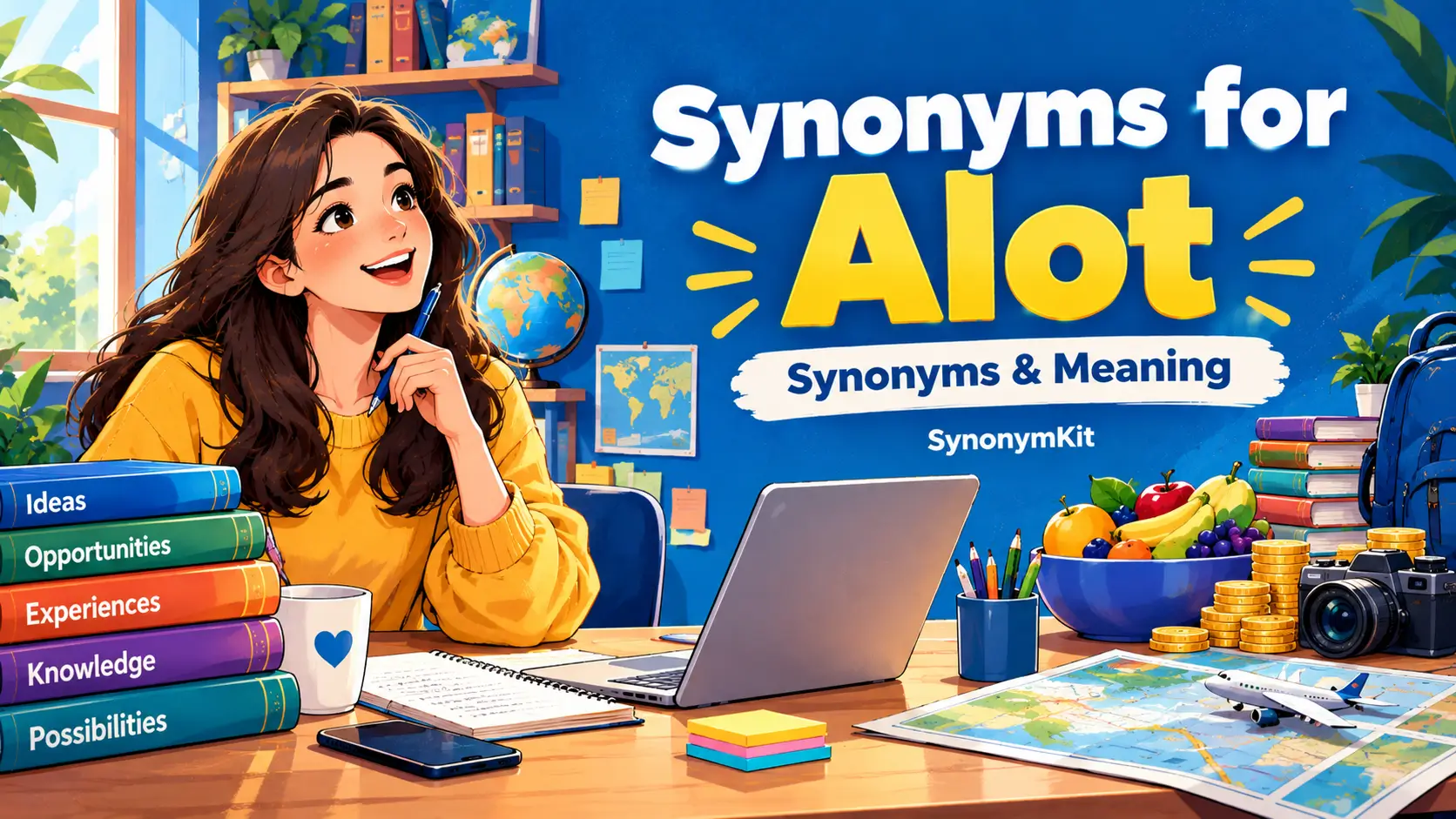
45 Synonyms for A Lot: Better Words for Everyday English
The phrase “a lot” has many useful alternatives, such as many, much, plenty, numerous, and abundant. Learning synonyms for a lot helps you describe large amounts, talk about people, discuss money, and express strong feelings. Choose the best word based on your sentence and whether you need casual or formal English.
Imagine writing a school essay about your favorite book. You want to say that you learned a lot, enjoyed a lot of stories, and met a lot of interesting characters. The words make sense, but repeating the same phrase can make your writing feel dull.
You can make your sentences more interesting by choosing different words. For example, instead of saying, “I have a lot of books,” you could write, “I have many books” or “I have plenty of books.” Both sentences sound clear and natural.
Students can use these words to make essays and homework better. Bloggers can make their posts easier and more fun to read. Content writers can avoid repeating the same phrases. Daily English users can speak with more confidence and express their ideas clearly.
“The limits of my language mean the limits of my world.”
The best word depends on what you want to say. Some alternatives work well with things you can count, while others describe amounts, feelings, or actions. Learning these differences will help you choose words that fit.
“Words are, of course, the most powerful drug used by persons.”
The phrase a lot can describe a large number, a large amount, or something that matters deeply. The following words can help you express these ideas in different ways. Remember that “a lot” is the standard spelling; “alot” is a common spelling mistake.
1. Many
Meaning: Many describes a large number of people, animals, or things.
Examples:
- Many students joined our school trip today.
- She has many friends in her new class.
2. Much
Meaning: Much describes a large amount of something that cannot be counted separately.
Examples:
- I do not have much free time.
- How much sugar should I add today?
3. Plenty
Meaning: Plenty means there is enough of something, often more than needed.
Examples:
- We have plenty of food for everyone.
- There is plenty of time before class starts.
4. Numerous
Meaning: Numerous means there are many people or things in one group.
Examples:
- Numerous guests came to the birthday party.
- She received numerous messages after her speech.
5. Several
Meaning: Several means more than two but not a very large number.
Examples:
- I visited several shops after school today.
- Several people asked about the new project.
6. Lots
Meaning: Lots means many things or a large amount of something.
Examples:
- We took lots of pictures during our trip.
- He has lots of ideas for the project.
7. Loads
Meaning: Loads is an informal word for a large amount or number.
Examples:
- She has loads of work to finish tonight.
- We saw loads of birds near the lake.
8. Tons
Meaning: Tons is a casual way to describe a very large amount.
Examples:
- I have tons of homework this weekend.
- They brought tons of snacks for everyone.
9. Heaps
Meaning: Heaps means a large amount or number of something in casual English.
Examples:
- We have heaps of clothes to wash today.
- He learned heaps of new words this month.
10. Abundant
Meaning: Abundant means there is a large amount of something available.
Examples:
- Fresh fruit is abundant during summer here.
- The garden has abundant flowers this year.
11. Ample
Meaning: Ample means there is enough of something, with some extra available.
Examples:
- We have ample space for all guests.
- Please allow ample time to reach the airport.
12. Numerous Amounts
Meaning: This phrase describes many amounts, but other words often sound more natural.
Examples:
- The report lists numerous amounts from each store.
- We checked numerous amounts before choosing the price.
13. Countless
Meaning: Countless means there are so many things that counting them is difficult.
Examples:
- She has countless memories of her childhood home.
- Countless stars filled the sky above us.
14. A Great Deal
Meaning: A great deal describes a large amount, especially in formal or careful speech.
Examples:
- We learned a great deal from our teacher.
- This project requires a great deal of patience.
15. A Large Number
Meaning: A large number describes many separate people, objects, or other countable things.
Examples:
- A large number of fans attended the match.
- A large number of students passed the test.
16. A Large Amount
Meaning: A large amount describes much of something that is measured rather than counted.
Examples:
- The recipe needs a large amount of water.
- She spent a large amount of money yesterday.
17. A Wealth of
Meaning: A wealth of means a rich supply of useful things or ideas.
Examples:
- The website offers a wealth of learning resources.
- Her notebook contains a wealth of creative ideas.
18. A Host of
Meaning: A host of means a large number of people or things.
Examples:
- A host of visitors came to the museum.
- The team faced a host of new challenges.
19. A Myriad of
Meaning: A myriad of means a very large number of different things.
Examples:
- The market sells a myriad of colorful gifts.
- She explored a myriad of choices before deciding.
20. Masses
Meaning: Masses means a very large number of people or things in casual speech.
Examples:
- Masses of fans waited outside the stadium.
- Masses of leaves covered our garden path.
21. Scores
Meaning: Scores means many people or things, often more than a few dozen.
Examples:
- Scores of people joined the town parade.
- We found scores of shells along the beach.
22. A Bunch
Meaning: A bunch is an informal way to describe many similar things or people.
Examples:
- I bought a bunch of fresh bananas today.
- A bunch of friends came over after school.
23. A Whole Lot
Meaning: A whole lot emphasizes that something is present in a large amount.
Examples:
- I learned a whole lot during the course.
- She has a whole lot of work today.
24. A Great Many
Meaning: A great many means a very large number of countable people or things.
Examples:
- A great many guests arrived before noon.
- A great many books filled the library shelves.
25. Substantial
Meaning: Substantial describes an amount or size that is large or important.
Examples:
- The company made substantial progress this year.
- We need substantial evidence before making decisions.
26. Considerable
Meaning: Considerable describes an amount that is large enough to matter.
Examples:
- She spent considerable time preparing for the exam.
- The repair caused considerable trouble for everyone.
27. Extensive
Meaning: Extensive means covering a large area, amount, or range of information.
Examples:
- The team carried out extensive research last month.
- This guide provides extensive details about the topic.
28. Vast
Meaning: Vast describes something extremely large in size, amount, or range.
Examples:
- The library holds a vast collection of books.
- We crossed a vast field during our walk.
29. Massive
Meaning: Massive means very large in size, scale, or amount.
Examples:
- The charity received a massive number of donations.
- They built a massive wall around the garden.
30. Enormous
Meaning: Enormous describes something that is extremely large or greater than expected.
Examples:
- The family prepared an enormous meal for guests.
- He made an enormous effort to help us.
31. Immense
Meaning: Immense means extremely large in size, amount, or degree.
Examples:
- The project required immense care and attention.
- She felt immense joy after hearing the news.
32. Ample Amount
Meaning: Ample amount means enough of something with extra left over.
Examples:
- We brought an ample amount of drinking water.
- The room has an ample amount of light.
33. More Than Enough
Meaning: More than enough means there is enough of something and extra remains.
Examples:
- We have more than enough chairs for guests.
- She packed more than enough food for lunch.
34. Overwhelming
Meaning: Overwhelming describes an amount or feeling that is very strong or hard to manage.
Examples:
- The team received overwhelming support from local people.
- I felt overwhelming joy when my family arrived.
35. Extra
Meaning: Extra means more than the usual amount or what is needed.
Examples:
- We made extra sandwiches for our guests.
- Please bring extra paper for the class activity.
36. Additional
Meaning: Additional means added to what already exists or has been provided.
Examples:
- We need additional chairs for the meeting.
- She gave additional details about the school event.
37. Plenty of
Meaning: Plenty of means a large supply of something that is available.
Examples:
- There are plenty of apples in the basket.
- We have plenty of time to finish lunch.
38. In Abundance
Meaning: In abundance means something exists in large amounts or numbers.
Examples:
- Wildflowers grow in abundance near the river.
- Fresh vegetables are available in abundance this season.
39. Profuse
Meaning: Profuse means something appears or happens in a large amount.
Examples:
- He offered profuse thanks to the helpful staff.
- Profuse rain flooded the streets overnight.
40. Prolific
Meaning: Prolific describes someone or something that produces many things or results.
Examples:
- She is a prolific writer of children’s books.
- The prolific artist created many paintings this year.
41. Frequently
Meaning: Frequently means something happens many times or at short intervals.
Examples:
- We frequently visit our grandparents on weekends.
- He frequently asks questions during the lesson.
42. Often
Meaning: Often means something happens many times, though not every single time.
Examples:
- I often read stories before going to bed.
- She often walks to work with her friend.
43. Repeatedly
Meaning: Repeatedly means something happens again and again over time.
Examples:
- The phone rang repeatedly during the meeting.
- He repeatedly checked his answers before submitting them.
44. Deeply
Meaning: Deeply can mean very strongly when talking about feelings or personal importance.
Examples:
- Your kind words mean a lot to me.
- She deeply values the support of her friends.
45. Tremendously
Meaning: Tremendously means to a very great degree or by a large amount.
Examples:
- Her English improved tremendously after daily practice.
- The team benefited tremendously from the extra training.
Usage tip: Some words above are best for specific contexts rather than direct replacements in every sentence. For example, frequently describes how often something happens, while many describes a countable number. Always choose a word that fits your meaning.
“The difference between the right word and the almost right word is the difference between lightning and a lightning bug.”
Synonyms for a Lot of People
When you describe a crowd, group, or audience, you can use many people, numerous people, a large number of people, or masses of people. For example, “Many people attended the event” sounds simple and clear.
In formal writing, “A large number of people attended the event” also works well. Choose the phrase that matches the size of the group and the tone of your writing.
Synonyms for a Lot of Money
If you are talking about money, useful alternatives include a large sum, a substantial amount, considerable money, and a fortune. For example, “She saved a substantial amount of money” sounds professional.
In casual speech, you might say, “That car costs a fortune.” Use “a large sum” for business or financial writing, and avoid choosing a phrase that suggests more money than you mean.
Synonyms for Not a Lot
When you mean a small amount, you can use a little, not much, few, limited, or hardly any. The correct choice depends on the noun. Use “few” with countable things, as in “I have few books.” Use “little” with uncountable things, as in “There is little milk left.” These choices help you describe small amounts without repeating the same phrase.
Synonyms for Talks a Lot
If someone speaks often, you can say they talk frequently, speak often, or talk at length. For example, “She often speaks during class” sounds natural and polite. “He talks at length about sports” means he speaks for a long time about that subject.
In formal writing, “speaks frequently” may fit better than casual phrases. Choose a description that sounds fair and fits the situation.
Synonyms for Means a Lot
When something is important to you, alternatives include matters greatly, is very important, means so much, and holds great value. For example, “Your support means so much to me” expresses warmth and thanks.
In a professional message, you might write, “Your help is greatly appreciated.” These phrases work well when you want to show gratitude, explain personal value, or describe why a person or experience matters.
Frequently Asked Questions
1. What can I say instead of “a lot”?
You can say many, much, plenty, numerous, a great deal, or a large amount instead of “a lot.” The best choice depends on the sentence. Use “many” for things you can count, such as books or people.
Use “much” for things you measure, such as water or time. In casual conversation, “loads” and “tons” are common. In formal writing, “considerable” and “substantial” may sound more suitable.
2. How do you say “lots” professionally?
Professional alternatives to “lots” include numerous, a substantial number, a significant amount, considerable, and a wide range of. For example, instead of writing, “We received lots of requests,” you can write, “We received numerous requests.”
Instead of “lots of progress,” use “significant progress.” Make sure the replacement fits the noun and sentence. Clear, accurate wording is more important than using complicated vocabulary just to sound professional.
3. How do you say a lot in fancy words?
Some polished alternatives include abundant, immense, myriad, substantial, extensive, and a wealth of. For example, “The website has a wealth of useful information” sounds more polished than “The website has a lot of information.”
However, fancy words are not always better. Use “immense” for something extremely large and “abundant” for something available in large amounts. Choose words that make your meaning clear to your reader.
4. What can I use instead of “a lot of”?
You can replace “a lot of” with many, much, plenty of, numerous, or a large amount of. Use “many” with countable nouns, such as “many books.” Use “much” with uncountable nouns, such as “much time.”
You can also write “plenty of food” or “numerous reasons.” Check the noun before choosing a replacement so your sentence stays grammatically correct and sounds natural.
Conclusion
Learning synonyms for a lot can help you become a stronger writer and speaker. Instead of using the same phrase in every sentence, you can choose words that express your ideas more clearly. Words like many, plenty, numerous, and abundant can make your writing more interesting when you use them correctly.
Students can use these words in essays, homework, and class projects. Bloggers can make their articles more engaging and easier to read.
Content writers can create fresh sentences without repeating common phrases. In daily conversations, the right words can help you explain your thoughts and feelings with confidence.
Start by learning five new alternatives each day. Write a sentence for each word, then try using those words in an email, an essay, or a conversation with a friend. Pay attention to whether the noun can be counted and whether the situation is formal or casual.
“The secret of good writing is to use simple words in the right way.”
Remember, you do not need fancy vocabulary in every sentence. Clear and natural language is often the best choice. Practice regularly, read different types of writing, and notice how other people use words. Over time, you will find it easier to express your ideas in new ways.
“Small steps every day can lead to great progress.”
Keep practicing, and let your growing vocabulary make your English clearer, more natural, and more enjoyable.

James is a former English teacher turned content strategist who’s passionate about making language learning less intimidating. At SynonymKit, he focuses on curating word lists that are practical for everyday writing, essays, and professional communication.